Postcard from Oaxaca, Mexico: Settling into La Biznaga

It would be easy to simply blame it on the margaritas. They are a major magnet. We are absolutely convinced La Biznaga shakes up the best ones anywhere, and we begin every meal there with one. It’s the first place we go when we hit town and the last place we go before leaving.

But our love of La Biznaga also lies in its menu. There are so many different dishes to try, and servers don’t mind if all you order is a quesadilla (under $2) or a bowl of soup. A new favorite for the Mister this time was the luscious blackberry mole over turkey breast meat. I confess I stole a little of the mole and drizzled it over seared tuna encrusted with amaranth seeds; it was perfect for it. The light and refreshing mushroom “ceviche” one day left room for us to share the rich coconut flan bathing in a mezcal-infused cajeta sauce.

La Biznaga does have a younger sibling restaurant in town, Cabuche. The menu is entirely different. We enjoyed Cabuche’s fresh ceviche and the unusual Mextlapique, a roasted corn husk stuffed full of smoky wild mushrooms native to Oaxaca.

We thought of returning, but big brother Biznaga does have an unfair advantage, that magnetic margarita served on a spacious sunny patio….

Postcard from Oaxaca, Mexico: Art along the streets

Adding to some photos from the past three years, here is another installment of random encounters with street art in Oaxaca….


Postcard from San Agustin Etla, Oaxaca, Mexico: Former factory rehabilitated as center for the arts

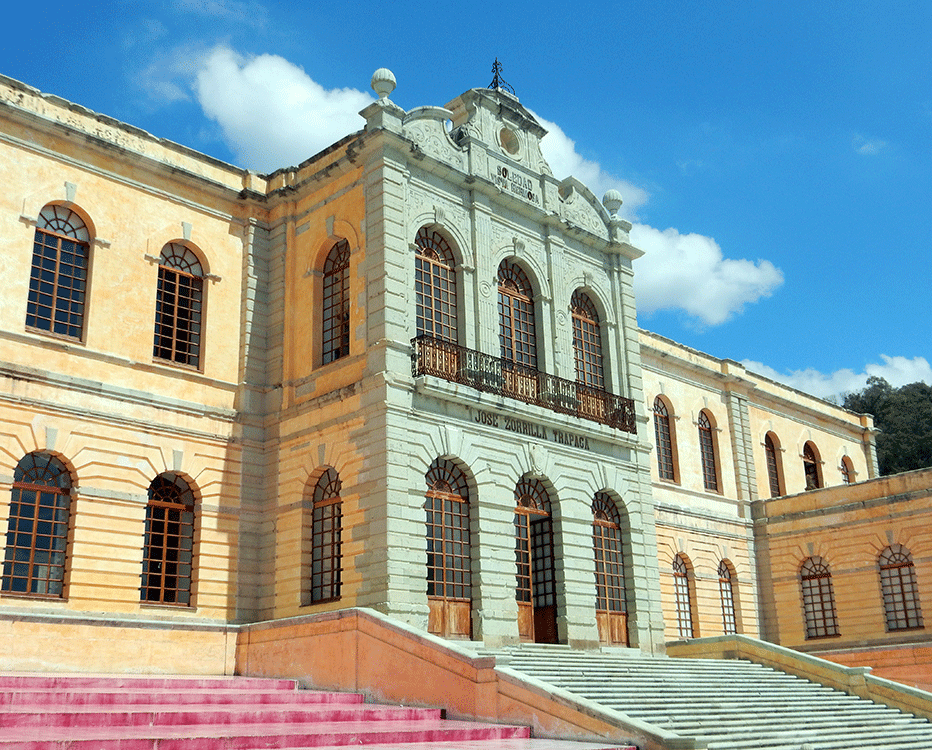
As someone who grew up going to school in one of those flat-roofed, aqua-paneled elementary schools built in an aesthetically-impaired period of the 1950s, bumping into architectural gems in rural Mexico is always amazing to me. Isolated from its surrounding landscape and thrown into the midst of photographs from around the world, the photo above would be difficult to place. But not only was this handsome structure built in 1883 in rural Oaxaca, its functional purpose was not to serve as a palatial retreat. It housed a spinning and weaving factory – Hilados y Tejidos La Soledad Vista-Hermosa.

In 2000, the shuttered factory in San Agustin Etla was reclaimed by artist Francisco Toledo, who had founded Arte Papel Vista Hermosa nearby two years earlier. The artist purchased the property to serve as an ecologically based arts center. With public and private funding underwriting its adaptive reuse, the property opened to the public in 2006 as the Centro de las Artes de San Agustin, or CASA.

A retrospective exhibit of photographs of Mary Ellen Mark, who died this past year, is currently on exhibit in the lime green Galeria del Chalet perched above the former factory.

In 1991, film director Louis Malle described Mark’s work in Rolling Stone:

Because she is so intensely involved with her subjects, because she gets to know them intimately, because she loves them, she often reveals in one single shot their history, their emotions, their souls. When she photographed runaway boys and girls in the streets of Seattle, she spent so much time with them that her portraits project a disturbing intimacy, a powerful bond between the camera and the children. Strangely, some of the photographs seem like self-portraits…. she knows how to find the perfect angle, the exact fraction of a second that will tell the story in one shot.

Not only did Mark leave behind a legacy of remarkable photographs, but she left her imprint on the work of the hundreds of photographers she taught through the years. She led workshops in Oaxaca for more than 20 years, and we were fortunate to catch an exhibition of some of her students’ works at the Centro Fotografico Manuel Alvarez Bravo in Oaxaca as well.