Postcard from Cadiz, Spain: Jueves Santo processions stretch toward dawn

As Saint John (I think?) headed down the street, we were returning to our apartment about 7:30 last night. During our meandering hour or two walk we encountered this float bearing the evangelist, Mary the wife of Cleopus, Mary Magdalene, the Virgin Mary and Jesus with the cross a multitude of times.

Their swaying journey on the golden paso was not close to over for the night. Perhaps they were still Cathedral-bound because costaleros in purple t-shirts slipped into the procession to replace the team underneath porting the heavy load within the next block. The back of this float has a small emblem of Hercules on it, which seems appropriate when you watch a team hoist it back up after lowering it.

The Mister spotted the putto with a nail-puller, perhaps indicative of the historical trade engaged in by some members of the velvet capirote-ed cofradia sponsoring the procession. (I have noticed the role of hard-working putti in the church often is overlooked. Yes, sometimes they appear fluttering around in fluffy clouds, but more often petite putti spend eternity supporting enormous statues, altars, organs, columns and even soaring domes.)

I am unsure how many processions were weaving their way around our neighborhood last night, but they do march for hours. Floats pass through the Cathedral, but do not encamp overnight. They must make the return trip to their home churches and squeeze back through the doors.

Our street might not quite be a paso-possible width, but processions were crossing at both ends less than a block away in addition to a square a block away. This crossroads location meant the procession-watchers on foot would come down our little rarely trafficked street in large, chattering groups before and after each passing.

They awakened me in time to hear the brass bands and thudding drums about 12:30 and 2:30. The 4:30 crowd sounded much smaller. At 6:30 this morning it seemed a second more refreshed and sedate shift of faithful followers was filtering out to view the final float trying to reach home before dawn.

How will they all recover in time to participate in Viernes Santo?
Postcard from Rome, Italy: When you start zooming in on the ‘wild things’

We stayed in Rome 30 days and 30 nights. A church a day. A museum a day. We never came close to exhausting them. But it really hit me on a day toward the end. Temporarily, I was museumed-out. And you probably are as well because I have been dragging you through all of them.

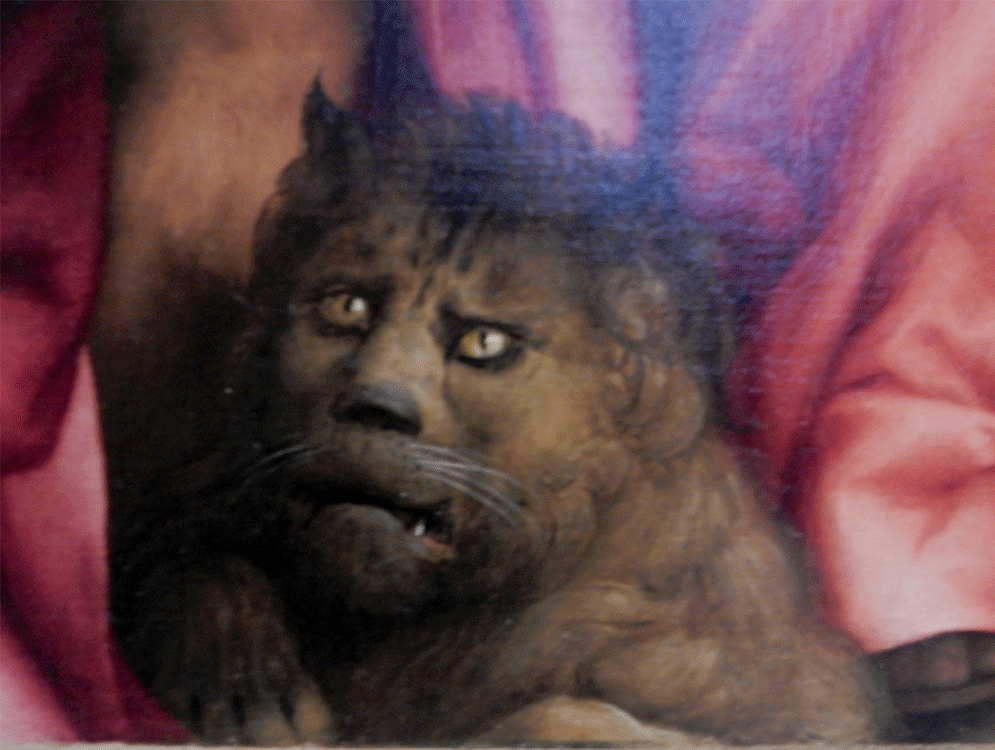
The major symptom of this over-exposure was focusing on bizarre details like an adolescent, and I was stricken with this illness almost immediately upon entering the stunning Palazzo Barberini, the Galleria Nazionale d’Arte Antica. It was Lorenzo Lotto’s fault. Right there at the bottom of his “Mystic Marriage of Saint Catherine of Alexandria” was an escapee from the “wild rumpus” of Maurice Sendak’s “Where the Wild Things Are.”

I went downhill from there, as though viewing art through Max’s eyes. Or through the eyes of the bad-behaving putti in Poussin’s “Baccanale.” There was a cute little rooster perched under Jesus’ feet nailed to the cross. Those limbo-like babies awkwardly cradled in Saint Michael’s scales, and the devil’s head spilling out over the frame under his red slippers. The devil wears polka-dots? Were those seemingly anachronistic stretch white undies added to Saint Sebastian later?

Those are the strangest little pink-winged angels catching cupfuls of Jesus’ blood. Who would park Baby Jesus naked on the bare ground of the manger, without even a bed of hay, with everyone else around him was comfortably clothed? How low did I sink? I am sorry, Lippi, but that plump little man in your Madonna’s arms appears trying to and capable of choking her. And, Caravaggio, Holfernes appears to be bleeding red plastic straws as Judith beheads him.

Forgive me for this major lapse. Maturity returned. I recovered my sense of cultural appreciation by the time we stood in the grand salon under Pietro da Corona’s “Triumph of Divine Providence.” On our way out, a velvet rope prevented us from getting more than a glimpse of Borromini’s spectacular oval spiral, or helicoidal, staircase.

About the bees. You might have noticed images of a trio of bees appearing off and on in earlier posts of photos taken in Roman churches. The bees are the symbol of the Barberini family.

In 1623, Maffeo Barberini (1568-1644) emerged as the candidate selected by the conclave, taking the name of Pope Urban VIII. Customs of the times dictated a pope’s family needs a palatial presence in Rome, so Pope Urban VIII purchased a villa on the Quirinal Hill that had been owned by the Sforza family.

Incorporating the original villa into the design as one side of an H-shaped palace, architect Carlo Maderno (1556-1629) began work in 1627 with assistance from his nephew, Francesco Borromini (1559-1667). Barely two years into the makeover, Maderno died. Despite Borromini’s presence on the job, the pope commissioned a younger rival, Gian Lorenzo Bernini (1598-1680), as the lead architect for the project.

Some time during his two decades as pope, Urban VIII most have incurred the wrath of the future Pope Innocent X (1574-1655) of the Pamphilj family, whose palace we visited quite a few posts ago. Pope Innocent X confiscated the both the Palazzo Barberini and its artwork. The family feud must have reached a truce, with Innocent returning the palace to the Barberini family two years before his death.

The companion museum that is part of the National Gallery of Paintings with Palazzo Barberini is the Palazzo Corsini, also visited in an earlier post.

Postcard from Ravenna, Italy: A pair of baptisteries

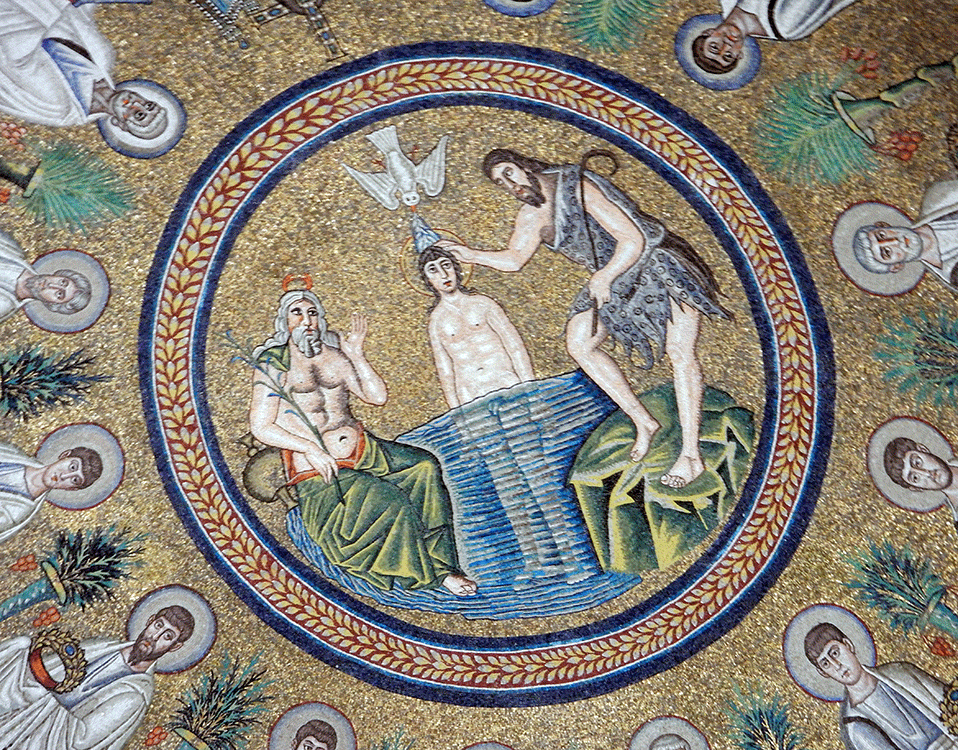
Ravenna has a pair of octagonal brick baptisteries dating from the first 500 years or so of Christianity. The oldest of the two, the Neonian Orthodox Baptistery, is named for Bishop Neon who had the existing structure crowned with a masonry dome. The second baptistery was built by Theodoric the Great, the King of the Ostrogoths, because…?

Maybe Theodoric wanted one closer to his palace; although Ravenna certainly is walkable. Plus, Theodoric was an Arian Christian, as opposed to Orthodox or Roman Catholic. To those mainstream Catholics, Arian Christians were heretics. Not a theologian, I have little understanding of the distinctions. Obviously, the differences are major or there would not have been two baptisteries, and the Ostrogoths and those they battled probably would have gotten along better.

The followers of these religions all believed in Jesus, but differed concerning the balance of power. Arians made Jesus subservient to God, His Father, and there was no Trinity. Arians, therefore, were not haunted by the Holy Ghost as part of the religious triumvirate. That made things much simpler to explain to potential converts because the Holy Spirit is conceptually difficult to grasp, particularly since the image is not personified.

Theodoric’s mosaic artists probably were not Arian because the Holy Ghost, represented as a dove, is hovering above spurting water over the scene above to assist the John the Baptist, modestly clad in a leopard-skin cloak. This was fortunate because, when the Arians were kicked back out of Ravenna only a couple of decades later, the mosaics were not destroyed as heretical.

The duplication of baptisteries is particularly interesting because, according to an article by Annabel Jane Wharton, the ceremonial structures were rarely used:

In the early Church, the principal baptismal liturgy took place once a year, on Easter Sunday eve: the of the Resurrection was deemed the most appropriate moment in which to die and be reborn in Christ…. Enrollment of those to be baptized took place at the beginning of Lent…. In the weeks of Lent efforts were made to prepare initiates for their admittance into the full fellowship of the Church through an arduous routine of fasting, catechism, and daily exorcism.

Wharton wrote participants entered the baptisteries and faced west first to renounce the Devil, then east to embrace Christ. Garments probably were removed before the baptism, leaving the new believers as exposed as Jesus above, with his navel the geographical center of the artistic composition and the dome. Then the baptized donned white garments as a sign of their new-found purity.

Because I feel fairly confident few religious scholars would read very far into my posts, I have taken the liberty of jumbling the photographs from the two baptisteries together into one collage. When returning from trips and sorting through images, I sometimes feel as though someone took the whole proverbial slide tray, dumped them out and shuffled them to confuse me. I do believe all of these photos belong to one baptistery or the other.

While years of Saturday catechism classes at Star of the Sea left me with a rather hazy understanding of the role of the Holy Spirit, I am sure happy the nuns opted for a rap on the knuckles instead of requiring daily exorcism during Lent.