Postcard from Genoa, Italy: Captain’s castle reflects his circumnavigations of the globe

Service in the Italian Navy and Merchant Navy did not diminish the love Captain Enrico Alberto d’Albertis (1846-1932) had for the sea. He circled the globe three times using diverse forms of transportation, explored Africa and even recreated the journey of Christopher Columbus to San Salvador relying on 15th-century-style navigational instruments he crafted himself. Known also as a writer, philologist and ethnologist, he collected enthusiastically during his travels.

The adventurer’s eclectic collection needed a home reflecting its quirkiness, so the captain helped design a Neo-Gothic Revival castle with major Moorish and other exotic embellishments. Perched atop a hill overlooking Genoa’s harbor, the castle was built between 1886 and1892 in the midst of medieval fortifications and incorporates one of the turrets from the 16th-century bastion.

Captain d’Albertis left his castle and collection to the city of Genoa where it serves as the city’s Museum of World Cultures. Many of the items and furnishings are arranged exactly as when the captain was alive.

The explorer was as colorful as the items he chose to collect. Elisabetta Genecchi-Ruscone delved into his journals to document some of his travels in the Journal de la Societe des Oceanistes:

D’Albertis really seemed to enjoy the thrill of trading for artefacts with natives approaching the ship on their canoes. In Battulei, in the Aru Islands, he reported trading for bracelets and skulls, but it was especially in Orangerie Bay that he did most of his ethnographic collection on this trip. He acquired spears, stone clubs, bamboo combs, cassowary ornaments, and bracelets made out of human mandibles. To the north of Dafure Island D’Albertis reported having nearly succeeded in bartering a piece of iron for a ten-year old boy. The arrival of the boy’s mother thwarted his efforts and instead he obtained a grass skirt.

And from the captain’s diary upon leaving the coast of New Guinea in 1880:

A last greeting to these children of Nature, a farewell, perhaps forever. Chance brought us to know them; we approached them, we may say, for a minute, yet this sufficed to breed in us a sympathy for this people who we call barbarous and savage because they live a life so different from ours. If we knew more intimately their customs we may have reason to be persuaded that they are better than is generally thought….

They had in them something noble, and did not lower themselves to asking or showing desire for what I showed them. No, these personages are something more than savages, they are in the European sense true gentlemen.

Not known for being shy, the flamboyant traveler did sometimes take advantage of the naïve:

To show that I intended being friends with Aira and his people, I hugged and kissed him, in the middle of the village square, then, among general laughter, I went on to kiss all the women: The scene was certainly among the most comical, some shyer women would have refused my embrace, but were incited by the others to let me do. It is true that to be impartial and give my act the true aspect of a ceremony I had to kiss some old and ugly ones, but on the whole there were more young and beautiful ones, and some really were beautiful.

One of the most interesting parts of a visit to the castle is to leaf through albums containing a small portion of the 20,000 photographs taken by the captain at home in Genoa and around the world. To explore images from his amazing journeys, click here.

Recycling a few haunted posts to say “Boo” to you

So many “postcards” are backlogged on my desk that I am dusting off some old seasonal favorites for Halloween and Day of the Dead offerings.

First, a few ghost stories from Brackenridge Park to set the tone for Halloween. Her murderers never caught, surely you have glimpsed Helen Madarasz roaming the park at night seeking justice: “The Madarasz Murder Mystery.” The post even throws in a few bonus ghosts who joined her later, all four who died in the park within a one-year period. Or perhaps you have heard the midnight screams of the glamorous Martha Mansfield, whose billowing crinolines set her ablaze in the park during the filming of a Civil War romance in 1923: “The Curse of Mararasz Park: Another Ghost Wandering in Brackenridge Park?”

When our daughter Kate said I could us this circa 1997 photo of her being kidnapped by the Pumpkin Monster, I do not think she realized it would continue to float up to the surface years later: “The Best Halloween.”

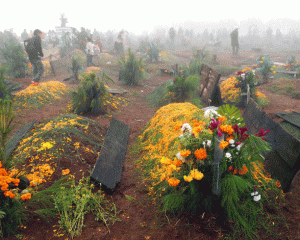
Dia de los Muertos, Romerillo, Chiapas

And then move on to some Day of the Dead celebrations in Mexico for All Souls Day and All Saints Day:

Finally, a few stops by graveyards in Europe: https://postcardsfromsanantonio.com/category/haunting-graveyards/

Happy Halloween!

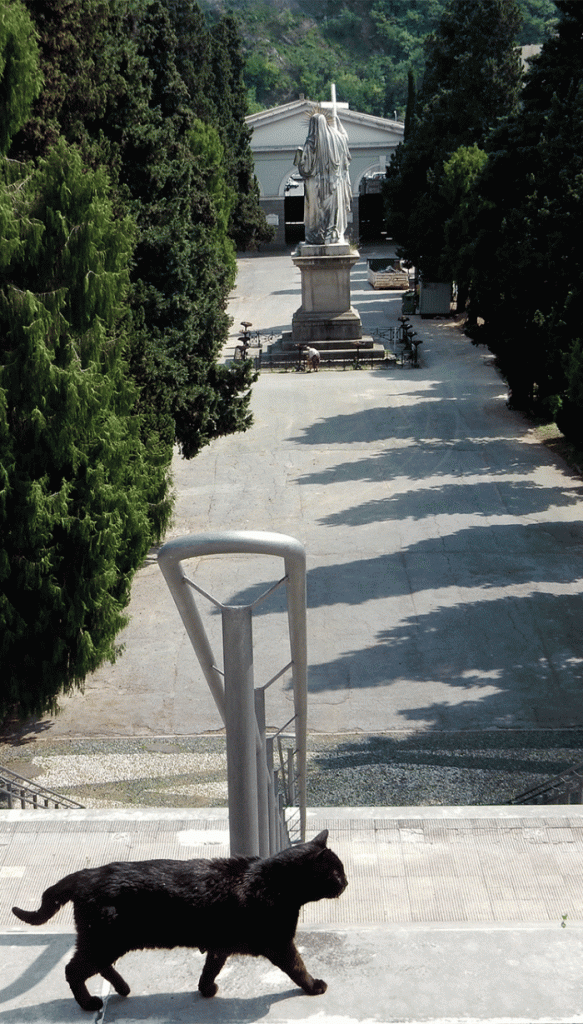
Monumental Cemetery of Staglieno, Genoa, Italy


Postcard from Nervi, Genoa, Italy: Seaside perch home to fishermen and the wealthy

The day was gray. Then it was sunny. It was the kind of day that couldn’t make up its mind, wavering back and forth. The lushly planted 22-acre grounds of Parchi Di Nervi and some of its museums were closed, as groundskeepers and museum staff refluffed everything after the wear and tear of the three-week-long Euroflora 2018, an event attracting 285,000 people to the park.

But none of that spoiled the outing to Nervi, a fishing village and seaside retreat now considered part of Genoa and only a short commuter train ride from its center. Handsome art nouveau or Liberty-style villas line her streets, and several museums (more later) welcomed us and one or two other visitors.

Named for the Brazilian-born wife (1821-1849) who fought alongside Guiseppe Garibaldi (1807-1882) in every battle he waged until she was felled by malaria, the winding mile-and-a-quarter long Passeggiata Anita Garibaldi hugs the rugged cliffs plunging down to the sea and provides stunning views at every turn. All of this so dramatically different from Genoa with its harbor full of freighters and cruise ships.

Taking a stairway down even closer to the sea than the passeggiata, we found an outside table perched on the balcony of Bagni Medusa for sampling some of the seafood the local fishermen haul in fresh daily.