Postcard from Sevilla, Spain: The house that made Mudejar-Renaissance mashups fashionable

When the governor of Andalusia, Pedro Enriguez de Quinones (1435-1492) began construction of his palace, most of the building expertise in the neighborhood was provided by Mudejar craftsmen.

A two-year grand tour of the Holy Land and Italy by his son, Fadrique Enríquez de Rivera (1476 – 1539), brought Renaissance influences into the home but not at the expense of Mudejar architectural details and azulejos. More than 100 different tile designs from the 1530s by the Pulido brothers color the interiors and its multiple courtyards. The first marques of Tarifa, Fadrique set a trend for mixing these styles among the wealthy in Sevilla, and that influence is reflected in a multitude of house museums now open to the public.

In 1521, Fadrique also established the Semana Santa tradition of a Lenten procession he was exposed to in Jerusalem, the Holy Way of the Cross. The route of La Via Crucis began in his chapel and proceeded 1,321 paces to a pillar just outside the city walls. The number represents the purported number of steps Jesus tread from the House of Pontius Pilate in Jerusalem to the crucifixion awaiting him. Possibly this association is what led Sevillanos to refer to the home as the Casa de Pilatos.

Casa de Pilatos was made a national monument in 1931, but it remains the residence of the family of the Duke of Medinaceli, who retain portions as their private quarters.

I feel guilty including the portrait of “The Bearded Woman” by the famous Joseph de la Ribera, except it does jump off the wall at you. Instead of trying to explain the painting or my inclusion of it, I offer a translation of Ribera’s inscription on it. This is provided by WTF Art History (great blog title):

Look, a great miracle of nature. Magdalena Ventura from the town of Accumulus in Samnium, in the vulgar tongue Abruzzo in the Kingdom of Naples, aged 52 and what is unusual is when she was in her 37th year she began to go through puberty and thus a full growth of beard appeared such that it seems rather that of a bearded gentleman than a woman who had previously lost three sons whom she had borne to her husband, Felici de Amici, whom you see next to her. Joseph de Ribera, a Spaniard, marked by the cross of Christ, a second Apelles of his own time, by order of Duke Ferdinand II of Alcalá, Viceroy at Naples, depicted in a marvelously lifelike way. 17th February 1631.
Postcard from Marfil, Guanajuato, Mexico: Artists gave new life to ancient hacienda

Silver from el Minero de Santiago Marfil afforded one of the Spanish elite settling in Mexico to purchase land above the Rio Guanajuato and oriented toward a church for a luxurious hacienda in the late 1700s.

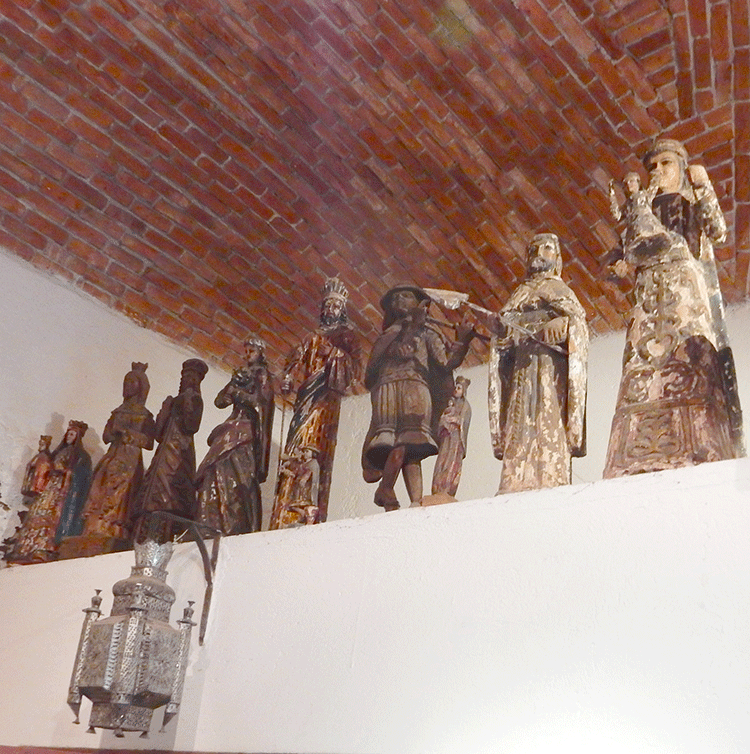
Centuries later in the 1960s when Canadian artist Gene Byron (1910-1987) and her husband Virgil Fernandez del Real purchased the ex-hacienda Santa Anna, Marfil was somewhat of a ghost town. The couple transformed the ancient buildings and grounds into a showcase for their collections of Colonial art and the results of their own artistic endeavors. In addition to her painting, Byron learned to craft handsome punched tin and copper pieces that are found throughout the house museum her husband opened to the public after her death.

The museum often hosts live classical or jazz concerts on Sundays in an intimate setting. During the week, wandering through the house with a docent often is a private tour.

There is a restaurant on site, but we visited on a Monday when it was closed. Although the road through no longer-sleepy Marfil has traffic speeding along, we walked along the narrow sidewalk to ascend to the colorful church perched above and then passed by the ancient statue-topped dam across the river on our way to score an incredible Italian feast at Piccato di Gola, fifteen minutes away at the other end of town.

Postcard from Budapest, Hungary: ‘Art is long; life is short.’

The grandson and son of glass-cutters, Miksa Roth (1865-1944) wanted to move beyond craftsmanship to high art. He traveled on his own to learn from examples created by European masters. Upon his return to Budapest, he found himself in the midst of a building boom, with Art Nouveau and, later, Art Deco works in high demand.

Roth’s glass and mosaic pieces are found in the Parliament Building, Saint Stephen’s Basilica, the Agricultural Museum and the Liszt Ferenc Academy of Music. Outside of Budapest, he executed an opalescent glass dome designed by Geza Maroti for the National Theater of Mexico and glass works in the Royal Palace of the Netherlands and in churches throughout Europe. He was awarded a silver medal in the Paris World Exhibition in 1900 and Grand Prizes in Turin and in St. Louis in 1904.

Roth moved into his home in Budapest in 1910, and a large building in the courtyard doubled as the Work Institute of Imperial and Royal Stained Glass and Mosaic Artist Roth Miksa (In Hungary, surnames precede given names.). During its peak, the workshop employed as many as 30 assistants.

The house, now a museum, features three rooms filled with furniture he designed and mosaics, stained glass and glass paintings of his as well as some he collected on travels throughout his career.

The intimate house museum is small, but the pieces inside are stunning and well worth a detour to Nefelejc Street.