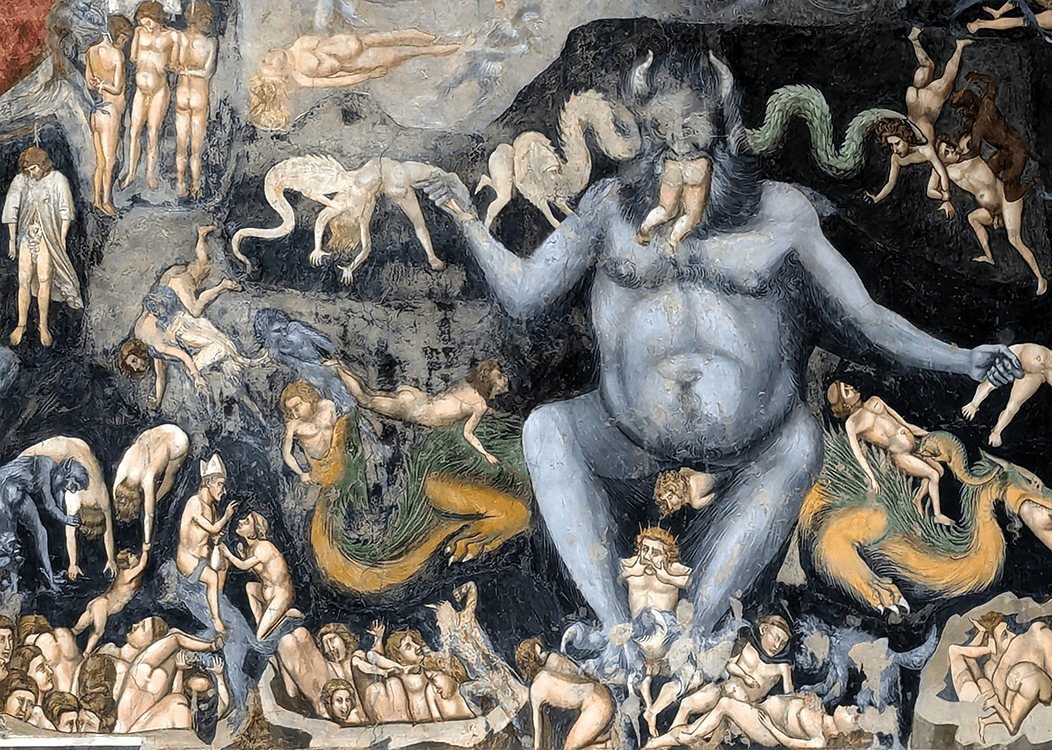
Postcard from Padua, Italy: How could I forget Giotto’s Hell?

A postage stamp depicting a scene from the Scrovegni Chapel, showing the Nativity with the Virgin Mary, Joseph, and angels, artistically rendered.

Above: The devil lording over Hell as depicted in “The Last Judgment” by Giotto (Ambrogiotto di Bondone, 1266-1337) in the Scrovegni Chapel

But as for the cowardly, the faithless, the detestable, as for murderers, the sexually immoral, sorcerers, idolaters, and all liars, their portion will be in the lake that burns with fire and sulfur, which is the second death.”

Book of Revelation, Chapter 21, Verse 8

Slides in Professor Bill White’s Renaissance art course at Hollins University groomed me into a Giotto groupie prior to standing in awe before Giotto’s actual frescoes in the Scrovegni Chapel. And Professor Henning surely pointed out Giotto’s horrific visions of Hell when I was on summer tour about a half-century ago, but I had sharper memories of gazing upward toward his Heaven.

Continue reading “Postcard from Padua, Italy: How could I forget Giotto’s Hell?”

Postcard from Madrid, Spain: Paradise found in parks

Better to reign in Hell,

Than to serve in Heaven

Lucifer in John Milton’s Paradise Lost

There he is, the fallen angel himself, painfully ensnared atop a beautiful fountain, guarded by gargoyles, in the heart of Madrid’s Retiro Park. John Milton’s Paradise Lost inspired sculptor Ricardo Bellver to create a monumental depiction of the devil in 1877. Both widely acclaimed and highly controversial, the statue is regarded as the only piece of major public art dedicated to the devil.

Anyone bedeviled by the artwork can easily avoid it, as Retiro Park is huge and is only one of many found in the capital city. Madrid has more parkland in its center than any other major European city, and Madrilenos take full advantage of them any time they are free.

These photos are from Retiro Park and the Jardin Botanico next to the Prado.

Totally swooned for the handsome tuxedoed birds. Exotic in my mind, but considered nuisances by many – common magpies. As with the storks earlier in our trip, never recalled setting eyes on them before, which might be lucky as a multitude of legends portray magpies as harbingers – or at least a single magpie – of ill will.

With his theft of glittering objects, the magpie envisioned by Gioachino Rossini in the plot of an 1815 opera almost caused an innocent maid to swing from the gallows. And the magpie’s reputation surely was not enhanced by the inclusion of the overture to signify impending over-the-top violence by Stanley Kubrick in his 1971 film, A Clockwork Orange.