Postcard from London, England: Fashion foot forward

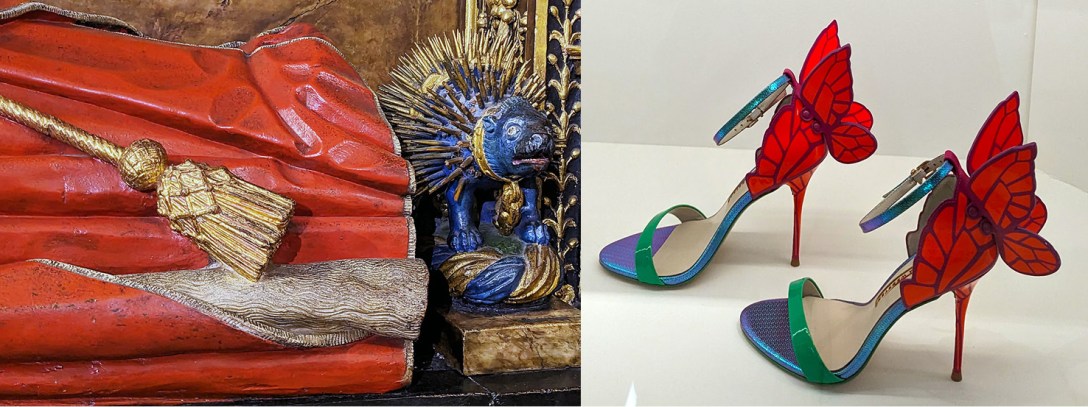
Above left: Hedgehog at the feet of an entombed noble, Westminster Abbey. Above right: Butterfly-wing sandals, Sophia Webster, “Rebel: Thirty Years of London Fashion,” The Design Museum

One might assume I have a foot fetish, as once again I focus on what’s found underfoot of effigies atop monumental tombs of the rich and powerful who occupy prime real estate in churches in Europe. Prior to this, most guardians of the feet we encountered were dogs – beloved lapdogs or prized hunting hounds to offer comfort and protection for the dead.

But the fashion for many of those buried in Westminster Abbey is sculpted to emphasize distinction and convey rank and power. Kings and queens incline toward lions. The regal Scottish red lion posted by Mary Queen of Scots appears assigned to make sure no one attempts to peep up her numerous layers of petticoats.

Continue reading “Postcard from London, England: Fashion foot forward”

Caste discrimination woven into Spanish Colonial art of the Americas

Above: “Virgin of the Tailors,” Cusco, Peru, circa 1750, on loan from Museo Pedro de Osma, Lima

Late-colonial New Spain was awash with conflicting energies: American-born Spaniards (Creoles), like their North American counterparts, felt a growing desire for independence, yet needed their identification with Europe to cement their sense of superiority over the racialized indigenous, African, and mixed-race lower classes….”

“Casta Painting and the Rhetorical Body,” Christa Olson, Rhetoric Society Quarterly, Fall 2009

And 18th-century fashion statements as recorded in paintings and sculpture became a tool to exhibit the claimed superiority of those with pure, or at least high, percentages of Spanish blood flowing through their veins. On display at the Blanton Museum of Art through January 8, Painted Cloth: Fashion and Ritual in Colonial Latin America focuses on the societal role of textiles in conveying class distinctions.

Continue reading “Caste discrimination woven into Spanish Colonial art of the Americas”

Postcard from Rome, Italy: Restricted ourselves to window-shopping

We’re not big on shopping, so, as usual, gazing at shop windows was about as close as we came to reaching for credit cards to make any actual purchases. Aside from edibles.

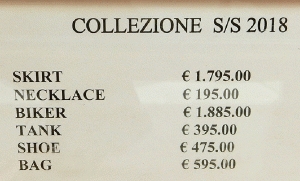
But, in case you are wondering how much that complete little tutu-type outfit above costs, the price in Euros totals 5,340, or, in dollars, $6,245.03. Maybe, if you spring for the whole combo, the store throws in those fishnet stockings, open-weave enough to let sardines and anchovies escape entanglement.

No tri-tone shoes, Cannabis Energy Drinks, priestly calendar boys, cardinal beanies or Trump bobbleheads found their way into our luggage.