“Via Irremeabile d’ell Eternita” labels a columned entrance to the Cimitero di Lecce. Loosely translated by the blogger who knows no Italian beyond words frequently encountered on menus, it means the road to eternity has no return.
Although we walked down that road, we fortunately were able to turn around. Noted for my taphophilia, my love of cemeteries is restricted to wandering in and out of them, not an eagerness to take up any permanent residence.
While the Cimitero di Lecce is not as impressive as the monumental ones of Bologna, Turin and Genoa, symbols most often associated with freemasonry make exploring it interesting.
Freemasonry mystifies me. As do its symbols, many drawn from ancient Egyptian art.
Interpreting with the same level of expertise as applied to the Italian above, the skulls and crossbones are not meant to intimidate but are a symbol of the new life to come. The eternal flame symbolizes enlightenment. There is the unblinking, all-seeing eye. A winged disk might represent a soul that has left its body on its way up to heaven; an acacia branch immortality. The owl, perhaps originating from the one always perched on the shoulder of the Goddess of Wisdom Minerva, represents knowledge and ability to see in the darkest night.

Mausoleum of the Pranzo family

Mausoleum with eternal flames, family crest and winged globe

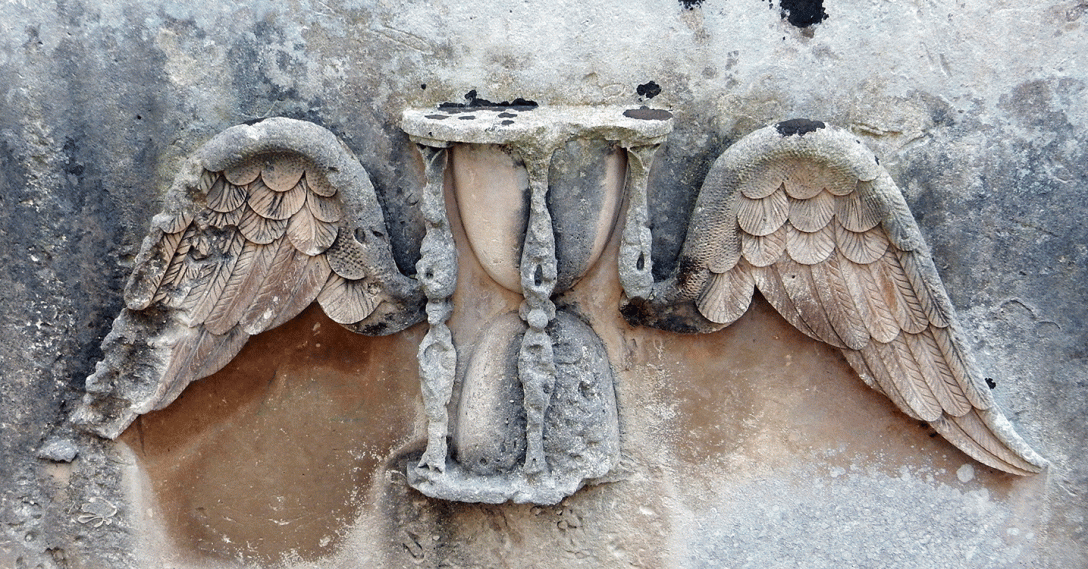
Francesco Contantini’s mausoleum is packed with symbols: an hourglass, winged skull, etrnal flame, acacia branches and compass.

Cemetery cats

Interior of mausoleum

War veterans from the Falco family

Owl

Sphinx

Alberto Montinaro (1902-1926)

Egyptian-inspired winged sun with serpants on Stampacchia family mausoleum

Eternal flame and skull on mausoleum

Owl on the mausoleum of the family of Francesco Chillino

“The Road of Eternity Offers No Return”

Michele Massari (1902-1954 is famous in Lecce for his Gothic Presepio, an elaborate nativity scene on display in the Castle of Charles V.

Angelo and Carolina

For our mother crowned by an owl

Stigliani mausoleum

Eternal flame of enlightenment on D’Elia family mausoleum
For all of these, there are antithetical dark meanings assigned to the symbols by those who regard freemasonry as akin to worship of the devil.
Historically, masonic membership was prevalent. Among famous masons were George Washington, Benjamin Franklin, Sam Houston, David Crockett, Theodore Roosevelt, Wolfgang Amadeus Mozart, Henry Ford, Winston Churchill and Antonio Lopez de Santa Anna. Its symbols are engraved in the design of our own dollar bill. Even the Mister’s Boerne-raised grandfather was a mason with a mantlepiece full of the wise owls he favored.
When the lights are permanently turned out for me and I am left standing in the middle of the road with no turning back, I would gladly welcome the appearance of a little owl to guide me along the dark path that lies ahead.





 Postcards from Barton Springs