Postcard from Toledo, Spain: A Cathedral fit for a royal capital

When Alfonso VI (1040-1109) of Castile captured Toledo from the Moors in 1085, he made the hilltop city his capital. Although royals moved their seats around Spain and Portugal, the city benefitted from the rule of numerous kings.

Construction of the city’s Gothic Cathedral, dedicated to the Assumption of Mary, was begun in 1227. The main six-story central carved altar, bookended by royal tombs, was added around the year 1500.

Felipe II (1527-1598) stroke a blow signaling the city’s decline in importance when he moved the capital permanently to Madrid in 1561.

Although Toledo’s population is around 80,000, every day thousands of visitors jostle through the crowds filling the narrow streets in the historic part of the city to tour the Cathedral. Fortunately, there is ample room inside to accommodate a crowd. The main nave alone is both longer and wider than an NFL football field.

When we were in the Cathedral, most of the area near the main altar was roped off for temporary seating for an evening organ concert. Disappointing yes, but, holy Toledo, the pipes resounding through that enormous space must have been magnificent.

Postcard from Segovia, Spain: Sumptuous cathedral honors saintly hermit

On the spot where Isabel was crowned Queen of Castile in 1474, Charles V (1500-1558) had the cornerstone laid for a monumental Gothic cathedral in Segovia. He would not live to see its completion, as construction spanned more than two centuries. Formal consecration took place in July of 1768.

Back in the seventh century, when the parents of Frutos died, he and his two siblings sold all their inherited worldly goods and each retreated to their own little hollowed-out cave to live as pious hermits. Moors killed his brother and sister, but Frutos drew a line (kind of like Travis at the Alamo?) in the dirt and suggested they not dare cross it. Some foolish Moorish soldiers could not resist the challenge, and a giant fissure opened up in the rocks to conveniently swallow and crush them. This miracle allowed Frutos to live to die a natural death.

Relics of the three saints are housed in the Cathedral, with Frutos primarily honored as the city’s patron.

Alternate spellings of the saint’s name include Fructos, which leads to much confusion as to whether he blesses inclusion of corn syrup in prepared foods today.

Postcard from Oaxaca, Mexico: Bite the baby; throw the party

three-kingsThe pair of skinny Santas on stilts (I know; I don’t comprehend their significance either.) who roamed the plaza in front of the Cathedral around Christmas have been replaced by itinerant trios of kings soliciting tips for family photos. This troupe was the only one around bearing gifts for Baby Jesus accompanied by the beasts (well, sort of) originally transporting them to the manger in Bethlehem on January 6.

Epiphany was always a holy day of obligation when I was growing up, another command day at church which fell within several weeks of a multitude of visits to church. But we weren’t rewarded with cake.

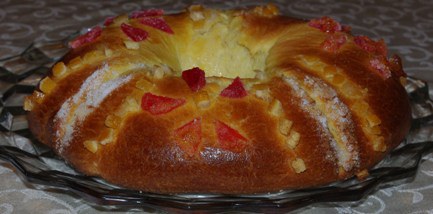
In Mexico, Saint Nicholas traditionally does not arrive bearing gifts for children on Jesus’ birthday. Children have to wait until the day Jesus received his presents – gold, frankincense and myrrh – delivered in tribute to him by the three kings. So, on January 6 in Mexico, Mass is followed by presents and a party with cake – rosca de reyes.

Shannon Costello's rosca de reyes
Shannon Costello’s rosca de reyes

The staff at the Library of the University of Texas at San Antonio has translated, along with helpful baking tips, a traditional kings’ cake recipe from Panes de Levadura by Josefina Velazquez de Leon, part of the collection of Mexican cookbooks, La Cocina Historica.

Not everyone in Oaxaca appears to make these from scratch. Boxes of the rings of cake have been flying off shelves in bakeries all over town.

Hidden inside each is a little figure representing Baby Jesus. If the piece you receive contains the nino, your family has to host the next fiesta specifically for Jesus on the calendar, Candelaria on February 2, or prepare the homemade tamales for the party (Whoa! I prefer the no-strings-attached prize in Cracker Jacks).

Candelaria is when all the Baby Jesuses housed by the faithful in their homes receive new clothes. Then, dressed in appropriate finery, all the little statues are carried to church to be blessed.

Hmmm. What should Jesus wear? Is Oaxaca ready to follow the fashion trends being set in San Cristobal de las Casas? Happy Kings’ Day.

And, if the kings have any gifts in mind for me, of the ancient trio, I’d prefer the gold.