Old and New World artistry merge in Hispanic Baroque

A 1893 one-cent postage stamp depicting Christopher Columbus and indigenous figures, surrounded by an ornate border. The inscription reads 'Columbus in Sight of Land.'

Above: “Annunciation and Saints,” Jose de Paez, Mexican (1727-1790), oil on copper, 1750-1760.

Spirit & Splendor: El Greco, Velázquez, and the Hispanic Baroque” surveys 150 years of Spanish art leading to the Baroque period with works culled from the collection of the Hispanic Society of America in New York City. Some of Spain’s most renowned and respected artists are represented in this ongoing exhibition at the Blanton Museum of Art, but don’t expect much more than a dozen of these works.

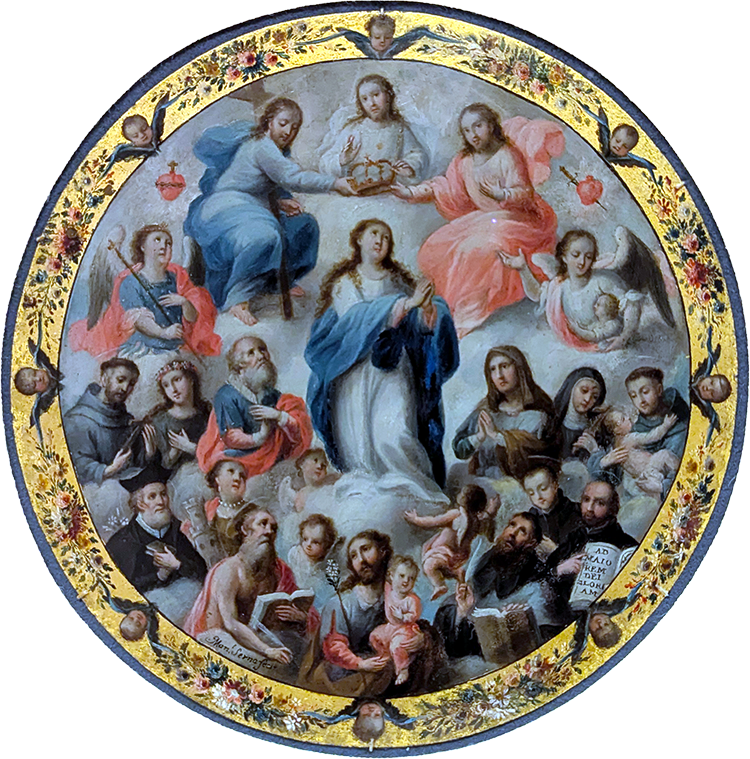
What I love are the pieces demonstrating the Baroque style translated by transplants and native-born artisans in the Americas. Artists took advantage of materials available in this so-called “New” World – copper, shells and, of course, more precious metals. They added a magical sheen to art designed to convert “pagans” to the foreign beliefs held by the Catholic conquerors.

Continue reading “Old and New World artistry merge in Hispanic Baroque”
Contemporary Native American artists, plus a century of Surrealism

Above: Detail of Martine Gutierrez’ “Queer Rage, Imagine Life-Size, and I’m Tyra, p66-67,” from Indigenous Woman, 2018.

Work by nine contemporary indigenous artists was assembled for “Native America: In Translation,” curated by artist Wendy Red Star and displayed at the Blanton Museum of Art.

No one was going to put me on the cover of a Paris fashion magazine, so I thought, I’m gonna make my own.”

Martine Gutierrez referring to her 2018 art magazine, Indigenous Women, Curator notes

Continue reading “Contemporary Native American artists, plus a century of Surrealism”

Japanese woodblock prints at Blanton reflect ‘Floating World’ values

Above: “Shadows on the Shoji,” Kikukawa Eizan, 1815

The two fashionably dressed courtesans in the foreground appear to have just stepped away from a lively party and are chatting on a veranda. The drinking and flirting figures inside cast shadows against the shoji (lattice-and-paper screen doors) of the brothel behind them.”

Curatorial notes for “Shadows on the Shoji,” Blanton Museum of Art

1815. The date surprised me, due to my lack of understanding the accepted restrictive roles assigned courtesans and geishas in Japanese culture. The witty social commentary and humor contained in Edo-era (1603-1868) woodblock prints in “The Floating World: Masterpieces from the Edo Period” on display at the Blanton Museum of Art prove captivating.

Continue reading “Japanese woodblock prints at Blanton reflect ‘Floating World’ values”