Around Alamo Plaza: Been a long time, but the signs are still there.

There have been many posts in this blog ranting about haphazard appearance of the front door for many a visitor to San Antonio – the Alamo Plaza Historic District.

Most businesses evidently believe duplicate signs are critical; even the city’s newly remodeled Visitor Information Center has two extra, twin signs flanking its doorways. I thought the Hotel Indigo was going for cool, but apparently not. And, although it’s not in the district, the city’s recently redone plaza with its strangely homuncular statue of Henry B. gets graced with an illegal sandwich board advertising a garage a block away.

There is no need for many words this time; the photos of illegal signs speak for themselves.

This slideshow requires JavaScript.

If you have the stomach for more ugly signage greeting our millions of visitors annually, here is a small sampling from older posts:

Please complain about the lack of enforcement of signage regulations in the Alamo Plaza Historic District to your city council representative and consider dialing 311 to report violations you see.

How would you feel about the Alamo with a crewcut?

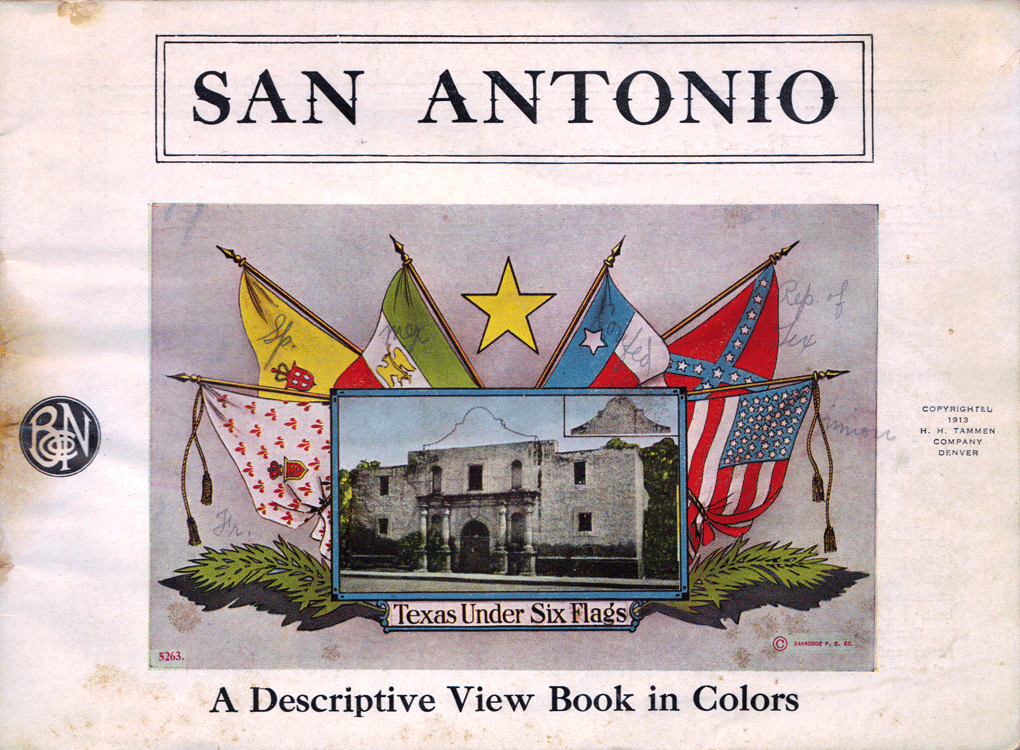
The treatment of the Alamo on the frontispiece of San Antonio, a 1913 “Descriptive View Book in Colors” – a birthday present from a friend – caught my eye with its unusually frank acknowledgement of the major alteration of the facade of the former Mission San Antonio de Valero.
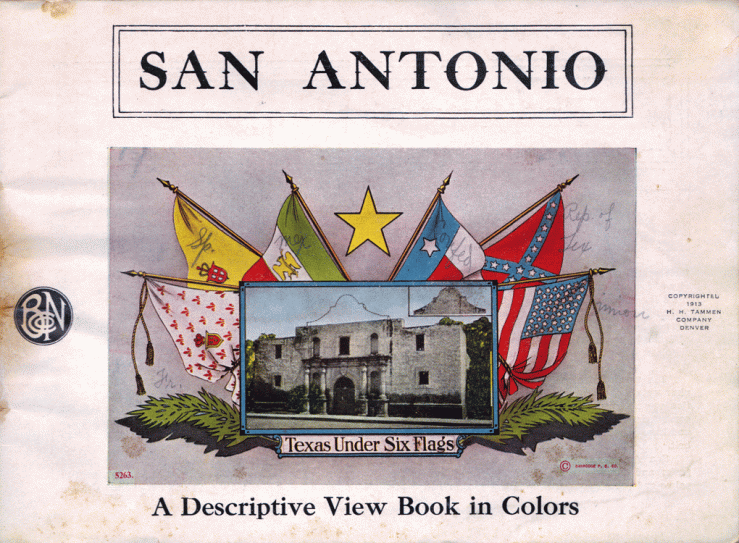
The frontispiece of this booklet showed the Alamo with the added architectural frontispiece removed.

The distinguished curving outline of the facade has become a symbol not only of the battle that took place there in 1836, but of the city itself. The widely replicated outline, commercialized into many a business logo, is recognized worldwide. 

But the distinctive parapet was not part of the original church built nearly 300 years ago; nor was it there during the famous battle in 1836.

According to the Handbook of Texas Online, the curvilinear addition is thought to have been the brainchild of an architect and builder by the name of John M. Friese, who designed the Menger Hotel next door to the Alamo a few years later. Friese’s client was the United States Army, which was renting the former mission from the Catholic Church. The project fell under the supervision of Major Edwin Burr Babbitt, assistant quartermaster for the post. According to the Handbook, Major Babbitt actually wanted to tear the Alamo down and erect a completely new building. General Thomas S. Jesup vetoed that idea, fortunately for today’s tourism industry, and the parapet was added in 1850 as part of the adaptation of the building for the Army’s needs.

Through the years, many changes have taken place on the plaza in front of the Alamo, the plaza that was enclosed by crumbling mission walls at the time of the battle.

A group has emerged with plans to recapture those grounds from the city that has encroached upon them. The Texas History Center at Alamo Plaza, Inc., has developed elaborate presentations for what it calls the Alamo Restoration Project.

The stated goal of this proposed project is:

to enhance the visitor’s pilgrimage to the “Cradle of Texas Liberty” by providing a historic atmosphere for personal reflection, inspiration, and learning. We encourage people to seek out their heritage, explore the rich and diverse history of the region, and immerse themselves with the texture of the past.

While this sounds noble on the surface, there are some who think the part of this site’s “heritage” and “diverse history” that is more important than a lost battle might be its much earlier role as a mission outpost.

Another major issue is the problem of a historic landmark built atop of the original western wall of the mission compound. The handsome Crockett Block, designed by architect Alfred Giles, was built only 30 years after the Army added the parapet to the Alamo. The project’s plan is to simply move the massive building, as The Fairmount was relocated in 1985.

What would be left would be a huge open footprint of the grounds at the time of the 1836 battle, but what I see is hot. There are just not many days of the year where people are going to want to stand in the middle of a treeless, shadeless plaza contemplating the battle. Five minutes in the middle of the plaza on a day like today would be more than enough to make one pray for the return of the raspa vendors.

To accomplish this restoration project would mean major battles with not just the Daughters of the Republic of Texas but also with the yellow-hatted ladies of the Battle of Flowers Association, whose parade has a strong historical connection to Alamo Plaza.

While there are pictures on the group’s website showing the Alamo without the added parapet, there is nothing written online that I see calling for its removal. But, to be true to the group’s goals, it obviously should be.

Calling attention to the need for better treatment and interpretation of our most famous tourist site is worthwhile, but stripping the area back to the battle era seems extreme.

And, would San Antonians ever be willing to let go of that distinctive frontispiece for an Alamo with a crewcut? If nothing else above were, those seem like fighting words to me.

Flippin’ San Antonio Fiesta

This will make no sense unless you read the post immediately prior to this, but we snapped a couple of photos at the June 13 Flippin’ San Antonio (or San Alamo in some of Rolando Briseno’s posts) Fiesta on Alamo Plaza. Held on the Feast Day of St. Anthony, last year’s event had the advantage of a normal Sunday crowd in front of the Alamo. Monday evening drew considerably fewer people, so was decidedly more local in flavor.

Rolando’s statement said he wanted the event to serve as “a catalyst to bring back the city’s Fiesta Patronal”:

My hope is that this metaphorical performance will promote greater cultural and historical awareness and understanding, and initiate a dialogue leading to a re-conceptualization of the Alamo as a space for celebrating the confluences of the various cultures – Native American, Spanish, African, Mexican, and Anglo – rather than as a shrine to Anglo-Texan dominance.

This slideshow requires JavaScript.

Things got off to a late and slow start, so, unfortunately, the goat cheese pizza at Tre started beckoning before the Alamo pinata filled with “mixed ethnicity baby dolls” was broken.

Whether next year brings a Flippin’ San Alamo Fiesta, a Flippin’ San Antonio Fiesta or a new Fiesta Patronal, watch for it. Because St. Anthony’s amazingly potent.

In fact, I’ve been wondering whether, if you put his medal on your key ring, it will automatically rise to the top of your purse….

Update on June 15, 2011: And on St. Anthony’s own feast day, a thief steals a rare reliquary from a church in Los Angeles….

Update on June 16, 2011: Corrections for “glaring” imperfections sent to me via facebook by event organizers:

Rolando Briseno

Hi Gayle, thanks for getting back to me. For the corrections: the event did start on time – there was a procession of low-riders that were going around the Alamo, as was Luis Valderes whose truck had the statue on the back. The concept was for the start to happen the way if it did – that was intentional, not by accident or due to mismanagement as was inferred in the blog. Also, this year’s event was entitled “Flippin San Antonio Fiesta,” to be differentiated from last year’s event entitled “Flippin’ San Alamo.” The change was intentional, not accidental, and we do not flip flop between the two titles: they are different events. the blog that you sent us the link to (listed above in this message), when clicked on again, has a second part added following the event in which the above inaccuracies are present. Thank you for getting back to me and being willing to make these corrections since they are quite glaring.

And, good news from Los Angeles: St. Anthony’s relic has been returned to his church.

Update on June 23: San Antonio Current posts a follow-up interview with Briseno, who said:

We are a culture and a group that is not accepted, does not have its history. It’s not there. That’s why I have the statue upside-down. Because I am asking a favor from San Antonio, which is inclusion of the history of the Tejanos and Mexican-American people in everything. Our story has not been told. That’s why I am trying to force it.

Update Posted on June 6, 2012: Erik Bosse’s posted a video of the 2011 Fiesta:

But June 13 is almost here, can a 2012 Fiesta be found?