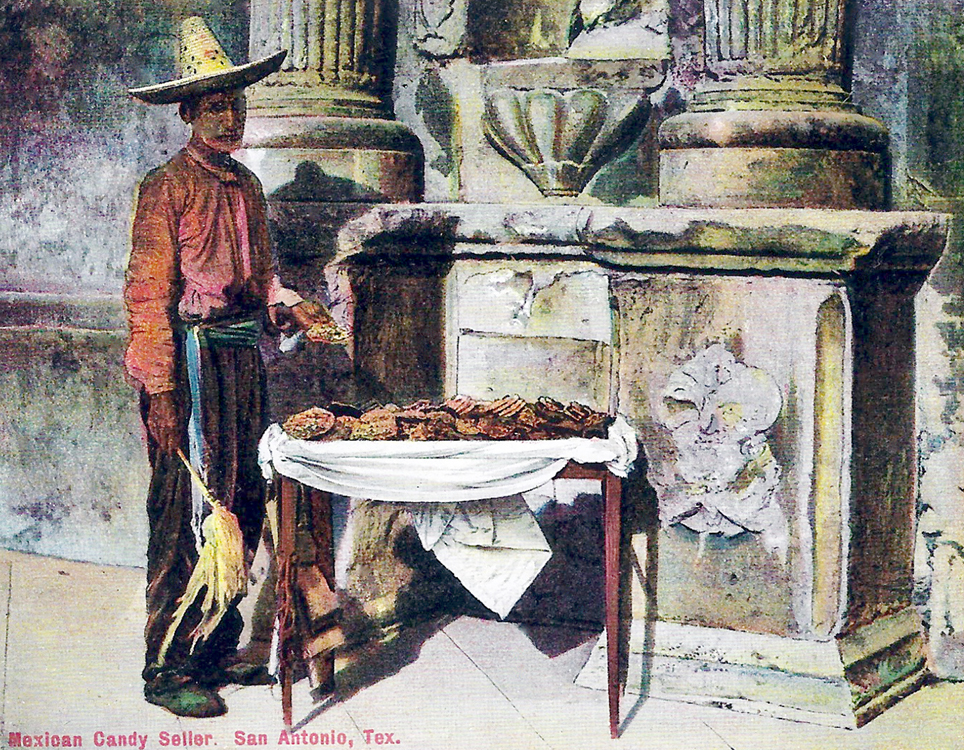
A sweet San Antonio mystery: Where did the Candy King’s recipe go?

Flip side of above postcard: “The Mexican Candy seller is a typical sight on the streets of San Antonio. Dressed in his native garb and selling a kind of pecan candy peculiar to Mexico which he alone seems to have the secret of making more toothsome than anyone else.”

Pecan pralines that melt in your mouth. The perfect finishing taste after overdosing your Mexican food with spoonful after spoonful of addictive salsa and jalapenos.

In 1910, there was one praline vendor who dominated the market in San Antonio, Tomas Contreras (1847-1912). I “met” him when I was researching my recent book, An Ostrich-Plumed Hat, and Yes, She Shot Him Dead. I stumbled across a full-page obituary for the Candy King in one of the local newspapers.

Tomas was born in Guanajuato and arrived in San Antonio with his mother Juanita in 1877. In the kitchen of their rented house on Matamoros Street, Juanita made what everybody claimed was the best pecan candy. She would dispatch Tomas to sell it downtown. He would take his basket and head to Alamo Plaza near the Menger Hotel. The Menger soon invited him to sell inside the lobby, positioned next to their popular blind harpist.

Continue reading “A sweet San Antonio mystery: Where did the Candy King’s recipe go?”
Postcard from Toulouse, France: A far from humble home for city’s leaders

Above: Under renovation this past fall, the distinctive pink brick Neoclassical facade of the Capitole stretches across the entire eastern side of an impressive plaza.

The city government of Toulouse has headquartered itself on the same expansive plaza since the 12th century.

In the early 16th century, the people of Toulouse lived in fear of invasion by Spanish forces under the flag of King Charles V (1500-1556). The threat was ongoing because Charles V was at constant war somewhere on the continent as he tried to defend his multiple titles in a far-flung Hapsburg Empire. Charles simultaneously was King in Germany, King of Italy and Emperor of the Holy Roman Empire. This powerful threat inspired city leaders to build what is now the oldest remaining governmental portion of its Capitole compound, a brick tower designed to protect the city’s archives and gunpowder. The tower often is referred to as Le Donjon, or The Keep. Le Donjon’s centuries newer belfry was added by the architect known for remodeling Notre Dame in Paris, Eugene Viollet-le-Duc (1814-1879).

Continue reading “Postcard from Toulouse, France: A far from humble home for city’s leaders”

If peculiarities were plumes, San Antonio would be a rare ostrich*

*With apologies to William Sydney Porter (O. Henry) for lifting his sentence from “Retrospects and Prospects” and turning his porcupine into an ostrich to suit the Author’s own selfish purposes.

Few people pause to read acknowledgments at the end of a book, so the Author is plucking them out of An Ostrich-Plumed Hat, and Yes, She Shot Him Dead and plopping them right here, front and center. The Author wants you to understand her lengthy journey and who helped her along the way.

Continue reading “If peculiarities were plumes, San Antonio would be a rare ostrich*”