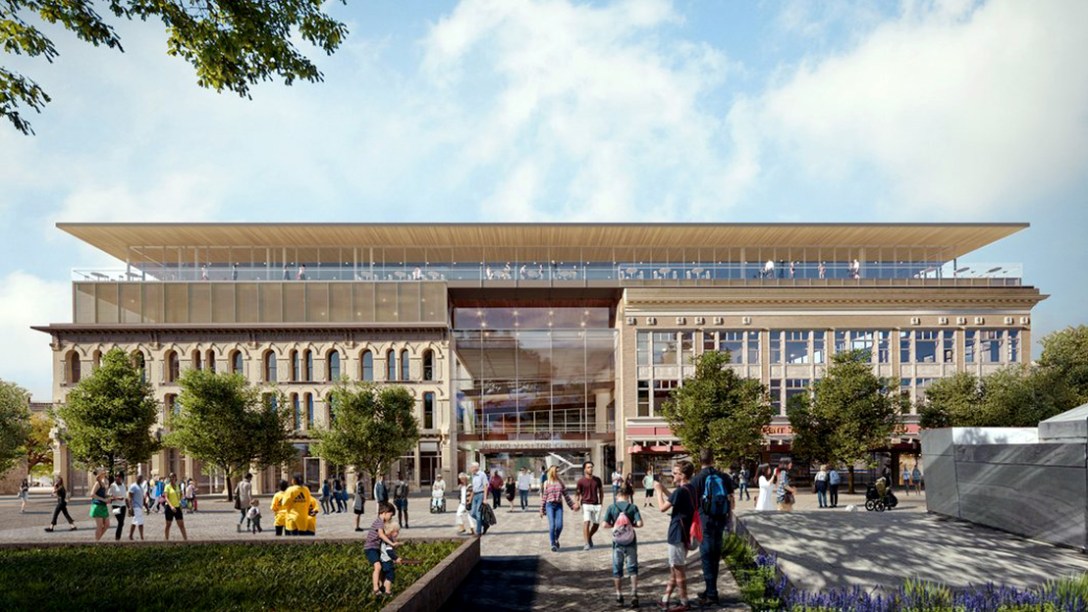
Postcard from San Antonio, Texas: Time to toast the Alamo Trust

Above: Rendering of plans for the Alamo Visitor Center and Museum from the Alamo Trust

Recent international trends in museum design and development have emphasized the reuse and transformation of historic industrial and commercial buildings for interpretive programming, providing stronger links between complex layers of history and dynamic visitor experiences. Through the historic preservation treatments of exterior restoration and interior rehabilitation, these three buildings on Alamo Plaza can provide the opportunity for a unique twenty-first century museum experience that is innovatively housed within some of San Antonio’s most historically significant commercial architecture of the nineteenth and early twentieth centuries.

“Historical Assessment of a Trio of Historic Buildings on the West Side of Alamo Plaza,” John G. Waite Associates’ study commissioned by the Alamo Trust, 2020

The Crockett Block (1882); the Palace Theater (1923); and the Woolworth Building (1921). All three recognized as significant historic landmarks in San Antonio and nationally. The 2020 evaluation by John G. Waite Associates let preservationists breathe a bit easier.

A cause for celebration: The block is no longer in danger of complete demolition to make way for a new museum directly across the plaza from the Alamo Chapel. The rendering at the top of this post is the current one espoused by the Alamo Trust. Most of this complex on the west side of Alamo Plaza will be transformed into a handsome museum and visitors center designed by a team of architects and designers from internationally renowned Gensler and San Antonio-based GRG Architecture.

In addition to private donations, the overall Alamo Plan is receiving an amazingly generous boost in the Texas State Budget – a whopping $400-million. In other words, the museum, preservation of the Alamo itself and redo of Alamo Plaza are all moving forward.

Continue reading “Postcard from San Antonio, Texas: Time to toast the Alamo Trust”

Postcard from London, England: Art restores power to the station

 Above: “Life in His Mouth, Death Cradles Her Arm,” Naufus Ramírez-Figueroa, 2016. Photo grab from video.

St. Paul’s Cathedral

Architectural Challenge Number One, 1940s: Design an industrial complex on a site directly across the Thames from one of London’s most cherished landmarks – Saint Paul’s Cathedral. Sir Giles Gilbert Scott (1880-1960) was an accomplished architect by the time he was tapped to tackle the Bankside Power Station. Unlike his earlier two-chimneyed Battersea Power Station, Bankside featured a single soaring chimney front and center, prompting some to refer to it as the cathedral of industry.

Architectural Challenge Number 2, 1990s: Convert a massive decommissioned power station into a frame for modern art. An international competition attracted 168 submissions, with the Swiss architectural firm of Herzog & de Meuron selected for the adaptive reuse project. The firm’s respect for and desire to preserve the external features of the brick power station impressed the selection committee of the Tate Modern.

Continue reading “Postcard from London, England: Art restores power to the station”

Postcard from Palermo, Sicily: Zisa Palace bears Moorish imprint

Above: Marble sepulcher marker of Anna, died in 1148, inscribed in Jewish, Latin, Greek and Arabic

The fourth-born son of a king rarely grows up preparing to ascend to the throne. Yet, the deaths of the eldest three sons of Roger II (1095-1154), King of Sicily and Africa, all preceded their father’s. Ready or not, William I of Sicily (1121-1166) inherited the crown.

Of course, that makes things sound simpler than they were. Naturally, he faced challenges, quickly losing Africa to the Moors. Then there problems with popes, Byzantines, Romans, Greeks, scheming relatives and revolting barons. King William managed to stay in power, while refusing Sicilian nobles the participation in government they coveted. While his father was known as Roger the Great, William was dubbed the Bad or the Wicked. Perhaps this was unfair, but the history of his reign was penned by a nobleman with a definite chip on his shoulder.

Continue reading “Postcard from Palermo, Sicily: Zisa Palace bears Moorish imprint”