Oh, no! Not the Alamo (again). Can the lost mission of St. Anthony be found?

Oh glorioso San Antonio!…. Tu alcanzaste con tus oraciones que las cosas perdidas fueran halladas….

Prayer from a holy card

St. Anthony, St. Anthony
Turn around.
I’ve lost something
That can’t be found.

one of many versions of traditional rhyming appeals to St. Anthony of Padua

He is petitioned for help in finding almost everything that is lost, from car keys and misplaced papers to a lost job, a lost lover, or a straying partner. People who are regarded as “lost souls” may also be placed in his care…. Quechua Indian charm vials from Peru containing tiny blue-robed St. Anthony statuettes are carried for the return of a lost lover; they also always contain a piece of the coiled jungle vine called “vuelve vuelve” (“come back, come back” in Spanish).

from luckymojo.com

St. Anthony, the patron saint of miracles and finding lost things. A preacher so effective fish in the river once raised their heads out of the water to hear his words. But can he find his mission now lost in the heart of the city named in his honor?

According to The Handbook of Texas Online, Mission San Antonio de Valero was founded on May 1, 1718, at San Pedro Springs. Heavily damaged in a hurricane, St. Anthony’s mission was moved to the east bank of the river in 1724 to a location now known as Alamo Plaza. Despite epidemics of smallpox and measles and attacks from marauding Apache, the Native Americans – including Karankawas, Yutas, Tacames and Payayas – populating the mission numbered more than 300 in the 1750s.

Their lives and the first half of the history of what is now called the Alamo seem mainly forgotten, overshadowed by a mixture of folklore and fact surrounding a siege that ended on March 6, 1836. Mexican troops under the command of General Antonio Lopez de Santa Anna were the victors in this battle.

Few countries commemorate the battles or wars they lost, but the lost battle at the Alamo survived the days of the Republic of Texas as the centerfold of Texas history. Perhaps the Texas psyche finds it far less painful to demonize the enemy and embrace the battle lost than to celebrate the eventual victory at San Jacinto, where Texians gained their bloody revenge threefold.

“Mission San Antonio de Valero Missing,” digital collage on display at King William Art through July 27, view online at http://postcardssanantonio.com.

My personal battle of words over the banner hung to commemorate the 175th anniversary of the fall of the Alamo only represented a continuation of a series of unheeded rants about rampant signage violations in the historic district encompassing the remnants of the Mission San Antonio de Valero. I’m not saying we need to forget the Alamo, but seeing the gigantic 175th on the side of the Emily Morgan Hotel constantly reminds me of the missing mission.

Should not the upcoming 300th anniversary of the founding of St. Anthony’s mission be something for his entire city to rally around? This heritage is what distinctively flavors San Antonio – our most precious quill. Dallas, Houston and Austin don’t share it; they weren’t even born until more than a century after San Antonio.

The banner compelled me to create a rather uncomplicated digital collage – not quite as unappealing as my two earlier signage protest pieces – drawing attention to the prominently missing mission. St. Anthony wistfully gazes down from his holy card (Okay, I confess. This antique card was not originally his; I helped him “find” it. It belonged to a teenage image of Jesus. But, since I made Jesus younger, gave him a friend for company and gave them both better halos than they had, I don’t think I really need to say two “Our Fathers” and three “Hail Marys” over the appropriated card.) at a hand-tinted postcard of the Alamo as though looking for “his” church. Despite the size of the 175th, the lace of the holy card curls around the date – 1718. I slipped this protest piece into my current show at King William Art.

This photo of “Flippin’ San Alamo” is from the June 14, 2010, online edition of the San Antonio Express-News.

This token print pales beside the protest slated for 6:30 p.m. on Monday, June 13, on Alamo Plaza – the Flippin’ San Alamo Fiesta. St. Anthony not only gets asked to turn around but ends up upside down. The event was the brainchild of artist Rolando Briseño and received extensive media coverage last year, including this from the San Antonio Express-News:

Briseño called the performance art piece “part of a cultural adjustment for the Alamo” and the lore that surrounds it. He describes the Alamo — a hallmark emblem for Texans most often used to inspire loyalty and patriotism — as a symbol of Anglo hegemony that ignores the role played by Tejanos and slaves of African descent in early San Antonio.

“I decided to let some of the skeletons out of the closet on the Alamo,” Briseño said Sunday. “Some days they try to get the history right, but they need to try harder.”

The event began with actors representing African slaves, Tejanos and indigenous Americans carrying a sculpture of Saint Anthony standing on a replica of the Alamo. Once they mounted it to a bar, the actors continually flipped the statue — when Saint Anthony was upright, the Alamo was upside down, and when the mission was upright, the saint stood on his head.

Briseño said he wanted the event to reaffirm the contributions of Mexican Americans to the United States.

Cartwheels seem a larger transgression than the absconded holy card; Rolando might need the full confessional prescription.

We’re not sure how St. Anthony would feel, but Gene Elder recently sat sculptor Tony Villejo on his “chartreuse couch” for an interview for Voices of Art Magazine. Villejo said:

Just a short mention of the spinning Alamo project…. It has gotten to be a bit unsettling with me…. it’s been a bit odd walking into a gallery or whatever the venue may be and seeing this piece making the rounds, thinking about the very personal connection I have to the sculpture.

And then there is the spiritual connection. As Gene’s interview with Tony continued, Tony said he was commissioned to create a bronzed St. Anthony holding Jesus for an actual church – St. Anthony Catholic Church in Spring Branch:

…the whole process from start to finish was the most difficult project I had ever been involved with. Technically, it was fine, but emotionally it drained me. Just the fact that it was to be a saint that was to be viewed by a serious Catholic community.

The project was so successful, Tony received another private commission for a plaster St. Anthony. And he delivered again.

Although Tony refers to himself as “the biggest skeptic I know,” strange things have been happening in his client’s backyard since St. Anthony took up residence. Tony described the events to Gene:

Well, this guy is new to the neighborhood. Keep in mind that every single home in the area has its own six-foot privacy fence. A couple of weeks later his neighbor informs him that the night before he had seen this really bright light radiating from his patio. That happens to be where this statue is situated….

A few days later, same scenario, from the other neighbor. Another incident happened during a very hard downpour. This time it’s the neighbor directly behind his home….

Well, he has a friend visiting for a few days and at around 3 a.m. his home alarm goes off. He rushes out of his bedroom and lo and behold, through the blinds there is this really bright light or aura radiating from you know what. The good thing is that he woke his guest from the other bedroom and had him sit there and experience this with him.

I’m just repeating things. But maybe I’m thinking the San Alamo sculpture might possess some powers unaccounted for by logic.

Maybe it’s not a mere coincidence that after St. Anthony – the patron saint of miracles – cartwheeled around the plaza, the Daughters of the Republic of Texas are turned all topsy-turvy by the State Legislature.

St. Anthony, St. Anthony,
Please look down.
Maybe there’s a mission
To be found.

Messing with miracle-makers might be dangerous. Maybe the Daughters need to sign that agreement and rush to set up committees to plan the 300th anniversary of Mission San Antonio de Valero in 2018.

By the way, did you ever hear the story of St. Anthony and the miser’s heart? The scolding he gave Ezzelino? Or the shamed simpleton who severed off his own foot?

Just saying. Just in case, maybe it’s time to sign on the dotted line.

Update: View event photos and video in this follow-up post
Stacy Levy: Interpreting the Connections of Nature and the Built Environment through Art

Often people think that nature ends where the city begins. But natural processes are always occurring in the city. I like to explore the idea of nature in the city and make it visible to people.

Stacy Levy, from her website

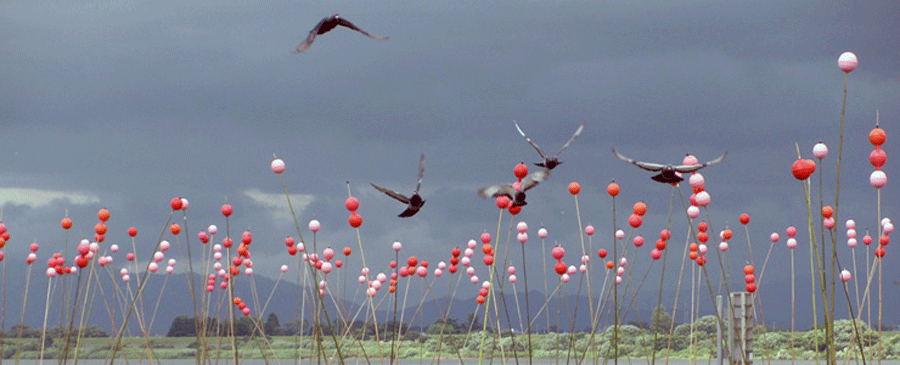
For the 2009 Water and Land Festival in Niigata, Japan, Stacy Levy "planted" 600 18-foot-tall bamboo stems, "like tall grasses moving to the choreography of the wind."

As the Mission Reach of the San Antonio River Improvements Project continues to stretch southward toward Mission Espada, the fruit of the fundraising efforts of the San Antonio River Foundation emerges as public art enhancing the linear park skirting the river’s banks. The next phase opens to the public on Saturday, June 25, and will feature a “portal” strengthening the historical connection of Mission Concepcion to the river.

Although based in Pennsylvania, Stacy Levy is an environmental artist of international standing. Recent commissions include “Tide Poles” on the waterfront in Yonkers, New York; “River of Shade” in Harmon Library Park in Phoenix, Arizona; and “Tide Flowers” in Hudson River Park in New York. She taps talents gleaned from an unusually rich interdisciplinary background – studies at The Architectural Association in London; a B.A. in sculpture with a minor in forestry from Yale University; additional studies at Skowhegan School of Painting and Sculpture; and a MFA in sculpture from the Tyler School of Art at Temple University – for her work.

Stacy shared a flowing description of her impression of the San Antonio River:

The San Antonio River flows through the city, its liquid presence flowing past the hardscape of the urban environment. This wonderful contrast of liquid nature and solid infrastructure is intriguing to me.  Sometimes water works slowly: sometimes languidly carving its path grain by grain, sometimes with the terrible scouring speed of a flood. But whatever the flow of the river, the water is always moving in a particular pattern of fluid dynamics. This pattern is beautiful but rarely perceivable to the eye. I wanted to capture this aspect of the flowing river and to show people another world of water: the pattern of fluid motion.

Her installation reflects not only the water and natural environment but also the built environment nearby, that of the more than 250-year-old Mission Nuestra Señora de la Purisima Concepción de Acuña. Stacy wrote:

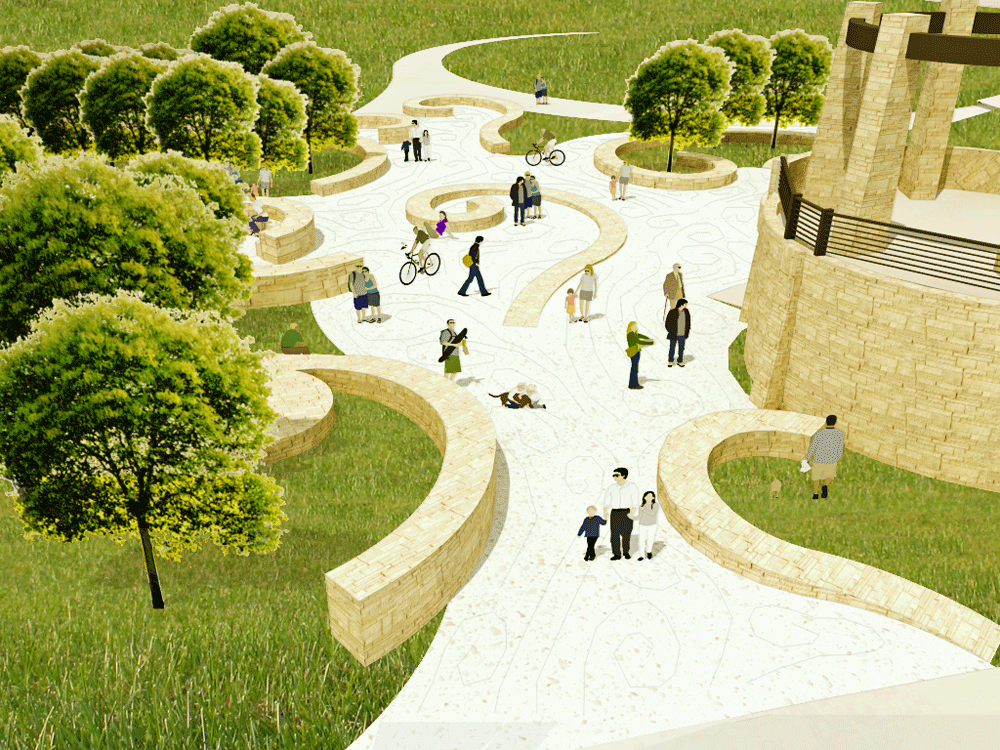
…here, the water is evoked by sloping stone walls, so reminiscent of the architecture of the Mission Concepcion. This place of stone and water is where the mission and the river meet in an artful form, borrowing patterns and materials from each of these icons.  The stone seating walls curve and undulate like the major hydrological forces, creating a pattern of vortices made from stone which sweep the park user in. I tried to make this solid and dry environment feel like the swirling movement of river water.  And the walls undulate and slope like the Mission’s walls, are rough and cool to the touch in the shade of the trees planted in the terrace.

Portal at Mission Concepcion as envisioned by artist Stacy Levy

The gracefully curved walls and walkways will be completed in time for the June 25th celebration, but they are only the first phase of her contributions to the Mission Reach. While the final design for the next portion have yet to be approved, Stacy envisions art evocative of the fluid patterns of the river meshed with the original floral patterns found at Mission Concepcion.

More wonderful reasons to keep walking the river (refer to older posts such as this and this). 

Update on June 24, 2011: Preview of the opening of the next segment of the Mission Reach from the Express-News

Update on June 26, 2011: Express-News reports about Anne Wallace’s footbridge and more art to come….

“Loanership” program leads to Texas Centennial series of prints opening at King William Art

Started watching ebay for memorabilia from the Texas Centennial about two years ago when I fell in love with a silver bracelet. Alas, the bracelet flirted with numerous suitors; the dowry I pledged proved insubstantial.

I dallied with other Centennial items, but continued to be too conservative in my courtships.

Again, I was heartbroken when I failed to win a cow I wanted to incorporate in the design for the inside flaps of the dust jacket of Last Farm Standing on Buttermilk Hill.

But this winter, a sheet with the cow for which I yearned and 29 other cinderella stamps promoting the 1936 Centennial of Texas independence found the chink in my common-sense fence. This was a whole herd of stamps exuberantly proclaiming the magnificent majesty of the great state of Texas. They represented the incredible boosterism and spirit of an era I wanted to lasso.

As I only wanted high-resolution copies not ownership of the stamps, I decided to leave an extravagant bid of $200 on auctionstealer before heading out to dinner. After scanning in the stamps, I would just re-post and sell. Unfortunately, there was another crazy person out there. I won, but was pushed up way too close to my maximum bid. When I turned around to re-sell, the other crazy was much lonelier. My scan ending up costing me about $60.

This perky blue dog is part of Sarah Reveley’s collection of Texas Centennial memorabilia.

The lesson learned was that I needed a system of “loanership” for, not ownership of, Centennial memorabilia.

Fortunately, I found someone who had gotten a severe case of Centennial fever well in advance of the 175th anniversary inflationary outbreak of 2011. There was an official Centennial almost everything, and Sarah Reveley has posted images of many online. And, best of all, Sarah agreed to be my lending library, providing virtually all the items I needed for the first five of my 1936 Texas Centennial digital collages, which will be included in an exhibit of two dozen prints drawn from several series opening with a reception from 6 to 8 p.m. on Thursday, June 2, in the King William Art Gallery at 1032 South Alamo.

The impact of the Texas Centennial proved enduring, both in contributing to the attributes that distinguish a Texan from those unfortunate enough to reside in the other 49 states and in leaving enduring physical landmarks behind.

Attitude and granite; attitude in granite.

According to The Handbook of Texas Online:

The Commission of Control worked with the Advisory Board of Texas Historians, the Work Projects Administration, and the Texas Highway Department to coordinate programs and to provide permanence to the centennial observance by the erection of permanent buildings, monuments, statues, and grave markers. Every county in the state received a marker indicating the date of its establishment and the source of its name. Permanent buildings that received financial assistance from the Commission of Control included the Hall of State at Dallas, the Panhandle-Plains Historical Museum at Canyon, the Texas Memorial Museum at Austin, the Sam Houston Memorial Museum at Huntsville, the Corpus Christi Centennial Museum, the West Texas Museum at Lubbock, the Big Bend Historical Museum at Alpine, the Alamo Museum at San Antonio, the Gonzales Memorial Museum, the David Crockett Memorial Building at Crockett, the Memorial Auditorium and Stadium at Goliad, the Pioneers, Trail Drivers, and Rangers Memorial at San Antonio, and the San Jacinto Monument and Museum of History near Houston. Monuments commemorated special events; historic buildings and forts were restored; and statues were erected to more than twenty Texas heroes.

The multitude of physical markers from 75 years ago – some maintained, some in need of major repair and some missing – have been photographed by history buffs throughout the state and assembled by Sarah online.

While cities and towns of all sizes throughout Texas were planning official events sanctioned by the Texas Centennial Commission, seems as though San Antonio would have been a shoe-in in a three-way race with Houston and Dallas to host the central exposition. Those two cities were mere upstarts by comparison – undeveloped land gleaming in speculators’ eyes in 1836.

But 100 years later, the wealth of Dallas beat out the Alamo City. According to The Handbook of Texas Online:

Although it possessed the least historical background, the commission chose Dallas because it offered the largest cash commitment ($7,791,000), the existing State Fair of Texas facility with provisions for expansion, and unified urban leadership headed by bankers Robert L. Thornton, Fred F. Florence, and Nathan Adams.

The state and federal governments each kicked in an additional $3 million dollars at a time when the country was only beginning to emerge from the Depression. The Handbook notes that, encompassing 50 buildings, the central exposition cost $25 million. In today’s dollars, that translates into a whopping investment of approximately $417 million (don’t trust my fuzzy math) – a major fiesta by any standards.

And major fiestas need music; The Handbook reports the Centennial commissioned and promoted all kinds of it:

The various genres of Texas Centennial music include popular and art songs, film music, operas, and a Mass…. Texas Centennial songs can be divided according to such types as praise songs, cowboy songs, advertisement songs, bluebonnet songs, and love songs.

Mitch Miller’s 1955 recording ruined “Yellow Rose of Texas” for me as a child; maybe even left it as irreparably damaged goods as an adult. But what other song could better symbolize the Centennial? The first known handwritten copy of the lyrics surfaced shortly after the Battle of San Jacinto in 1836, with words altered to suit the what was regarded as politically correct (generally incorrect by today’s standards) times through the years.

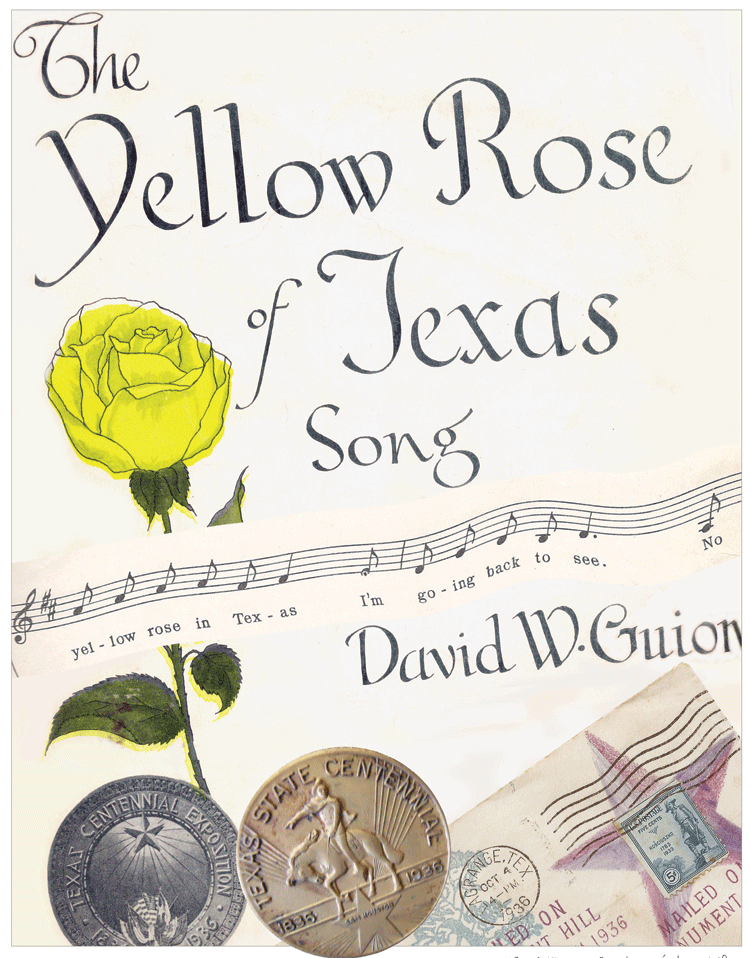
1936 Texas Centennial No 1, “Yellow Rose of Texas,” 7.5 X 9.75 inch image, edition limited to 25, view online at http://postcardssanantonio.com

The Centennial version of “Yellow Rose” was penned by David Wendel Guion, a native of Ballinger who had studied at the Royal Conservatory of Music in Vienna. According to The Handbook of Texas, Guion composed and performed western-themed songs, preserved traditional folk tunes, hosted a radio show focusing on the west and composed a collection of waltzes used in the film Grand Hotel (Only a pale memory, the trailer makes me want to watch it.). Among his most famous arrangements are “Turkey in the Straw” and “Home on the Range,” a favorite of President Franklin D. Roosevelt to whom he dedicated his version of “Yellow Rose.”

Following my earlier incorporation of  “San Antonio Song” into a collage, I combined the image of the sheet music of “Yellow Rose” with a Centennial envelope and an official Centennial medallion featuring General Sam Houston astride Saracen. The medal seemed appropriate because, were the myths surrounding the role of “Yellow Rose” at San Jacinto true, the general would have been eternally grateful to her for distracting General Santa Anna with her womanly ways just prior to the battle. This tinge of naughtiness in the legend led me to add the envelope postmarked La Grange, home of the Chicken Ranch.

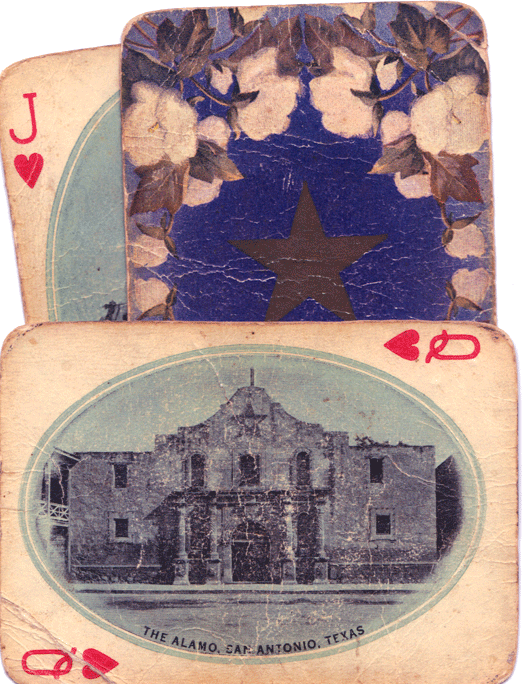
A guide in Sarah’s collection that attracted my attention was written by Miss Elise Hendrick promoting the purchase of a multitude of Centennial products by ladies for hosting a picture-perfect Centennial bridge party. While slim on its artistic appearance, it provided me with the long-awaited excuse to use some well-worn playing cards from an earlier decade begging to escape from my overflowing files.

Loved reading the accompanying recipes for hospitably entertaining a polite gathering of ladies. A jelly-roll style sandwich featured a layer of cream cheese, a layer of red plum jelly and another layer of cream cheese, this one tinted with blue food coloring, sliced into pinwheels. Then there was a recommendation for absolutely plain “gelatine” frozen in Texas star “moulds.” Even the “cocktail” recipe fizzled: equal part orange and grapefruit juices, dash of lemon juice, slice of orange, sprig of mint, a red cherry and a green cherry. Missing a major ingredient. Obviously, not my kind of party. Hell, I forgot; I don’t even play bridge.

Rather tame. And sweet, much like the lyrics of the Official Centennial “Blue Bonnet Girl” by Glenn Spencer, recorded by Roy Rogers and the Sons of Pioneers:

Down in Texas there’s a blossom blooming in the moonlight. She nods a greeting like a sweet blue bonnet bathed in starlight. She’s my angel come from above….

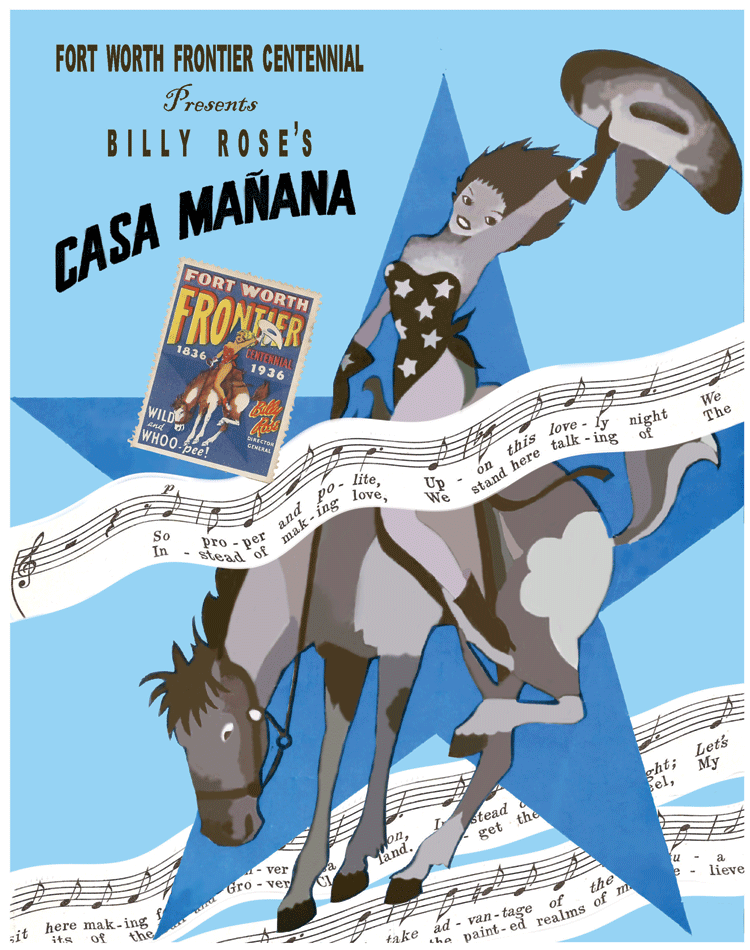
These words stand naive in contrast with Billy Rose’s lyrics, “The Night is Young:”

So proper and polite upon this lovely night, we sit here making foolish conversation, instead of making bright; let’s be ourselves tonight and take advantage of the situation….

1936 Texas Centennial No 4, “WHOO-pee! The Night is Young,” 7.5 X 9.75 inch image, edition limited to 25, view online at http://postcardsfromsanantonio.com

The difference? The stretch of highway between Dallas and Fort Worth.

Fort Worth publisher Amon Carter saw no need to let the Centennial centerpiece being staged in neighboring Dallas outshine Cowtown. Fort Worth would just mount its own event capturing the spirit of the west – the Texas Frontier Centennial – with no eyes of official Centennial Commission members censuring its components.

According The Handbook of Texas:

The spectacle covered 162 acres and cost $5 million. The Old West lived again in Frontier Village, in which Sunset Trail was lined with livery stables, general stores, an old church, and other buildings typical of the 1870s to 1890s. A railroad train with wood-burning locomotive and wooden coaches demonstrated transportation of the same period…. The most publicized part of the celebration was Casa Mañana, “the House of Tomorrow,” in which seats and tables to accommodate 3,500 spectators faced a revolving stage on which Billy Rose presented his musical show.

This extravaganza seems purposefully planned to pit proper Dallas against rowdy Fort Worth. According to Clay Coppedge writing on Texas Escapes:

“Go Elsewhere For Education, Come to Fort Worth For Entertainment” read the billboards, thousands of them, spread over several states. Aside from the slogan, the billboards showed scantily clad young women cavorting about in a Western setting. Among the people so intrigued by the billboards to change a road trip itinerary was Ernest Hemingway, who decided to go to Memphis from Idaho via Fort Worth after seeing the billboards.

And there was Sally Rand. Sally had gained notoriety during 1933 Chicago World’s Fair, where the chorus line dancer debuted her legendary Fan and Bubble Dances, artfully and carefully choreographed to give the impression of total nudity. According to the Virtual Museum of San Francisco:

This was the fair that made Sally Rand famous. She had been a nightclub cigarette girl and dancer, and joined a chorus line at the fair. She was arrested for an “obscene” performance, and was catapulted to fame. It is said her act, in Chicago, grossed $6,000 per week during the depths of the Depression.

Coppedge explained how Fort Worth’s door swung wide open to welcome Sally:

The idea of bringing Sally Rand to Fort Worth began with Billy Rose denouncing her during an impromptu press conference announcing his involvement in Casa Mañana. Rose promised that his show would have “neither nudity or smut” and added, “we don’t need any fans or bubble dances at the Texas Frontier Celebration.”

Later, Carter asked Rose what he was talking about and Rose told him about Sally Rand’s fan dance and bubble dance, which she had performed at the World’s Fair. Carter asked if the show drew a lot of people and Rose assured him that it did. That’s when Amon Carter decided that Texas needed Sally Rand to help celebrate its heritage….

So Sally Rand’s NDude Ranch set up camp for the duration of the Centennial. And the next year as well.

In 1936, George Lester was ten years old, and he shared his remembrance of life on that ranch on Texas Escapes:

My dad and my adult brother decided see the Billy Rose production called Sally Rand’s Nude Ranch…. My brother Sam was only a year older than me, so our dad gave us money for the rides while they went to see the show.

We chose to start with the Ferris wheel. On our first ascent we discovered something the producers of the event had overlooked. From high above we could look down onto the roofless show below and see all the scantily clad ladies. We kept riding until we ran out of money. I don’t think we ever told our dad why we liked the Ferris wheel so much.

Were the sensibilities of the elite of Fort Worth offended by the randy Sally? According to Coppedge:

The city of Fort Worth declared November 6, 1936 as “Sally Rand Day” where she was lauded for her “graciousness and consummate artistry” and officially thanked for bringing “culture and progress to the city.”

1936 Texas Centennial No 4, “Wonderful World of Wild Women,” 5 X 5.75 inch image, edition limited to 25, view online at http://postcardssanantonio.com

I apologize. All of this scintillating sensationalism is a shameful tease.

No Centennial collector of Sally Rand postcards has stepped forward to participate in my new “loanership” program, and, at least temporarily, I’m still keeping my hands in my pockets, away from auctionstealer and ebay.

But the 175th anniversary isn’t over yet.

The exhibit continues during office hours of the King William Association through Wednesday, July 27.

And, not to let Mitch Miller be the last taste of “Yellow Rose” in your mouth, here is Elvis’ version from Viva Las Vegas:

Okay. Only marginally better.

But, “The Night is Still Young.”

Update on June 3, 2011: