
San Antonio Express
April 12, 1912
Programme for Fiesta Week
Monday
Fiesta San Jacinto opens. All-day shows on all plazas, open air concerts and marching bands.
4:30 P.M. – Decorated automobile parade. It will form at 4 o’clock and start made promptly.
At night, shows on all plazas, open air concerts and marching bands. free exhibitions here and there. Mexican village in Haymarket Square.
Tuesday
Shows on all the plazas all day and in the evening, open air concerts and marching bands. Free exhibitions here and there. Mexican village in Haymarket Square.
8 P.M. – King Zeus will arrive at Southern Pacific Station and be met by assemblage of loyal subjects with massed bands.
8:30 P.M. – FIRELIGHT PARADE will start at the Federal Building on Alamo Plaza, led by King Zeus, the way being blazed by Milt Mooney with his 1,000-light electric tandem.
8:35 P.M. – “Fiesta Fete.” “The Little Princess” in Grand Opera House, the cast made up of society maidens and men of the city.
Wednesday
Entertainment of various kinds on all plazas, Mexican village in Haymarket Square, open day and evening. Open air concerts and marching bands.
4:30 P.M. – Burlesque circus parade, introducing strange, ferocious and voracious animals.
8:30 P.M. – “Fiesta Fete.” “The Little Princess” in Grand Opera House, with the same cast as the previous night.
Thursday
Mexican village in Haymarket Square, new and novel shows in all the plazas, open air concerts and marching bands, open for enjoyment early and late. Free exhibitions.
3 P.M. – Parade of Ben Hur Shriners with band of initiates seeking passage over the hot sands.
4:30 P.M. – Civic trades display, with more than one hundred decorated commercial floats in parade.
7 P.M. – Ceremonial session of Ben Hur Temple. Nobles of the Mystic Shrine.
8:15 P.M. – “Texas Under Six Flags” in the Grand Opera House, with cast of society people.
9 P.M. – Fiesta Queen will be crowned in Beethoven Hall amidst a court of the lilies, one of the most beautiful and magnificent events ever held in this city.
10 P.M. – San Jacinto ball, given by the San Jacinto Club in St. Anthony Hotel.
Friday
Shows, shows and more shows in every one of the beautiful plazas. Mexican village in Haymarket Square. Marching bands and open air concerts. All day, morning and evening. Free exhibitions.
8:30 P.M. – Parade of Fables, an allegorical parade, one of the most beautiful events of Fiesta week.
8:35 P.M. – “Texas Under Six Flags,” in Grand Opera House, with same cast as previous night.
9 P.M. – Ball in honor of Fiesta Queen, given under auspices of the Order of the Alamo in Beethoven Hall.
Saturday
All shows open morning, afternoon and evening in all the plazas. Marching bands and open air concerts. Free exhibitions. Mexican village in Haymarket Square.
4:30 P.M. – FLOWER PARADE AND BATTLE OF FLOWERS. Floats will get in line at four o’clock all ready to start at word of command.
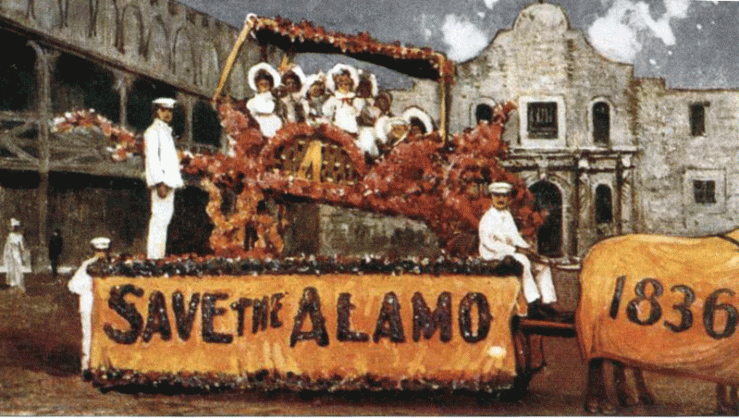
8:30 P.M. – Mask Lantern Parade, in which travelling men and members of various athletic and fraternal societies will participate, each carrying a lantern and wearing mask.
This will be followed by a period of revelry and pure, clean fun until the midnight hour announces the close of Fiesta.
The newspaper was quite the plot-spoiler when it came to the “Fiesta Fete”:
The story of the fete is the story of a princess in quest of a husband, who must be a prince and yet who must combine all the many graces with the romantic charms of a medieval knight, forming the basis of the plot. Beautiful maiden weave a magic spell about the princess, and bid off of the eligible young men of the kingdom to a ball, which is given on an enchanted island, the Isle of Dreams, where every maiden meets her heart’s desire. “Cupid,” no longer a blind boy, but a very clever maiden, aided by her nymphs, contrives to produce the prince at just the right moment, and the beautiful princess, thinking she is wedding a penniless minstrel, gives heart and hand to the “Prince of the Isle of Make Believe,” just a rainbow’s length from the Isle of Dreams.
Refraining from revealing the predictably painstakingly described happy ending, we’ll move on instead to the paper’s description of the arrival of the King of Fiesta:
He will come in the Royal Special and will be met at the Southern Pacific station by thousands of his loyal subjects. All the bands in the city will be massed and be at the station to “Hail the Chief.” The King will be driven through many of the principal streets of the city and, promptly at 8:30 o’clock, will head the Fire-Light parade, which will start from Avenue E and Alamo Plaza. He will head the procession and the way will be cleared for him by Milt Mooney driving his electric tandem. San Antonio is proud of this tandem, besides driving two of the finest high-school show horses in the country, Mr. Mooney has equipped the horses and cart with more than one thousand incandescent lights, operated by sixteen batteries, and himself wears a coat similarly adorned.
The Fire-Light Parade “will illustrate the development of light and fire, showing both in their various phases.…” Among the floats were: “Starlight,” with Venus perched in a crescent; “Moonlight,” two lovers basking in gleaming moonbeams; “Phosphorous,” with Neptune rising from the sea; “Will of the Wisp,” bearing grotesque motifs from A Midsummer’s Night Dream, including bull frogs and toad stools; and “Cloud Reflection,” with an aeroplane resting on a cloud. Members of the San Antonio Turn Verein were charged with providing the men and women to play the parts aboard the floats.

The Fiesta Queen to be crowned in 1912 would 13th in the line, but in the same edition of the San Antonio Express, the social columnist, Marin B. Fenwick revealed the rocky history behind the crown:
At this distant day it is amusing to recall the social row that was precipitated by the choice of the first queen. The ladies with the best intentions in the world and for the purpose of interesting a wide circle, selected Miss Ida Archer, the belle of Austin, whose fame for beauty and grace had been sung all over the State. There was no effort made in those days to keep the identity of the queen a secret, and those who approved of the choice made haste to proclaim the fact that the most beautiful girl in Texas had consented to grace the occasion. After the first announcement they made haste more slowly. A storm of protest poured in from all sides, and the men all declared that it was a direct insult to the San Antonio girls. It looked for a time as though the ball would be boycotted, but curiosity brought out a large attendance. Miss Archer, the innocent victim, came, saw and only partially conquered.
Choosing the queen was too important to be left to the womenfolk, so soon the men took over the whole selection process:
Four years ago, the Order of the Alamo was formed, the membership including the prominent society men of the city. Since that time they have chosen the queen by secret ballot, and the coronation is attended with a great deal of pomp and display.
Unfortunately, much of the copy in related articles is illegible. But it seems amazing how many of the descriptions are reflected a century later in today’s 10-day celebration of Fiesta San Antonio.
Though I just can’t stop worrying about the feet of those Ben Hur initiates seeking passage over the “hot sands.” Should that be taken literally? And, if so, did they then have to squeeze their poor blistered soles into shoes for the evening ceremonies with the “Nobles”?
Viva Fiesta!
Note Added on April 22, 2012: Actually, it is quite amazing there ever was a second Battle of Flowers Parade. Sarah Reveley transcribed the description of the 1891 melee from an April 25, 1891, edition of the San Antonio Daily Light:
…The procession contained over 100 carriages and other vehicles, all gaily decorated and many containing decorations of real artistic merit. Mr. Madarasz’s carriage, decked in pure white lilies and variegated grasses, with honeysuckle was plain, pretty and neat. Col. H. B. Andrews’ pony phaeton, with four Shetlands drawing it, was exquisite, and J. J. Stevens’ children in a four-in-hand Shetland surrey, representing a yacht, was also very pretty….
On arriving at the plaza the police divided the procession into two lines, each half going in opposite directions and passing around the park were brought, face to face with each other. The crowd on foot pressed the carriages closely and the fight began and waged furiously for nearly an hour. The occupants of the carriages had all the ammunition while those on foot had none. They began picking the fallen roses from the pavement, and even tore off the trimmings of the carriages, and soon had the best of the fight. Heavy bunches of laurel thrown soon had their effect, and many ladies lost their temper and used their carriage whips indiscriminately on the crowd. One lady struck Mr. Doc Fitzgerald, a passive spectator, a severe blow on the face with her whip, but did not see fit to apologise for her mistake. Mr. H. P. Drought made an ugly cut with his whip into the crowd, struck a negro and the boy ran into a carriage horse in front of the Menger and nearly caused a runaway. A negro driving in a phaeton by himself in the procession, struck Louis Glaeser, a white boy, in the right eye with the ends of his reins. The buckle on the straps made a cruel wound, and the boy was taken to a drug store by sympathetic bystanders. One young angel with white wings appealed to the crowd for protection from the missiles saying, “I wish you men would make them quit….”
The police were powerless to keep the people off the park beds, and prevent them from tearing off the flowers. One outright fight occurred. Mr. Phil Shook, one of the horseback party, lost his temper, and cutting a man in the face with his riding whip, was assaulted, and a fist fight on the pavement resulted. Both combatants were arrested by the police. Mr. Charley Baker used his umbrella for defense. While the crowd was very dense on the plaza, waiting for the procession to come along, Mr. Cristoph Pfeuffer’s splendid team and carriage took fright on South Alamo street, at an electric car. The carriage was decorated and contained several ladies, a child and the driver. Dashing into Alamo street, past and into the crowd of people and vehicles, it overturned a buggy and horse at the corner, and its driver jumped out and was dragged under the carriage by the lines. The lady on the front seat caught one of the lines and held it, but the horses made straight for the crowd of women and children in the park and struck a very deep mass of them, it being impossible for them to move out of the way. The ladies were thrown out and their clothing was badly torn. One little boy was knocked senseless, another was bruised, and one little girl had her apron torn off. Other children were trampled by the frightened people. The plunging horses were secured and the carriage was taken to a side street….
Some irrepressible small boys arranged a dog fight in the midst of an interested crowd of spectators, during the battle, and a regular stampede ensued. Some of the combatants whose supply of ammunition had exhausted, resorted to buggy robes and quirts for aggressive warfare, and umbrellas and parasols for the defensive….
The battle was a success, but if it is given next year, more police will be needed, carriages must not be allowed on the plaza at all, and the participants must not lose their temper.





 Postcards from Barton Springs