Horse Feathers: Coming Full Circle

Wagon and carriage manufacturers failed to take the automobile seriously, at least in the beginning. More than one of them dismissed it as a passing fad like the 1860s “bone shaker” velocipede, or the 1880s high-wheel bicycle.

Thomas A. Kinney, The Carriage Trade: Making Horse-Drawn Vehicles in America

The Model T made its debut in 1908 with a purchase price of $825.00. Over ten thousand were sold in its first year, establishing a new record.

Henry Ford Changes the World

One-hundred years ago, automobiles began to crowd horse-drawn carriages off the streets of downtown San Antonio. Downtown retail flourished as people living on surrounding farms and ranches could actually make a round-trip to buy necessities and luxuries in less than a day. Car dealers replaced carriage sellers; parking lots replaced livery stables.

By the middle of the century, the automobile began to transport people farther and farther out from the center of the city.  Toward the end of the 20th century, the abundant car dealerships around the fringes of downtown had followed the customers outward in the sprawling city.

But lately, the horse seems to be having the last whinny downtown. The repurposing of Automotive Accents on Avenue B always makes me smile when I pedal by in the mornings.

This slideshow requires JavaScript.

I enjoy the tortoise and hare concept of the slow-plodding horse taking over the automotive barn. The man managing the horses and carriages under the Mr. Goodwrench sign even wears a Star Motors shirt indicating his former occupation.

It’s not that I’m particularly fond of horses and carriages. Don’t recall riding  in one since I was a child in Colonial Williamsburg. But for me, their clip-clopping along Madison and King William Streets represents people slowing down to enjoy the city itself, people walking and riding bikes to appreciate San Antonio’s urban amenities instead of racing past them.

The horses better enjoy their hay while they can, though. Another cycle could be on the horizon. Some politicians in New York City are threatening to replace the horse carriages circling Central Park with hybrid replicas of vintage Model Ts.

The fight continues, but The Gothamist reported that the head of the Horse and Carriage Association summed up the feelings of many:

No one wants to replace clip-clop, clip-clop with chitty chitty bang bang.
Haunting the graveyard to unearth the past

The pains of death are past.

Labor and sorrow cease.

And life’s long warfare closed at last.

His soul is found in peace.

Headstone of Joseph Coker, 1799-1881

One day I found myself, sitting in the middle of the carpet surrounded by boxes stacked in an attorney’s office on the 30th floor, rooting through another woman’s purse.

This really was not a planned direction for my career, but, undisciplined, I have always let it take numerous unscheduled detours.

I wanted the vintage pocketbook to spill the story of Minnie Tomerlin Voelcker out on the floor in front of me. Although its contents provided tiny glimpses of her personality, it was going to take a lot more time and effort to flesh out her and husband Max. Thanks to the Max and Minnie Tomerlin Voelcker Fund, I devoted two years to getting acquainted with the two hardworking dairy farmers who reside in the Coker Cemetery, resulting in the publication of The Last Farm Standing on Buttermilk Hill: Voelcker Roots Run Deep in Hardberger Park.

The Voelckers’ farm was part of a community of dairy farmers clustered together just north of Loop 410 in San Antonio. These families were unified by school, church and graveyard into a tightly knit community – the Coker settlement, and the Coker Cemetery Association plans to reunite these families in a book.

This slideshow requires JavaScript.

Farewell, my wife

and children all,

From you a Father

Christ doth call.

Headstone of James J. Tomerlin, 1858-1896

As the Voelckers did, many of these hardworking farmers retired to the Coker Cemetery. I went to visit them recently, hoping they would whisper tales to me.

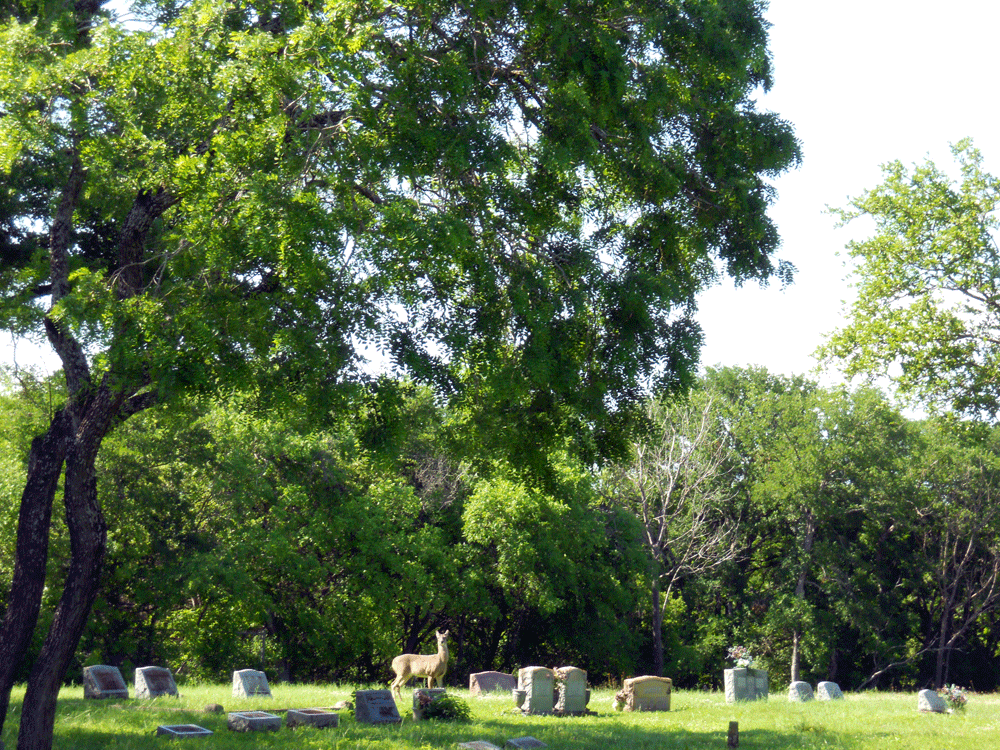
The jarring sounds of bulldozers working on the new portion of Wurzbach Parkway crashing through the former farms at first spoiled the peacefulness. But the spirits in this bucolic setting gradually quashed the intrusive noise, leaving me and several deer free to wander in the past.

The hours spent in the Coker Cemetery revealed some of the names of the farming families populating the settlement: Coker, Gerfers, Hampton, Harrison, Jones, Marmon, Smith, Tomerlin, Autry, Dekunder, Gulick, Harper, Isom, Maltsberger, Pipes, Tomasini and Voelcker. While their dairies in the area known as Buttermilk Hill were swallowed by behemoth San Antonio, the nonprofit association maintaining this historical cemetery knows their stories merit preservation.

As families dispersed from farms, remnants of the area’s history scattered with them. The Coker Cemetery Association asked me to bring these back together as a gift to the descendents of all who rest under the tombstones behind the old Coker church.

Charged with weaving bits of historical information together to illuminate this oft-forgotten portion of San Antonio’s rural heritage, I find myself again looking for chards. A page recording births and weddings in a family Bible. A brand registration from the late 1800s. A class photo from the old Coker schoolhouse. A tax return from the 1920s. A long-forgotten diary or letters tucked away in a shoebox. Memories grandparents shared about families’ arrivals in San Antonio or life on the farm.

I am asking descendants to introduce me to their ancestors from the Coker community, to search their studies, basements and attics and dust off the cobwebs in their minds to share memories and artifacts for this project. To ensure their ancestors are:

Gone but not forgotten.

Headstone of Rebecca Ford, 1823-1881

Thank goodness for detours, always full of unexpected opportunities and discoveries.

The sex life of garlic

Face it. We’ve been eating clones. And not just recent clones, but clones of clones of clones. Generations of us have been eating generation upon generation of clones for possibly thousands of years.

Bob Anderson, Texas’ “garlicmeister,” dropped hints about the importance of the sex life of garlic in a phone interview I had with him for the April-May issue of San Antonio Taste Magazine.

Little did I know that great garlic requires some sex in the wild, or at least some wild sex in the last few decades. But finding proper propagating partners for garlic was impossible in this part of the world until Gorbachev and GW Bush officially thawed the Cold War at Malta in 1989.

Once the two leaders decided to finally melt the ice, the door opened to Kyrgyzstan, Tajikistan, Turkmenistan and Uzbekistan, the only places where garlic still grew wild, freely engaging in unbridled cross-pollination.

I gleaned this from reading Phillip Simon’s research for the USDA. Simon went on the 1989 expedition to what I call the “Four Stans” (because I clumsily stumble over their full names) to collect all kinds of new hardneck garlics capable of producing “true garlic seed,” unlike the Dolly-like clones we have been consuming.

Anderson passionately gushes about some of the distinctive flavors of the resulting children of these newly available types of garlic on page after page of his website.

The above information represents only a few of the titillating facts I learned about garlic for San Antonio Taste.

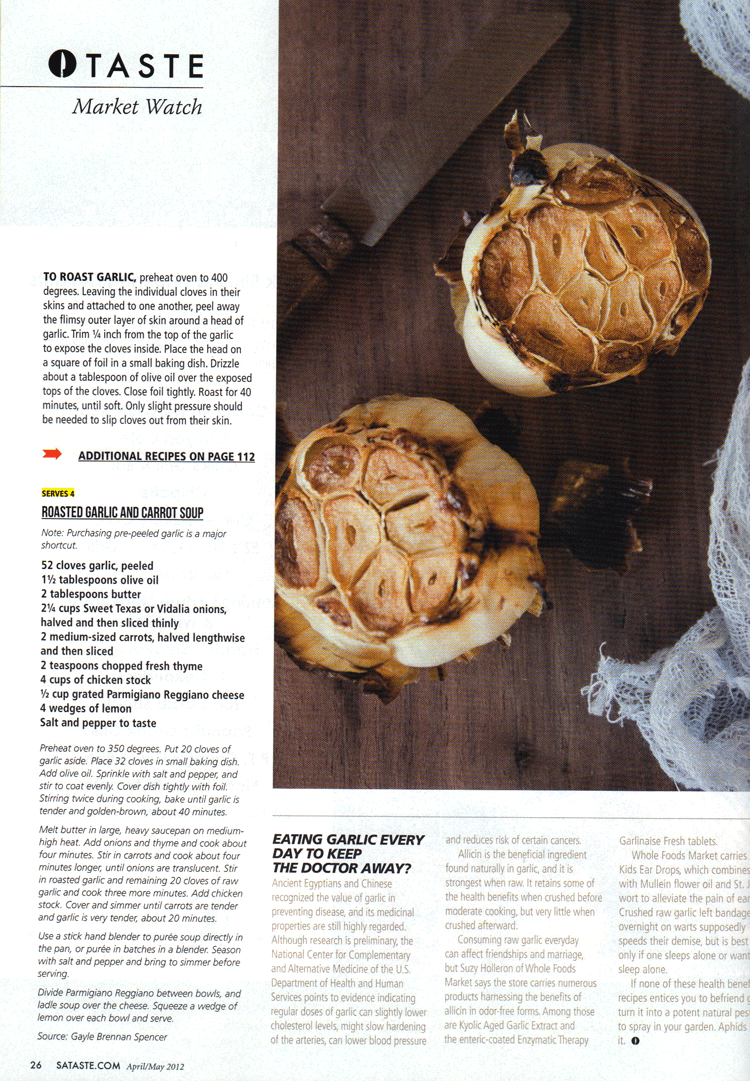
garlic goes topless

I’m sure my feature on garlic would have been the magazine’s cover story if the garlic had not posed topless. The editors probably feared highlighting such a steamy topic would mean some outlets would require a brown paper outer wrapper or only be willing to sell the magazine from under the counter.

Note added on April 10, 2012: Totally missed that April is National Garlic Month.