Postcard from Madrid, Spain: Paradise found in parks

Better to reign in Hell,

Than to serve in Heaven

Lucifer in John Milton’s Paradise Lost

There he is, the fallen angel himself, painfully ensnared atop a beautiful fountain, guarded by gargoyles, in the heart of Madrid’s Retiro Park. John Milton’s Paradise Lost inspired sculptor Ricardo Bellver to create a monumental depiction of the devil in 1877. Both widely acclaimed and highly controversial, the statue is regarded as the only piece of major public art dedicated to the devil.

Anyone bedeviled by the artwork can easily avoid it, as Retiro Park is huge and is only one of many found in the capital city. Madrid has more parkland in its center than any other major European city, and Madrilenos take full advantage of them any time they are free.

These photos are from Retiro Park and the Jardin Botanico next to the Prado.

Totally swooned for the handsome tuxedoed birds. Exotic in my mind, but considered nuisances by many – common magpies. As with the storks earlier in our trip, never recalled setting eyes on them before, which might be lucky as a multitude of legends portray magpies as harbingers – or at least a single magpie – of ill will.

With his theft of glittering objects, the magpie envisioned by Gioachino Rossini in the plot of an 1815 opera almost caused an innocent maid to swing from the gallows. And the magpie’s reputation surely was not enhanced by the inclusion of the overture to signify impending over-the-top violence by Stanley Kubrick in his 1971 film, A Clockwork Orange.

Postcard from Madrid, Spain: ‘To market, to market….’

An earlier post makes it obvious we ate out in Madrid… a lot. But we atoned, somewhat, for that activity with light meals at our apartment. Learning where to find specific foods in a different country is an entertaining part of the overall adventure.

Searching for an ideal loaf of grainy artisan bread took us on numerous explorations of nearby neighborhoods. Accidental encounters resulting in totally different purchases sometimes happened along the way, including a gleaming “extreme chocolate” pastry and a dinner-plate size meringue that made their way back to the apartment.

The route to my favorite mercado for buying both bread and cheese passed through the narrow, tree-lined streets of Salamanca. Residences fill the top floors along the way, while ground-floor storefronts display the wares of designer boutiques. The tonier the boutique, the more shelf space allotted each individual item. Dresses hanging on racks are separated from one another by about a foot; each purse is distanced from its neighbor by the same; shoes stand individually on pedestals, as though fine sculptures perched in museums. Prices in the windows have a startling extra zero on the end. Well beyond my budget, but people in the fashionable neighborhood could be spotted actually wearing the designer outfits as they walked to join friends for afternoon pastry breaks or cocktails. Why, oh why, didn’t we snap a photo of the man in the red suit?

After finally ambling our way to Mercado de la Paz, we were rewarded with fresh, healthy and surprisingly inexpensive breads (if you avoid their seductive pastries) at La Tahona de Ayala and a tantalizing cheese selection at La Boulette.

Many a guidebook steers you straight to Mercado de San Miguel adjacent to the Plaza Mayor. The mercado is stocked with an amazing selection of expensive gourmet items, with most individual vendors selling tapas and wine that you could possibly manage to balance enough to eat and drink by aggressively elbowing your way to a shared sliver of a stand-up table. Almost every tourist heads there. It’s crazy crowded, so bustling busy I didn’t even pause to take photos of the appetizing displays.

Chased out of the too-successful Mercado de San Miguel, locals find refuge in the 70-year-old Mercado de San Anton in the trendy yet still rough-around-the-edges Chueca neighborhood. The new San Ildefonso Mercado nearby completely abandons any pretense of selling foods to prepare at home in favor of gourmet food stalls with enough elbow-room and tabletops to enjoy them.

Back in San Antonio, just returned from a 20-minute car drive to restock our larder at home. Convenient? Maybe. Fun and exciting? No. Sigh.

P.S. Okay, life here is not all that bad. In addition to snagging seasonally cheap fresh Gulf shrimp at my H-E-B, I bumped into a new item in the produce section – bags of padron peppers. Blistered in a little olive oil in a skillet and finished with some flaky pink Hawaiian salt (a gift), they transported me back to a stool in Taberna Maceiras….

Struggling and longing to be ‘fictionalized’

deer


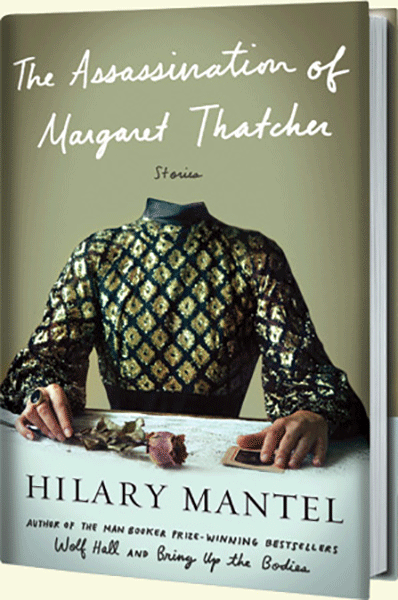
So can identify with the whining of the main character in “How Shall I Know You,” a short story in Hilary Mantel‘s The Assassination of Margaret Thatcher.

The woman is an author who has been “struggling with a biography” for several years.

As a biographer I was more than usually inefficient in untangling my subject’s accursed genealogy. I mixed up Aunt Virginie with the one who married the Mexican, and spent a whole hour with a churning stomach, thinking that all my dates were wrong and believing that my whole Chapter Two would have to be reworked.

Why, I can out-whine her any day. I have a whole cemetery I’m trying to untangle, and I’m sure I’m at least three years into it. And it is filled with a multitude of Smiths and Joneses and Cokers, many of whom inconsiderately passed down the same first names over and over. The Joneses prove particularly difficult, as they originate from two completely unrelated lines, or unrelated for quite a while before the Texas Revolution and not again until some time later.

And she only spent “a whole hour” thinking everything was awry? That’s nothing.

The author in the short story finds writing the truth, when it has to be uncovered, difficult.

I seemed to be pining for those three short early novels, and their brittle personnel. I felt a wish to be fictionalized.

Making up things does seem much easier than digging up facts long-buried. Often I want to just linger in the tub imagining different lives among all of those Coker descendants. The writer in “How Shall I Know You” does just that. She starts typing up exciting invented versions of the lives of Aunt Virginie and the Mexican, completely avoiding the facts associated with the original subject of the biography.

But, unfortunately, you just can’t make this stuff up.

And, I know I don’t need to.

The Coker Cemetery is fertile with true tales that should be passed on to the descendants of the residents resting there.

I’ve made it through the Texas Revolution, the arrival of German and Hungarian settlers and the Civil War. I’m getting there. Slowly.

Each nugget I discover is rewarding. In addition to the everyday stories of hardworking dairy farmers, there is a surprising bit of murder and mayhem to entertain me.

All I need is patience. And an extremely large dose of it.

the-assassination-of-margaret-thatcherWait a minute. Wolf Hall. Bring Up the Bodies.

The author of the author in the short story is the ultimate award-winning, best-selling researcher.

All whining privileges on my part are hereby revoked.