The sounds woke me up Monday through Saturday in Genoa. The way-too-early alarm echoed from two doors and two floors down the steep 10-foot-wide street, actually only a pedestrian passageway. The fish monger hurling up the metal shutter, hauling out the trough and filling it with ice to hold the fresh catch of the day. Those jarring noises were followed shortly by the first customers, evidently all friends as interested in exchanging pleasantries, amplified by the four-story buildings, as purchasing seafood.
But the morning sounds quickly reminded me of a meal ahead and what always is central to menus in this port city – an abundance of fresh seafood. Mussels, squid, octopus, shrimp, butterflied fried sardines. The Mister often has remarked that Italians frown upon mixing seafood with cheese, but Genoa breaks that rule. Several restaurants feature striking black and white squares of ravioli filled with fish and ricotta cheese.
Also, Genoa is the home of pesto. Demanding Ligurians expect pesto alla Genovese to be made with D.O.P. basil, found only in the immediate region and terroir-dependent for its flavor. A favorite Ligurian pasta often paired with pesto is trofie, rolled out by hand on a flat surface to taper its ends and then twisted. Another regional specialty sold like pizza by the slice is farinata, made from a mixture of chickpea flour, water, olive oil and salt. The baked-until-golden, somewhat floppy slices are most commonly offered and consumed unadorned .
Le Piastre di Emma trofie with pesto
Trattoria le Maschere fritto misto di pesce
Locanda Spinola neri pasta
Trattoria le Maschere seafood
Savo Pizza Gourmet la tonnara pizza
Trattoria le Maschere cozze alla Genovese
Pesciolino Mandarin shrimp
Trattoria le Maschere paella
Le Piastre di Emma ravioli with squid
Locanda Spinola fritto misto di pesce
Sciuscia Sciorbi caprese
Savo Pizza Gourmet insalate
Le Piastre di Emma mussels with tomato broth
Trattoria le Maschere gnochi al pesto
Locanda Spinola fish and ricotta ravioli
Trattoria le Maschere verdure grigliate
Trattoria le Maschere spaghetti allo scoglio
Almost every guidebook or travel feature tells you to head to Eataly on the harbor. We ventured inside, as we did in Rome, and tried to talk ourselves into eating there. The food did indeed look amazingly good and the displays of high quality, authentic Italian food products were enticing. But the atmosphere felt manufactured. The customer base appeared composed of passengers recently disgorged from the massive cruise ships docked there. Disneyland for foodies. A place to avoid crossing paths with any of the immigrant population now calling the center of Genoa home. We declined to dine. And for shopping? The alleyways in the historic center of Genoa are packed with charming and pristine specialty cheese and pasta shops and meat markets – the places where the locals go.
Instead, we enjoyed a wonderful meal at Locanda Spinola, so popular with locals on a Saturday afternoon that we felt fortunate to get a table. Parents pushed strollers in and out of an upscale cheese shop and a deli across the narrow pedestrian-only street. And now for the gritty side of a port city that keeps many tourists unnecessarily clustered near their cruise ships: a prostitute was standing on the corner. When an interested party approached, the pair subtly would disappear up the street somewhere to take care of business. Another woman immediately took up the station. But Genovesi, young and old alike, were unfazed by their presence. The prostitutes were not harassing or blatantly soliciting passersby, and most locals walking by took no more notice than they would a door of a shop selling products they did not want. The only gawker was me, albeit screened from being caught by the restaurant’s curtained window.
We enjoyed the slow-rise gourmet pizza topped with seared tuna at Savo Pizza Gourmet, and the Mandarin shrimp at Pesciolino were tasty. The casual Le Piastre di Emma is always packed; expect waiting lines. Contributing to the bustling confusion inside is one of the flamboyant owners who dramatically scurries about like a mother hen, perhaps almost to the point of flapping like a chicken with its head cut off. But the place that kept drawing us back was the family-run Trattoria le Maschere. The almost-homely décor fails to draw in many tourists and leaves the tables with their inexpensive platters full of perfectly prepared fresh seafood and classic pesto to the locals. And us.
This blog’s most recent post left you touring palaces in Genoa but now is flying you back to San Antonio for the King William Home Tour.
The King William Association has arranged for a peek inside six private homes, two museums and its own offices on Saturday, December 1, in the historic neighborhood just south of downtown. The residential streets were surveyed by the City of San Antonio in 1859, and the historic district’s namesake King William Street honored Kaiser Wilhelm I (1797-1888), King of Prussia and the first German Emperor.
This blog tour begins at the southern end of King William Street at house number 524, the Albert Moye House, because it is one of two places you can purchase a ticket, $25 per person, on the route. Mathilda Louise von Bartheld (1821-1896) and Albert Carl Moye (1820-1899) arrived at Indianola, Texas, with their two oldest sons in tow in 1845. The Moye family were part of a wave of immigrants attracted by the overblown promises of the German Emigration Company. By 1850, the saddler and his family had made their way to San Antonio. The Moyes built their symmetrical wood-sided house with Doric columns across the front porch in 1881, with Albert residing there until after Mathilda’s death.
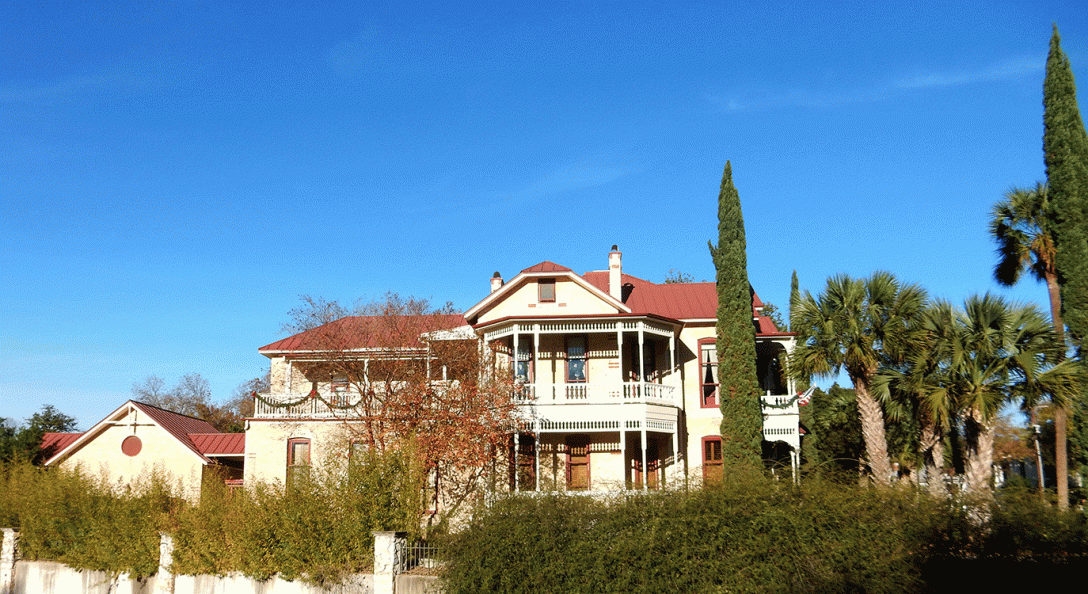
The featured photo above is the riverside view of the Harnisch House, 523 King William. Prussian-born Carl Harnisch (1833-1920) entered into a partnership in San Antonio with a pair of immigrants who married in 1853, shortly after their arrival in Texas – Josephine Brentano (1823-1917) and Christian Baer (1824-1882). Harnisch and Baer elegantly displayed its cakes, pastries, and ice cream in glass cases and provided upscale full restaurant service in its palm-filled location at 109 West Commerce Street.
“Harnisch and Baer Restaurant,” Reflections on Texas Video Collection, KMOL-TV, UTSA Special Collections
The successful business partnership was cemented more closely by the marriage of Carl to the Baers’ Texas-born daughter, Louisa (1853-1917), in 1876. The yellow brick home with red accents the Harnish family built on three lots was designed by architect Albert Felix Beckmann (1855-1900). Although Beckmann was born in San Antonio, he studied architecture in Germany before returning to Texas in the early 1880s. Completed before 1892, the residence was listed with an address on Pershing Street at the time of Carl’s death. During World War I, the street name temporarily was changed from honoring the Kaiser to an American hero, General John Pershing (1860-1948).
The Victorian-style house was occupied by Harnisch descendants until 1963. More than a century after its construction, Debra and Steve Walker purchased and began to renovate it. Just prior to completion of the major undertaking, a fire swept through the structure. The Walkers persuaded the city not to proceed with condemnation of the heavily damaged house and managed to oversee a second, more massive renovation project transforming the burned-out shell into their home.
San Antonio Art League current exhibition
524 King William Street
Jessie Simpson and Al Rendon have updated and enlarged Mary Burkholder’s 1973 “The King William Area: A History and Guide to the Houses” for the King William Association.
523 King William Street
202 Madison Street
Villa Finale
Villa Finale
202 Madison Street
402 Madison Street
402 Madison Street
San Antonio Art League
Villa Finale
202 Madison Street
San Antonio Art League
523 King William Street
Villa Finale
Villa Finale
Villa Finale
Villa Finale
418 Madison Street
523 King William Street
Villa Finale gazebo
San Antonio Art League
The next palatial structure on the tour, 401 King William, has a humble four-room limestone house at its core. Born in Texas while it still was a republic, hardware merchant Russell Cogswell Norton (1844-1928) and his wife Ellen Hayes Whiteley (1846-1899) had their home erected there in 1876. A Missouri-born stockman, Edwin Polk (1849-1918), purchased the home in 1881 and added a two-story brick wing and a porch.
But it would be cattleman Isaac (Ike) Thomas Pryor (1852-1937) who added the architectural flourishes enlarging the home in 1896 to accommodate his family and that of his second wife, a widow, Myra E. Stafford Early (1863-1943). The addition of the three-story tower and adjacent two-story porch reflect the immense success his Texas and Colorado Land and Cattle Company enjoyed leasing land and running cattle in Indian Territory.
Numerous owners lived there through the years as the neighborhood suffered ups ad downs, with perhaps one of the most colorful being Billy Keilman (1875-1925). Keilman owned the seedy Beauty Saloon, developed a hangover cure billed as “patent plugs for pifflicated people” and published The Blue Book, a 1911-1912 guide for visitors to San Antonio’s “sporting district.”
When Walter Nold Mathis (1919-2005) purchased the house in 1967, it had fallen upon hard times and was subdivided into a boarding house. Mathis restored it as his home, Villa Finale, and went on to restore numerous other houses in the neighborhood. Mathis bequeathed his home with furnishings and collections to the National Trust for Historic Preservation as a museum, and Villa Finale retains the interior furnishings and art exactly as he had them arranged during his lifetime.
Vergie Gibbs (1875-1912) and her new husband Dr. Alfred Clifton McDaniel (1866-1944) moved into a grand Victorian Richardsonian Romanesque brick home courtesy of her father in 1896. The next stop is 130 King William Street, the original, much altered, carriage house for the McDaniel House behind it on Madison. The doctor converted the former carriage house into a duplex in 1926.
Kaye and Charles Scheer harvested hardware, windows and banisters from Victorian-era tear-downs in an attempt to make the house measure up to others lining the street. The property was purchased by the San Antonio Art League and Museum in 1987. Founded in 1912, the Art League has more than 600 works in its collection. The current exhibition features paintings by Sylvia Benitez and Vikki Fields.
Thirsty? Time to take a cookie and wine break at the offices of the King William Association, 122 Madison Street, the second location where tour tickets can be purchased beginning at 10 a.m. During tour hours, the Stray Grape Urban Winery will be offering a wine-tasting.
Plus, by now you will want to know about every house you have walked past so you are ready to invest in the updated, expanded and now in color version of Mary V. Burkholder’s 1973 The King William Area: A History and Guide to the Houses. Resident Jessie N.M. Simpson updated and expanded Burkholder’s original narrative, and photographer Al Rendon added contemporary photographs of the neighborhood. The price of the guide, published by the King William Association, is discounted to $20 for ticket holders on tour day.
After wining, step across the street to 202 Madison. A married couple from Iowa, Pauline Witting (1864-1949) and attorney Isaac Bradford Henyan (1856-1922), agreed to pay Ed. Steves and Sons $3,500 to build the brick home designed by architect Beverly Welford Spillman (1885-1977). With its raised porch and upper door to nowhere, eclectic architectural details lend the property an unusual Swiss chalet appearance. Several subsequent owners of the now-renovated home repeat stories that it served as a house of ill repute during the 1940s.
George Alexander Chabot (1864-1941) was born in San Luis, Potosi, Mexico, while his English-born father was employed with the British foreign service. In 1885, he purchased lots across the street from his parents, Mary Taft Vanderlip (1842-1929) and George Stooks Chabot (1821-1902).
It is unclear when George Alexander Chabot built upon the property at 402 Madison, but he and his wife, Lucile Stapp (1875-1962), moved in after their 1893 marriage. The crockery merchant, according to the 1900 census, and his wife relocated to California before 1910, where he was employed as an accountant with the Southern Pacific Railroad. The career move led the couple to rent out their Victorian Queen Anne style home, distinguished by its hexagonal porch.
The final tour stop is a contemporary townhome, modern infill located on a lot formerly occupied by a wing of the defunct St. Benedict’s Hospital. The single-family residence was designed by architect Jim Poteet and then modified to fit the clients’ needs by Darryl Ohlenbusch.
Phew. Maybe you will be lucky enough to snag some more wine at the King William office before 5. Or maybe plan to adjourn to one of Southtown’s numerous watering holes within walking distance.
In a port city through which gold flowed from the New World to the Old, those who profited along the way built grand palaces befitting their aristocratic ascension. With grand staircases, ballrooms, art collections and landscaped courtyards in their mansions, the owners’ only need were opportunities to show off the evidence of their success to visiting dignitaries. In the spirit of fairness, the Republic of Genoa kept parchment scrolls listing palaces suitable for VIP guests. From these scrolls, known as rolli, a lottery was held to select hosts to keep peace among competitive neighbors.
Many of the surviving Palazzi dei Rolli of Genoa, UNESCO World Heritage Sites, still open their doors up for gawkers during May and October for what are known as Rolli Days. While we were not in the city then, several of these grand dames are open throughout the year as museums. Earlier, this blog took you to one of these, the Balbi Palace, and now will swing by several more.
Part of an aristocratic family but orphaned while young, Andrea Doria (1466-1560) looked seaward to advance himself. As a soldier of fortune, mercenary commander, perhaps even somewhat of a pirate, his naval skills afforded him great success. With Genoa in the middle of military tug-of-war maneuvers between France and the Holy Roman Empire, Doria switched sides numerous times, with his forces often a determining factor in the balance of power. At one point, he outfitted his own fleet of eight ships to fight the Ottoman Turks and seize fortunes from the plunder in the holds of Barbary pirate ships. In reward for his service, Emperor Charles V (1500-1558) named Doria the Grand Admiral of the imperial fleet and Prince of Melfi.
The prince of Genoa began construction of his Villa del Principe overlooking the Gulf of Genoa in 1529. While we were in Genoa, part of the Palazzo di Andrea Doria was closed off in preparation for an elegant evening dinner, although we did slip in for a peek at the long table set up for 100 or so guests. Private quarters for the princess were sealed off as well. The entire façade with its grand loggia was under scaffolding, and we felt sorry for whoever might have to bear the costs for such extensive renovation. No longer.
The Andrea Doria family of Genoa and the Pamphilj family merged several centuries ago, and this palace is held by the same family as the Palazzo Doria Pamphilj we toured earlier in Rome, one acquired through papal perks during the reign of Innocent X (1574-1655). Delving into the riches accumulated by families whose fortunes were tied to popes while in Rome, I failed completely to grasp the wealth of the contemporary owners of these two palaces in Rome and Genoa.
When Princess Orietta Pogson Doria Pamphilj (1922-2000) died, her fortune was estimated somewhere in the billion-dollar range. First, let me pause here to try to explain the use of the royal title of “princess.” Italy long ago banished royal titles, but, evidently in Europe, if one has enough money, royal society allows one to continue to employ discontinued terms.
Princess Orietta’s wealth was left to her two adopted children: Prince Jonathan Doria Pamphilj, who resides in regal quarters in the art-filled family palace in Rome, and Princess Gesine Doria Pamphilj, who counts an apartment in the tapestry-filled palace in Genoa among her residences. The immense bequest proved an irritant between the siblings, though, and the princess sued the prince to protect the future inheritance of her children against the children her gay brother sired via surrogate mothers. Ah, as complicated as papal politics of yore. One can read more in Vanity Fair, but, suffice it to say, renovating the palace in Genoa scarcely dents their bank accounts.
Galleria Nazionale di Palazzo Spinola
Villa de Principe, Palazzo di Andrea Doria
Musei di Strada Nuova
Villa de Principe, Palazzo di Andrea Doria
Galleria Nazionale di Palazzo Spinola
Galleria Nazionale di Palazzo Spinola
Galleria Nazionale di Palazzo Spinola, detail from “The Temptation of St. Anthony,” Hieronymus Bosch
Musei di Strada Nuova, Palazzo Doria Tursi
Galleria Nazionale di Palazzo Spinola
Musei di Strada Nuova, Palazzo Doria Tursi, Guarneri del Gesu violin owned by Niccolo Paganini
Villa de Principe, Palazzo di Andrea Doria
Galleria Nazionale di Palazzo Spinola
Musei di Strada Nuova
Villa de Principe, Palazzo di Andrea Doria
Galleria Nazionale di Palazzo Spinola
Musei di Strada Nuova, Palazzo Doria Tursi
Galleria Nazionale di Palazzo Spinola
Musei di Strada Nuova
Galleria Nazionale di Palazzo Spinola
Musei di Strada Nuova
Musei di Strada Nuova
Musei di Strada Nuova, view from the mirador of Palazzo Rosso
Galleria Nazionale di Palazzo Spinola
Musei di Strada Nuova, Palazzo Doria Tursi
Villa de Principe, Palazzo di Andrea Doria
Galleria Nazionale di Palazzo Spinola
Palazzo Spinola originally was built in 1593 for members of the House of Grimaldi, one of the powerful families ruling Genoa whose name you might associate with the royal family of Monaco. Legend claims a crafty family member disguised himself and his soldiers as Franciscan friars to gain admission and then seize power of Monaco in 1297.
Among the prominent families owning and remodeling the palace through the centuries were the Doria and Spinola. During World War II, the third floor of the palace was destroyed. Members of the Spinola family donated it and all of its rich furnishings and art to the Italian government in 1958. The government rebuilt the top floor and rooftop garden, and the palace now serves as the Galleria Nazionale di Palazzo Spinola.
A trio of handsome palaces clustered together on Via Garibaldi are known collectively as Musei di Strada Nuova. The oldest of three, dating from 1565, also passed from the Grimaldi to the Doria family. Palazzo Doria Tursi takes its name from Carlo Doria (1576-1650), the Duke of Tursi, who inherited it in 1597. In addition to the art collection spilling over into it from Palazzo Bianco next door, the building serves as the City Hall of Genoa.
And Palazzo Tursi holds the Guanerius violin, left to the city of Genoa by one of its favorite famous sons, Niccolo Paganini (1782-1840). The composer and performer zoomed to rock-star-like status during his early years and was known for his flamboyant performances, his fingers flying with such rapidity he was rumored to have sold his soul to the devil.
David Garrett portraying Niccolo Paganini playing his “Caprice 24” in The Devil’s Violinist, 2015
A daughter of the Kingdom of Sardinia’s Ambassador to France, the Duchess of Galliera, Maria Brignole-Sale de Ferrari (1811-1888), spent much of her life in Paris. Her husband, Duke Rafaele de Ferrari (1803-1876), made much of his financial fortune in Paris as a cofounder of Credit Mobilier. Some say, according to the reliable source of Wikipedia, the wealthy duke died after accidentally locking himself inside one of his immense safes.
Comfortably ensconced in the family’s luxurious quarters in the Hotel Matignon on Rue de Varenne in Paris, their son Philipp (1815-1917) declined the title of Duke.Since his youth, Phillpp’s main interest was not in finance but in collecting stamps. His inheritance of about $5 million enabled the passionate philatelist to assemble one of the greatest collections of rare stamps in the world. His enthusiasm led some unscrupulous traders to con him with convincing forgeries, leading to the coining of “Ferrarities” to mean exceptionally good fakes. He employed fulltime curators for both his stamps and postcards. With childhood stamp albums still tucked away in a closet and a small assemblage of old postcards in a drawer by my desk, my own collecting obsessions have remained safely in check by a lack of equivalent funding.
Surrounded by the multitude of museums in Paris, the duchess was aware of what her hometown was lacking – a public art gallery. To remedy the situation, she bequeathed a pair of art-filled family palaces, unneeded by Philippe, to the city of Genoa. The elegant Palazzo Rosso, built in 1675, and Palazzo Blanco, 1711, round out the Musei di Strada Nuova. Reflecting the international connections of Genoa as a center of trade and commerce, the collection housed in these palaces is particularly rich in works by Flemish masters.
Based on this small sampling, to be in Genoa during Rolli Days when more of the palace doors swing open must be amazing.




 Postcards from Barton Springs