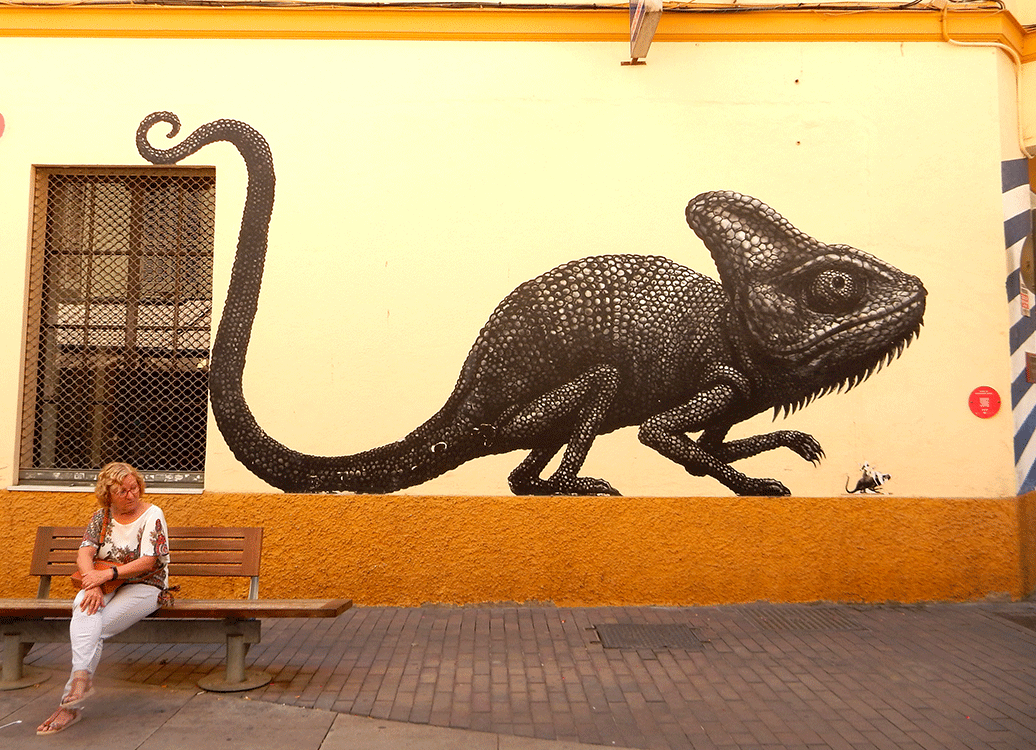
So here’s the second installment of following the trail street artists have marked in Malaga….


Gayle Brennan Spencer – sending random thoughts to and from South Austin
So here’s the second installment of following the trail street artists have marked in Malaga….

El Pimpi Bodega Bar
El Pimpi Bodega Bar is an institution in Malaga. Although it was not founded until 1971, the buildings and décor are much older. Enormous wooden wine kegs line the hallway of the entrance.
Historically, los pimpis were the young men who would head to the docks to help unload cruise ships and then freelance their services as informal tour guides for the newly arrived tourists. El Pimpi has numerous dining rooms and a bright patio, but unfortunately it feels as though pimpis just led an entire boatload of tourists there. Definitely worth visiting though. Somehow we found a slow time, like early on a Monday evening, to belly up to the bar for a glass of wine and a tapa-sized order of croquetas. Both were perfect.
But on to seafood. And where to find the freshest? Head to a market. El Mercado Atarazanas is reputed to have the best. Tourists and locals in equal numbers compete for high tops with stools outside the market. The first time we landed at was a relative newcomer, Happy Fish, the name of which worried us. Too close to “happy meals.” But, fortunately, that was not the case. We felt reassured by the fact we were brought a bottle of wine that coincidentally bore the name of our favorite restaurant almost anywhere – La Biznaga in Oaxaca. On two other occasions we snagged space at the longer established Bar Mercado Atarazanas.
Both delivered great fresh seafood. We dove into platters of boquerones fritos (fried fresh white anchovies), chiles padron, fried eggplant, tortillitas de camarones (shrimp fritters). By our third trip to Mercado Atarazanas and after almost two months of opportunities, we finally got up the courage to take the plunge. We ordered an Andalucian delicacy we had been avoiding – ortiguillas de mar frito.
In the sea, these anemones use their long swaying tenacles to sting and entrap fish. Green algae filters through their somewhat translucent bodies. Restaurants serve them battered and fried. Hey, anything is good fried, right? Ortiguillas come close to a fried oyster in texture, but an oyster with a belly-full of blackish green algae. That makes them sound horrible, which they weren’t. Just a tad challenging for us. We did make it through about two-thirds of the way through our media racion (no tapa-size available). Box checked. More boquerones, please.
The market seafood stalls are packed, but locals have an escape spot away from the maddening crowd – La Peregrina. Not always easy to snag a table, but there is more elbow room. The place is somewhat sterile compared to the bustling market, but loved that women seemed to rule the open kitchen. All the same dishes can be found here. The grilled pulpo was perfect, but the pincho (skewer) of red tuna blew us away. You cannot tell from the photo, but it was seared on the outside and rare in the center – wonderful.


By all inside appearances, La Taberna de Cervantes appeared a perfect place to delve into traditional dishes, and our food was fine. But our waiter totally ruined it for us. Menus in the Andalucia region often feature three sizes of servings – tapas (light appetizers), media racion and full racion (full size). Our waiter, acting like a greedy pimpi trying to take advantage of tourists just off the boat, kept trying to upsize us, saying we needed raciones of everything. Oh, and better wine. And the “background music” was a commercial radio station playing tired cheesy tunes. Not a good experience, but, who knows, the “parent” restaurant does get good reviews….
El Gastronauta really should not be lumped together with these more traditional places, but, in order to restrict Malaga to two food posts, I needed a volunteer. Reservations are recommended in this small, narrow casual restaurant popular with a young crowd of locals. Vegetable sides are a bit more creative than many places, and on weekends the kitchen turns out a variety of quite respectable paellas.
More food later….

“Woman with Pistol,” Julio Ramiro de Torres, 1923
The alluring, perplexing and dangerous attraction of women was in the spotlight this past summer in two exhibitions at the Museo Carmen Thyssen Malaga: “Perversity: Femmes Fatales in Modern Art, 1880-1950” and “Modern and Seductive: Women in the ABC Collection” (1900-1936).
The notes for both exhibitions are thoughtful, so will rely on them. On “Perversity:”
From the eternal feminine to the new woman, this exhibition surveys more than half a century of images featuring women in a period… when their representation in art underwent a paradigm shift as a reflection of the social situation of the time. The exclusively male and misogynist viewpoint came up against women’s questioning of their own identity.
Women went from being passive, sexualized subjects to champions of emancipation and freedom. The perverse fin-de-siècle femmes fatales, icons of a destructive sexuality, gave way to modern women whose perversity lay in their opposition to the established order and their demands of their own, which rocked the foundations of a historically patriarchal society in the throes of transforming revolution.
And on “Modern and Seductive,” illustrators:
…depicted women who were elegant and sophisticated but had vampire wings, and showed them in what were traditionally considered masculine settings. Being modern meant achieving freedom in a world dominated by men, but also using a dangerous beauty to subvert the established canons….
The magazine Blanco y Negro was a pioneer in introducing modern femininity in full color. Founded in 1891 by Torcuato Luca de Tena, it became a lifestyle manual that nobody… could afford to miss if they wanted to keep abreast of the latest trends….
Artists and illustrators did not hesitate to shun the “eternal feminine” and seek inspiration from the femme fatale – a beguiling temptress who ensnares with her charms and subjugates with her gaze….
They all drew the dreams and desires of women determined to break the moulds of their time.
The images below were snapped of works of art from the museum’s permanent collection, as well as these two temporary exhibitions.


There were probably some snide snickers when these exhibitions opened at the Museo Carmen Thyssen Malaga.
Few articles ever written about Maria del Carmen Rosario Soledad Cervera y Fernandez de la Guerra, Dowager Baroness Thyssen-Bornemisza de Kaszon et Imperfalva, fail to mention Carmen Cervera’s 1961 title of “Miss Spain” before referring to her as the fifth and final wife of the late Baron Hans Heinrich Thyssen-Bornemisza (1921-2002), her third husband. And there, I just did it as well.
(As a further gossipy aside, Tita was also the fifth wife of her first husband, who was perhaps better known in the United States. After Lex Barker succeeded Johnny Weissmuller as Tarzan, a New York Times film critic described him as “a younger more streamlined apeman with a personable grin and a torso guaranteed to make any lion cringe.” But his films were panned as “stale peanuts at the same old jungle stand.” He was 54 when he left Tita a widow in 1973.)
And, while the Baron’s children might regard Tita Cervera as a femme fatale, the dowager baroness has moved well beyond her beauty pageant title in her importance in the world of art. Particularly in what she has meant for Spain.
Between art he inherited and that he added, Baron Heini possessed one of the greatest personal art collections in the world. He had so many paintings, he had no place to hang them all. This despite owning numerous expansive abodes in several countries.
The baron personally was courted by President Mitterand of France, the Getty Foundation in California and Prince Charles and Prime Minister Thatcher of England, all touting their respective countries as the best for his collection. Baroness Tita had his ear though. She lobbied for her homeland and won, despite efforts by the Swiss government to prevent the relocation from their palace in Lugano.
Spain donated the Villahermosa Palace near the Prado to house it and paid the Baron somewhere in the neighborhood of $350 million to permanently purchase 775 pieces of his collection for what is called the Museo Nacional Thyssen-Bornemisza. The museum opened in 1994.
Prior to his death, Baron Heini helped his wife successfully break a trust fund so she would inherit a significant share of his wealth. This allowed Baroness Tita to continue her passion as a collector of significant art. While some of her growing collection is on loan to the Madrid museum, she yearned for a home bearing more of her stamp. And Malaga was agressively striving to further cement its position as an important center for art in Europe.
Malaga restored and adapted a 16th-century residential palace, Palacio de Villalon, to house some of the Dowager Baroness Tita’s collection. The Museo Carmen Thyssen opened in 2011.
 Postcards from Barton Springs