Postcard from Malaga, Spain: Femmes fatales dominate the walls

“Woman with Pistol,” Julio Ramiro de Torres, 1923

The alluring, perplexing and dangerous attraction of women was in the spotlight this past summer in two exhibitions at the Museo Carmen Thyssen Malaga: “Perversity: Femmes Fatales in Modern Art, 1880-1950” and “Modern and Seductive: Women in the ABC Collection” (1900-1936).

The notes for both exhibitions are thoughtful, so will rely on them. On “Perversity:”

From the eternal feminine to the new woman, this exhibition surveys more than half a century of images featuring women in a period… when their representation in art underwent a paradigm shift as a reflection of the social situation of the time. The exclusively male and misogynist viewpoint came up against women’s questioning of their own identity.

Women went from being passive, sexualized subjects to champions of emancipation and freedom. The perverse fin-de-siècle femmes fatales, icons of a destructive sexuality, gave way to modern women whose perversity lay in their opposition to the established order and their demands of their own, which rocked the foundations of a historically patriarchal society in the throes of transforming revolution.

And on “Modern and Seductive,” illustrators:

…depicted women who were elegant and sophisticated but had vampire wings, and showed them in what were traditionally considered masculine settings. Being modern meant achieving freedom in a world dominated by men, but also using a dangerous beauty to subvert the established canons….

The magazine Blanco y Negro was a pioneer in introducing modern femininity in full color. Founded in 1891 by Torcuato Luca de Tena, it became a lifestyle manual that nobody… could afford to miss if they wanted to keep abreast of the latest trends….

Artists and illustrators did not hesitate to shun the “eternal feminine” and seek inspiration from the femme fatale – a beguiling temptress who ensnares with her charms and subjugates with her gaze….

They all drew the dreams and desires of women determined to break the moulds of their time.

The images below were snapped of works of art from the museum’s permanent collection, as well as these two temporary exhibitions.

There were probably some snide snickers when these exhibitions opened at the Museo Carmen Thyssen Malaga.

Few articles ever written about Maria del Carmen Rosario Soledad Cervera y Fernandez de la Guerra, Dowager Baroness Thyssen-Bornemisza de Kaszon et Imperfalva, fail to mention Carmen Cervera’s 1961 title of “Miss Spain” before referring to her as the fifth and final wife of the late Baron Hans Heinrich Thyssen-Bornemisza (1921-2002), her third husband. And there, I just did it as well.

(As a further gossipy aside, Tita was also the fifth wife of her first husband, who was perhaps better known in the United States. After Lex Barker succeeded Johnny Weissmuller as Tarzan, a New York Times film critic described him as “a younger more streamlined apeman with a personable grin and a torso guaranteed to make any lion cringe.” But his films were panned as “stale peanuts at the same old jungle stand.” He was 54 when he left Tita a widow in 1973.)

And, while the Baron’s children might regard Tita Cervera as a femme fatale, the dowager baroness has moved well beyond her beauty pageant title in her importance in the world of art. Particularly in what she has meant for Spain.

Between art he inherited and that he added, Baron Heini possessed one of the greatest personal art collections in the world. He had so many paintings, he had no place to hang them all. This despite owning numerous expansive abodes in several countries.

The baron personally was courted by President Mitterand of France, the Getty Foundation in California and Prince Charles and Prime Minister Thatcher of England, all touting their respective countries as the best for his collection. Baroness Tita had his ear though. She lobbied for her homeland and won, despite efforts by the Swiss government to prevent the relocation from their palace in Lugano.

Spain donated the Villahermosa Palace near the Prado to house it and paid the Baron somewhere in the neighborhood of $350 million to permanently purchase 775 pieces of his collection for what is called the Museo Nacional Thyssen-Bornemisza. The museum opened in 1994.

Prior to his death, Baron Heini helped his wife successfully break a trust fund so she would inherit a significant share of his wealth. This allowed Baroness Tita to continue her passion as a collector of significant art. While some of her growing collection is on loan to the Madrid museum, she yearned for a home bearing more of her stamp. And Malaga was agressively striving to further cement its position as an important center for art in Europe.

Malaga restored and adapted a 16th-century residential palace, Palacio de Villalon, to house some of the Dowager Baroness Tita’s collection. The Museo Carmen Thyssen opened in 2011.

Postcard from Malaga, Spain: Street Art, Part I

Pulpo and wine. Not an uncommon combination for us while in Malaga, but fortunately we had an apartment for recovery. And octopi never invaded dreams, as far as I know.

The historic center of Malaga is pretty pristine, with polished marble pavers on pedestrian streets gleaming as though in a palace.

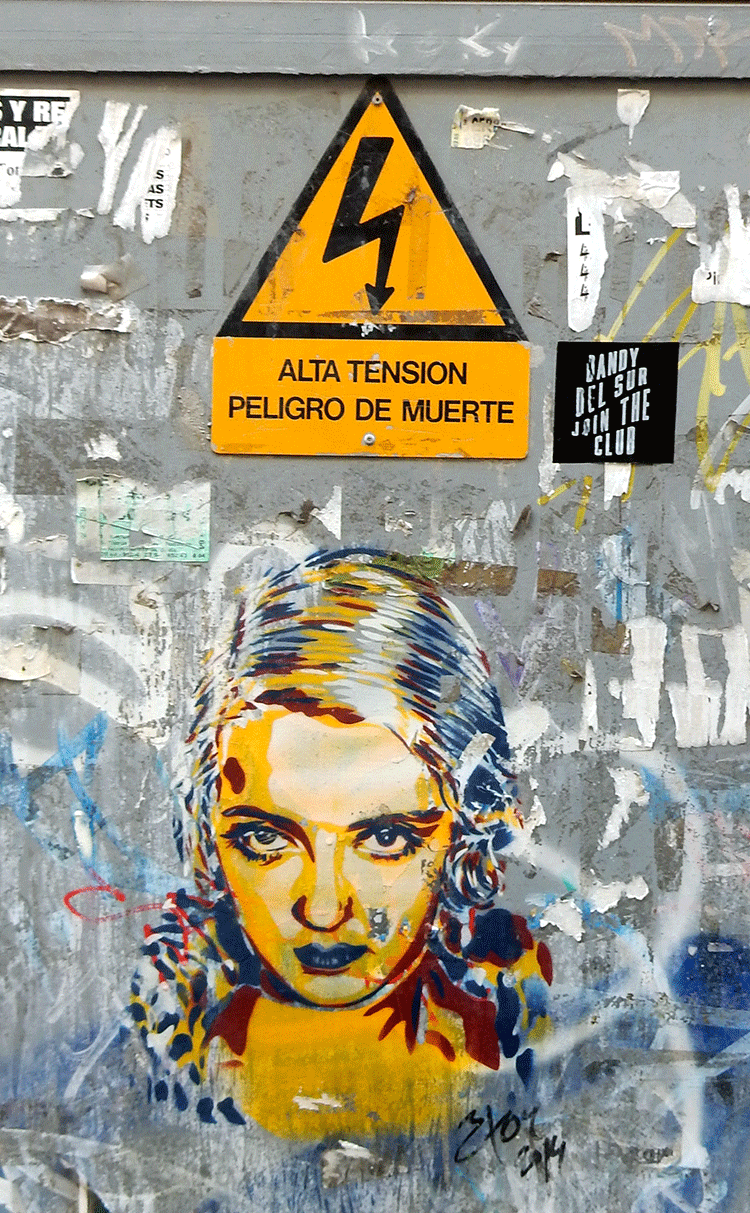
A few steps outside, and artists displaying varying degree of talents begin to commandeer attention in several neighborhoods. Some work is obviously invitational or approved; others unauthorized. Some artists cannot resist reminders that this is the birthplace of Picasso.


This post represents one of a series of shots snapped during wanderings. For visitors, street art always seems a way to gain a deeper understanding of people inhabiting a city.

More to come later.

Postcard from Malaga, Spain: All the saints and those Limbo babies, too

Gothic altar in the Chapel of Santa Barbara in the Cathedral of Nuestra Senora de le Encarnacion in Malaga

Layers upon layers of of saints climb the numerous gilded altars found in the Malaga Cathedral. Saints carved in wood by Pedro de Mena (1628-1688) grace the choir stalls. Today is all of their days. November 1. All Saints Day, and, for Catholics, a Holy Day of Obligation.

When I was young, the thrill of a night of trick-or-treating with its late night sugar high always was followed the next day by attendance at Mass. Unlike many holidays, it was particularly hard to comprehend why almost none of my friends had to go to church on November 1.

My godmother, Aunt Gen (Genevieve Louise Brennan Savage, 1907-2004), tried her best to explain things, but the nuns really never talked to us much about saints. Like Santa Barbara, whose own father carried out her martyrdom for her belief in the Holy Trinity. Although he was struck by lightening and consumed by fire on his way home after the act.

But the major impact for me was November 2, All Souls’ Day. You might not know this, but there are all of these bazillions of poor souls stuck in Purgatory – not so evil that they were condemned to hell but instead hanging around in an uncomfortable state trying to slip through the gates to heaven. Our prayers were supposed to free some of them and send them soaring above the clouds.

Even more concerning for me was Limbo. Limbo was where the little babies throughout the world who died unbaptized were supposed to go. Through no fault of their own, they were sentenced to remain suspended, constantly fluttering their wings in some mysterious twilight zone.

Those little poor souls were the ones for whom I would join my hands, palms sweating in those uncomfortable white gloves, squeeze my eyes tightly together and plead. God took a while to process my prayers from almost 60 years ago. In 2007, the Catholic Church finally liberated them all, burying the whole Limbo concept.

Sorry for the detour. Back to Malaga and its Cathedral. After all it’s a Holy Day of Obligation.

The foundation for the Cathedral of Nuestra Senora de le Encarnacion was laid in 1530 atop the Almohad Mosque. Taking more than a century to complete, the church is viewed as a chronicle of the transition of religious Gothic architecture into the Renaissance. The facades reflect extensive Baroque updating.

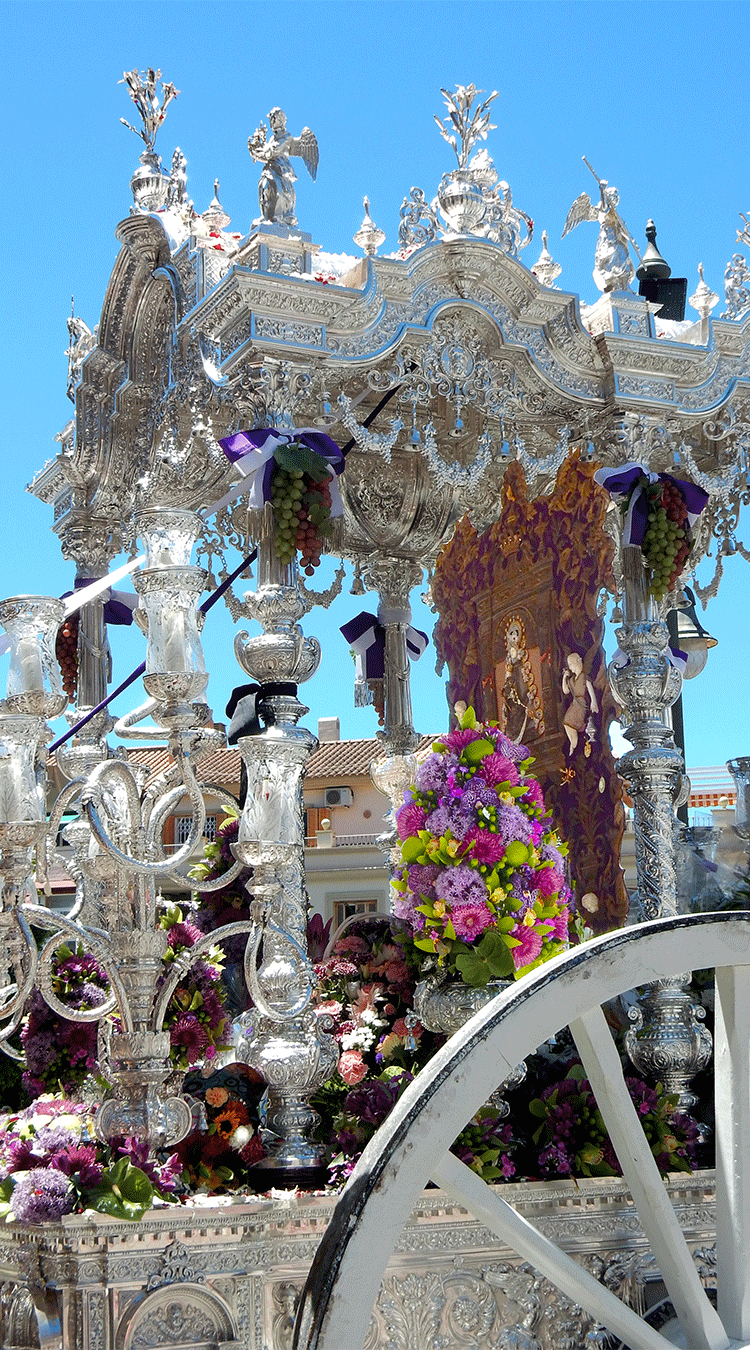
In addition to photos taken in the Cathedral, this post includes images from the Parroquia de los Santos Martires Ciriaco y Paula. The two were executed, with great difficulty requiring several attempts, for their Christian beliefs at the dawn of the 4th century. While their executioners set their remains ablaze, an unexpected torrential rain quenched the flames and faithful carted them off for more respectful last rites. It is believed the two somehow resurfaced to miraculously help expel the Moors about a millennium later, so they were proclaimed the patron saints of Malaga.

My prayers have lapsed, but I trust there are a multitude of people inclined to remember as many saints as possible today. Tomorrow, please pray doubly hard, just in case any little babies somehow remained stuck in Limbo.