@OedipusGothplex 2bornt2b? Can one tweet beyond the mental coil?
Tweet based on William Shakespeare’s Hamlet as translated in Twitterature
All that time wasted in high school. Struggling through the purgatory of Milton’s Paradise Lost. And those Shakespeare plays, one after another. All those sexual innuendos eighth graders would love if they were not penned in an obscure archaic tongue.
Top those off with Melville’s Moby Dick. Actually, I was pretty impressed with Melville. In fact, he was such a good writer, he even managed to make whale hunting fascinating. But, he did go on and on. And on and on. Completion would have interfered with my telephone time, of utmost importance at that stage in life. Midway through I was desperate. I finally invoked the every-fifth-chapter approach. Amazingly, employing this arbitrary and brutal form of editing allowed me to follow the plot enough to regurgitate meaty, quasi-intelligent answers to Mrs. Masterson’s dreadfully detail-demanding discussion questions.
Why, oh why, wasn’t Twitterature available then? So concise, condensed to a point no slicing-and-dicing editor at Readers’s Digest could have imagined. Written in language high school students can comprehend.
@AliceInTheSkyWithDiamonds This land is terrorized by the Queen of Hearts. She’s a card. Wouldn’t it be funny if I just destroyed her army by shuffling them?
Tweet based on Lewis Carroll’s Alice’s Adventures in Wonderland as translated in Twitterature
For the old-fashioned, tweets come across as texts on your cellphones. Each tweet an author chirps – including the identifying “from” name as in @OediupusGothplex – cannot contain more than 140 characters. And that’s counting punctuation and spaces. This extreme brevity means they can be scrolled through rapidly, unlike the unabridged Moby Dick.
@EarlyBloomer69 All his intello friends are coming over all the time. Borrrrrring. All they do is talk about books.
Tweet based on D.H. Lawrence’s Lady Chatterley’s Lover as translated in Twitterature
Imagine, each assigned tome compressed into a mere 20 tweets or less. The book’s editor at Viking/Penguin, Will Hammond wrote:
Say the word Twitter to a book lover and they will probably roll their eyes at you and sigh. Some of the greatest works of literature… are long, sometimes difficult and often challenging. Twitter is the opposite: a free-for-all of voices clamouring for a split-second’s attention with zero quality control. This is what makes Twitterature so funny: huge books made ridiculously small; great stories told in silly voices. Like all good pastiche, Twitterature skewers the original work with pin-point accuracy – mocking its grandiosity, exposing absurd coincidences of plotting, parodying its subject’s ticks, slips and oddities.
Twitterature is not new. It was written by two University of Chicago students, @AcimanandRensin, or Alexander Aciman and Emmett Rensin, in 2009. The book was written so long ago even @AcimanandRensin no longer tweets about it.
But I’m a little slow in discovering it, probably because I didn’t start tweeting for clients until three years ago. A fellow blogger tweeted about the book from London only this morning. And, now, able to comprehend tweet-speak at this late point in my career, I am appreciative of the humor. Coupled with Will Cuppy’s versions of history found in The Decline and Fall of Practically Everybody to which Bluebird led me, my academic path and my grade-point average would have been impacted radically.
@TheRealDesperateHousewife My life is awful. I’m going shopping. I want to buy a whole bunch on credit that I can’t afford, and then declare bankruptcy.
Tweet based on Gustave Flaubert’s Madame Bovary as translated in Twitterature
Can’t believe I waded through the whole thing in French. A Twitteral translation would have made it so easy.
You might wonder, if I’m so social-media proficient now, why am I blogging about Twitterature instead of tweeting? Restricting my fingers to 140 characters is work. Blogging allows me the recreational therapy of being loose-finger-tipped. The above paragraphs would add up to way more tweets than Twitterature‘s entire version of Moby Dick.
The authors of Twitterature were considerate enough of those unaccustomed to the tweet language to generally write in complete words and sentences with few of the widely accepted Twitter shortcuts, and they actually grasp the literature they harpoon. According to Hammond:
…what makes this little collection particularly enjoyable, is that the joke falls just as heavily (well, probably more so) on Twitter. In a face-off between Shakespeare’s Macbeth and his Twitter avatar ‘BigMac’, it’s fairly clear who comes off looking worse. So, in a curious way, Twitterature is just as much a celebration of the classics as it is a mockery of them.
Do you think @AcimanandRensin composed the entire volume of Twitterature on their cellphones?
The preliminary schedule is so packed I assembled links to resolve (or attempt to resolve) conflicting pulls among the readings in advance. Definitely check the official website for updates before heading downtown:
All Day
Book Sales
Coloring Station, Painting Bookmarks; H-E-B Children’s Area
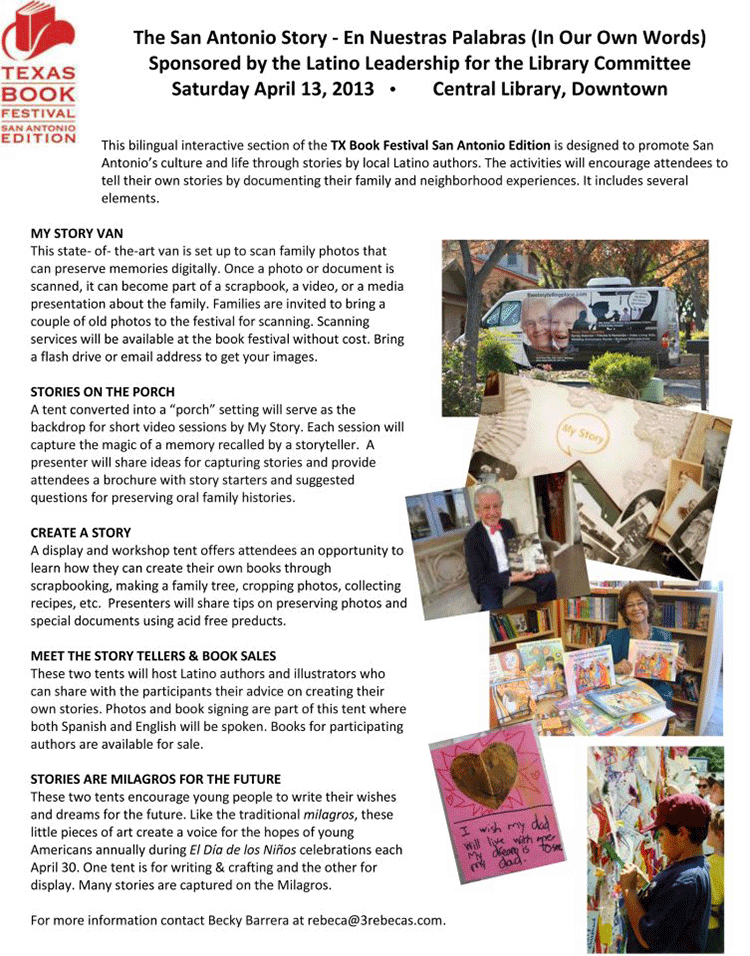
Latino Leadership for the Library En Nuestras Palabras: My Story Van, Stories on the Porch, Create A Story, Meet the Story Tellers, Stories are Milagros for the Future; Central Library Plaza Walk
You Can’t Go Home Again: Fiction about Family Secrets with Nan Cuba and Andrew Porter; Moderator, David Martin Davies; Southwest School of Art, Ursuline Campus
The Dallas Cowboys: The Outrageous History of the Biggest, Loudest, Most Hated, Best Loved Football Team in America with Joe Nick Patoski; Moderator, Joe Holley; Southwest School of Art, Navarro Campus
A Sense of Birthplace: Investigating the Past: Beatriz de la Garza and Sarah Cortez; Moderator, Yvette Benavides; Southwest School of Art, Navarro Campus
The Children of the Revolución with Lionel Sosa, panelists Dr. Maria Ferrier, Dr. Nef Garcia and Jesus Ramirez; Moderator, Gilberto M. Hinojosa; Central Library
Diane Gonzales Bertrand (Sofía and the Purple Dress/Sofía y el vestido morado); Children’s Area, Central Library
Finding Friday; Music in Frost Garden, Southwest School of Art
2:45 p.m.
At War Over the Environment: Two Experts on the Politics of Parks and the Natural World with George Bristol and Char Miller; Moderator, Weir Labatt; Southwest School of Art, Navarro Campus
3 p.m.
Esmeralda Santiago on Conquistadora; Moderator, José Rubén De León, Central Library
For readers of Young Adult fiction: Summer of the Mariposaswith Guadalupe Garcia McCall; Moderator, Yvette Benavides; Southwest School of Art, Navarro Campus
Thinking caps and creativity crowns; H-E-B Children’s Area
3:15 p.m.
H.W. Brands on his new biography of Ulysses S. Grant; Moderator, Gregory Curtis; Central Library
Xavier Garza (Maximilian and the Mystery of the Guardian Angel); Children’s Area, Central Library
The Rise of Reagan (and the Aftermath of His Administration) with Robert Flynn and Gilbert Garcia; Moderator, Rick Casey; Southwest School of Art, Navarro Campus
Storytelling with Javier Garza; H-E-B Children’s Area
An incredible agenda for a first-time event (May there be many more).
Of course you will need breaks, so there will be children’s activities and music throughout the day.
And nourishing your mind makes you hungry, so some of San Antonio’s favorite food trucks will be parked nearby for refueling.
Hmm, this is San Antonio. Wonder where the beer stand is….
Note to Austinites: Your turn to hit I-35.
Note to Self: Never get so excited about something you decide to post the whole schedule – with custom links – again.
And thanks to the Mister Barista for that caffe corretto blast.
April 12, 2013, Update:
Just received the schedule for the Latino Leadership for the Library area just outside the Central Library, and it adds another slew of author appearances.
There we were, sitting beside each other. Phil and I.
I’m talking about Phil Collins. But I just call him Phil now. Because I sat beside him for about one minute.
As you can tell this is leading to one of celebrities’ worst curses: people who don’t know them writing about them.
But, of course, this is different. Because I know him. Because I sat beside him for about one minute. And he politely introduced himself to me and shook my hand.
That, and we have several things in common.
Davy Crockett, for one.
When Phil Collins was a kid growing up in a London suburb, he would often watch an amazing show on his family television. There, in black and white, was Fess Parker as Davy Crockett, King of the Wild Frontier. As he matured, Collins not only acted out the exploits of his new hero, but he often refought the Battle of the Alamo with his toy soldiers.
While I’ve never sure been it’s psychologically healthy to adopt Texans’ fascination with the battle they lost, playing Alamo seems a better alternative than the Davy** Crockett chapter that influenced me as a child in Virginia Beach.
I sat alone in my room, playing the record. Over and over and over.
It wasn’t this one, or, if it was, it was part of a much longer recording. I can’t find the version in my mind online.
Perhaps what I remember didn’t exist except as a compilation in my jumbled file cabinet of a mind. But it was Davy Crockett. Or Fess Parker. And it was a life and death struggle with bears and Indians… and the part that haunted me.
I have no idea how many times I listened to that recording, but definitely many times too many.
Even I knew my mother was exasperated.
I would wet my bed. We’re not talking about a three-year old. I was six.
But I had my reasons.
I ran screaming to my parents one night about the bears in the house – my visiting Great Aunt Mary snoring.
There were Indians in my closet. I finally learned keeping the light on in the closet kept them at bay.
But the light filtering through the louvered door did not help with the Crockett family’s other adversaries.
The women then slacked the rope a little and made it fast round a hickory stump, when my oldest darter took the tongs and jumped on [the alligator’s] back, when she beat up the “devil’s tattoo” on it, and gave his hide a real “rub a dub.”…My wife threw a bucket of scalding suds down his throat, which made him thrash round as though he was sent for. She then cut his throat with a big butcher knife. He measured thirty seven feet in length. (Davy Crockett’s almanack,*** of wild sports in the West, life in the backwoods, & sketches of Texas. 1837, p. 10).
My self-preservation instinct was strong. Who in their right mind would risk getting out of bed with alligators on the prowl? Alligators hungry for a “tongariferous” fight. Bladder be damned if I would.
Not only would I not set foot on the floor when alone in my room at night, I would not let a pinky slip over the edge because…. Snap! Those alligators were fast.
And I had a family to protect – a toucan whose name now escapes me; George the green monkey whose rubbery pink hands and feet were comforting to chew nervously upon when trying to make it through dangers lurking in the night; and Nipper, a huge RCA dog who took up easily half of my single bed. I never once let George’s tail hang over the edge. I would sleep rigidly, never ever tumping one over the edge into the alligator pit.
To dream of an alligator, unless you kill it, is unfavorable to all persons connected with the dream.
The flaw, of course, was no one understood this was why I wet the bed. And, when I finally managed to explain, no one took the danger seriously. Of course, now they have books about this. But that was the late ’50s, and they had not yet been written.
Finally, midway through first grade, a solution was found. A path of folding chairs was set up each night between my bed and the bathroom. Somehow, I was able to summon the courage to imperil myself by crawling across this wobbly bridge to the safety of the bathroom, and, of course, everyone knows alligators would never cross the threshold onto the tile floor.
So, as I was writing, Phil’s interest in perpetually fighting – probably trying to change the outcome – the losing battle at the Alamo seems a preferable Davy chapter in which to be stuck.
And Davy seems to have stuck with both of us, Alamobsessive souls that we are.
I focus on and fret about the Alamo as the city’s front door. I constantly nag, in blog form, the city to enforce its historic ordinance to keep illegal signs from multiplying at night. I have even used some of the historic postcards I have assembled to create protest collages.
Postcards from San Antonio ~ No. 21 ~ “We’ve Lost the Alamo.” 2010 edition of 25. Yes, Numbers 21 and 22 are the ugliest collages ever to reflect the overwhelming commercialization of Alamo Plaza. Even Waldo (Yes, he’s there.) is easier to find than the Alamo. An early 1900s postcard of a parade float, “Save the Alamo,” and “Letter from the Alamo” from a plaque on the grounds are surrounded by some of the plaza’s clutter, including a dinosaur, Stumpy, snow cones, the Odditorium, the t-shirt bearing the unheeded message “Don’t Mess with Texas, San Antonio” and even the Daughters of the Republic of Texas’ own unsightly addition of a pop-up tent pushing their “Live the Drama”‘ guides (Fortunately, this pop-up was removed). http://www.postcardsfromsanantonio.comPostcards from San Antonio ~ No. 22 ~ “They’ve Breached the Walls.” 2010 edition of 25. Mary Bonner’s tasteful woodblock print originally made to help raise funds for the San Antonio Conservation Society is paired with an inscription from the Cenotaph, “In Memory of the Heroes…at the Alamo, March 6, 1836.” The images are overwhelmed by surrounding offers to shop at “Liber-T,” view repulsive world records, obtain henna tattoos or consume ice cream cones and hoagies. Sorry to have left out the coonskin cap. http://www.postcardsfromsanantonio.com
These efforts have had limited effect. And, not surprisingly, these particular collages have not resonated well with art collectors.
Now, legislation has been filed to form a commission to study the state of Alamo Plaza. Good news to some, but the bill would go farther than my Alamobsession wants by giving the commission the mission to “reclaim its original footprint.” I might not love Ripley’s, but I love the Alfred Giles’ Crockett Block.
Plus, if returning Alamo Plaza to its appearance at the time of the battle is taken literally, the Alamo would get a crewcut (Click here for a long-winded post about that particular issue).
“San Antonio: A Descriptive View Book in Colors,” 1913
I don’t know how Phil feels about this. Because how much ground can you cover in one minute?
But I do know, while I was collecting postcards of chili queens on Alamo Plaza, Phil was collecting everything else Alamo. When Phil does something, he doesn’t fool around. He gets serious. He even collected a building off the plaza. This is from his myspace page:
From Bill Wyman’s metal detecting to Alex James’s cheese-making, every self-respecting musician is obliged to cultivate a hobby to relieve the stresses of the rock star life. Collins is no exception, utilizing the basement of his Swiss home for his twin enthusiasms: building model railways and tending to his vast collection of Alamo memorabilia.
“… it’s an all-consuming thing for me. I spend as much time in San Antonio as I can. I rent a little property out there on the walls of The Alamo itself where I’ll dig for artifacts. I’m always looking for stuff to buy and the collection is growing fast. I’ve got a huge number of cannonballs, muskets and bowie knives that were used there, Lady Crockett’s pouch and many documents that were written by the main protagonists. One of my prized possessions is a receipt signed by Commander William B. Travis for 32 head of cattle used to feed the Alamo defenders.
“My kids are convinced that I was present at The Alamo in a previous life. Just recently I attended a convention out there and met a clairvoyant who is married to a man who’s attempting to restore the Alamo compound. She walked up to me and said, ‘’You’ve been here before. In a previous life you were John W. Smith, one of the major couriers who survived the Alamo and become one of San Antonio’s first mayors.’ Oddly enough one of the first documents I bought for my collection was the receipt for Smith’s saddle. So maybe my kids are on to something.”
Phil collected so many Alamo things that photos and information about them now fill a 400-page book, which brings us to another thing we have in common.
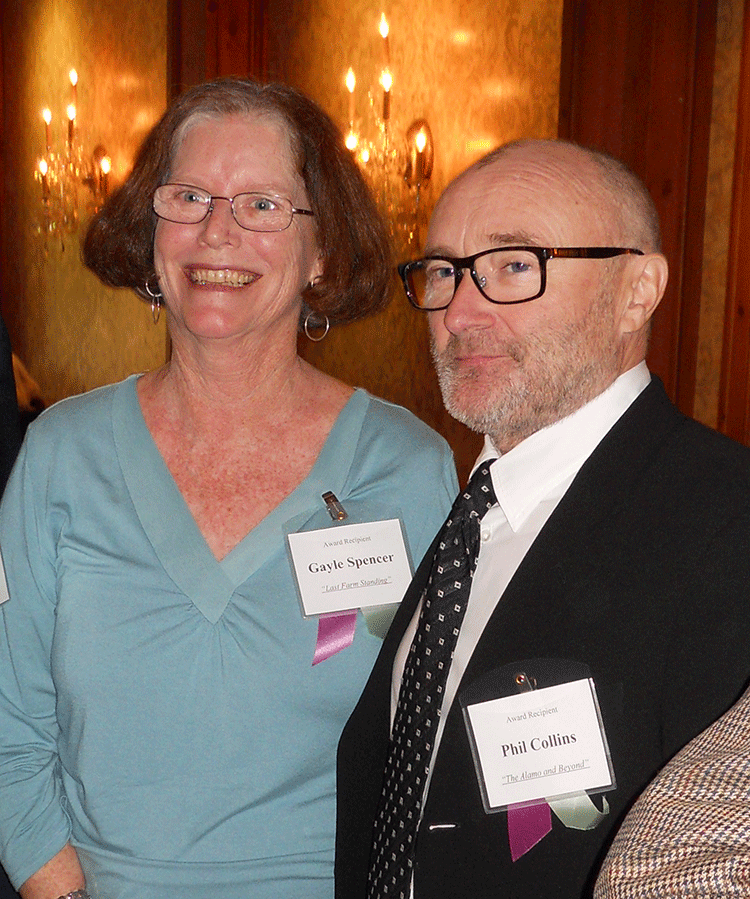
Because I sat beside him for about one minute. And, as you can see, we obviously engaged in animated conversation. Probably because we have so much in common. And I didn’t even get a chance to tell him I’m married to a bluesman.
Somehow, KSAT-TV failed to catch this important connection on camera, which is good because I would not have wanted to end up in the pages of some publication, such as The Star, where they zoom in on the superficial shortcomings of someone my age – the preponderance of wrinkles, protruding bellies and falling bustlines.
Another thing Phil and I share is we have changed careers. I have changed career directions several times and feel free to sprint off in any direction I choose. If I choose to write books, that’s fine. No one objects; no one cares.
But, poor Phil. He’s worked hard his whole life – “I enjoyed Genesis when I was 19” – and wants to pursue his hobbies now:
Reporters repetitively bombard him with “why?” Some fans of the Grammy-winning star express anger at him for retiring from concerts. This, even though, according to his myspace page:
His less prolific work rate is partly down to health reasons. Since 2000 he has suffered from loss of hearing in his right ear. More recently he was diagnosed with severe nerve damage to his hands, making drumming extremely challenging. During recording sessions for his new album, he was forced to tape his sticks to his hands.
Owsers. That sounds totally painful. Give this man a well-deserved break.
Keen to accentuate the positive, he explains that his medical concerns have forced him to take stock of his life. “I never used to think of myself as a workaholic,” he says. “I used to work non-stop because I couldn’t believe my luck that I was able to do all these things that I loved. I was everywhere and I can see why that must have been annoying to some people. Then I reached a point where I no longer felt the need to go zooming around the world and attend the opening of every envelope. Basically I stopped.
“I’ve got a nine-year-old and a five-year-old. I take them to football. I like to take them to school and pick them up. That’s my life now. I love doing the things that other people probably find tedious because they’ve been doing them for so long. I never did those things in the past as I was always working flat out. That was my loss. Now I’m able to do all that and also have time to indulge my passions.”
Besides, somehow I feel this man’s Alamobsession will end up helping shape the future of Alamo Plaza. I’m sure it will accomplish more than my haranguing collages and blog posts.
Oh, and, Phil, if you get tired of staying in hotels when you visit San Antonio, the Mister and I might be able to work out a house swap with you. The Alamo’s less than a mile away from our door. Call me next time you are in town and you’ve got a minute. Who knows what else we might have in common?
*With apologies to William C. Davis, author of Three Roads to the Alamo: The Lives and Fortunes of David Crockett, James Bowie, and William Barret Travis. Hey, at least I didn’t title the post My Life with Phil Collins. Now that would have been a stretch.
** David would be more historically correct, but does not represent the popular culture upon which we – Phil and I – were weaned.
***Oh, dear. I had to stop in the middle of this post to order a copy of Davy Crockett’s Riproarious Shemales and Sentimental Sisters: Women’s Tall Tales from the Crockett Almanacs, 1835-1856, for which I paid a penny, plus $3.99 shipping – quite a bargain unless the alligators return ‘neath my bed. And, as that is an “our” bed, I’m positive the Mister would not relish the thought.
Update on March 25, 2013: John Spong of Texas Monthly spent considerably longer than a minute with Phil Collins.
Phil Collins at age 5, an image (now blog-altered) originally appearing in the San Antonio Express-News
Update on March 27, 2013:
A follower reminded me to look back for this photo of Phil Collins, coonskin-hatted at age five playing Davy, that appeared alongside an article by Steve Bennett in the San Antonio Express-News last May.
Which reminded me of another obvious thing Phil and I have in common – the Battle of San Jacinto. His collection began with a receipt for a saddle purchased by John W. Smith, who was at both the Battle of the Alamo and the Battle of San Jacinto and seems to continue to haunt the collector a bit. My desk currently is haunted by reams of paper pertaining to the families and relatives of John Coker who settled on his land grant on the north side of San Antonio. Jack Coker was a hero of San Jacinto credited with the idea of blowing up Vince’s Bridge, blocking one of the possible escape routes for the Mexican troops.
And, on another note, one of my sisters fessed up that she was the one who told me I’d be safe from dangers lurking in my room if I let no part of me slip over the edge of the mattress. So nice after all these years to finally unload the psychological burden for bedwetting on a sibling.
Update on May 6, 2013: Mary Dearen’s version of the same awards luncheon as published on mywesttexas.com.

@AliceInTheSkyWithDiamonds This land is terrorized by the Queen of Hearts. She’s a card. Wouldn’t it be funny if I just destroyed her army by shuffling them?

 Twitterature is not new. It was written by two University of Chicago students, @AcimanandRensin, or Alexander Aciman and Emmett Rensin, in 2009. The book was written so long ago even @AcimanandRensin no longer tweets about it.








 Postcards from Barton Springs