It seems every time I type a few sentences for the book I’m writing about the Coker community, I come across something that makes me want to dig deeper. Most of the time, the research is like doggedly following a trail of bread crumbs through dense underbrush for hours only to look up and realize a flock of crows just swept down and gobbled up the path ahead.
Sometimes though, as in two days ago, I am rewarded. When I wrote Last Farm Standing on Buttermilk Hill, I was not comfortable in the identity of the man Joseph Coker shot by water hole. Seeking someone named John Jones in a community full of Joneses can be tricky. But at last, I found him, and it was not the one I had assumed.
My point is, that discovery now serves to justify my endless, stubborn wanderings after trivia to round out the story. Cutting off research is the hardest thing about writing nonfiction.
The following update from the Coker Cemetery Association Newsletter, illustrates the stumbling-lost-in-the-woods style of research distracting me daily:
In the 1860 Census, Ella and J.K.P. Campbell were listed between the Robert Smith family and Joseph Coker. A 35-year-old stock raiser from Tennessee with a 21-year-old wife from Vermont made an interesting pairing, particularly on the eve of the Civil War.
James Knox Polk Campbell with daughter Mattie from the family files of Chuck and Honor
With no intermarrying ties in the community, the couple slipped out of my mind until I was working on the Civil War chapter for the book you have commissioned about the Coker Settlement. Unlike many men in the community who enlisted as privates, James Knox Polk Campbell immediately was appointed assistant commissary for the Sixth Regiment of Texas Infantry at Camp Holmes, Arkansas.
So many families stayed for so long on the land around the Coker Settlement, the families moving away always mystify me. Why would anyone abandon a home in this rattlesnake-infested, drought-prone land where one had to constantly watch out for marauding Indians poised to snatch up your children while you were hoeing or bent over laundry?
Digging to find out more about Campbell, I stumbled across an online post dating from the 1990s. Charles _____ had letters, letters referencing Campbell’s “ranching venture” outside of San Antonio and his Civil War imprisonment. All I had to do was find Charles _____.
I prefer looking for dead people; surely they are happy to know someone cares enough to want to know their stories after they have left the earth. Nosing around the internet for the living makes you feel you are prying, spying, trying to identify someone by prowling on LinkedIn, Facebook, Google, white page look-ups.
And then making that phone call, to perhaps the totally wrong stranger, and not sound crazy? I lucked out and got an answering machine. And lucked out even more. I hit the right person in the right state the first time and got a return call.
And from someone sympathetic to such a call emerging from nowhere about some post made more than a decade earlier. Chuck, himself, had stumbled across the letters on the internet years earlier.
Billee W. Hoombeek brought them to the surface. Chuck retained her email from years ago and forwarded it to me. She was an archaeologist working on the Green Mountain National Forest project in Vermont between 1979 and 1988. As part of her project, she concentrated on “interpreting the deserted farmsteads that dotted the woods.” Hmm, a kindred spirit perhaps?
One of her resources in the Brandon, Vermont, library was a collection of materials assembled by a “Mr. Chamberlin” for a novel he had intended to write comparing life in two small towns – Brandon, Vermont, and Brandon, Virginia. Here, Hoombeek encountered the letters from Campbell to his father-in-law, Colonel Frank Farrington, of Vermont. Finding them fascinating, she went out of her way to share them through a Campbell descendant organization and online.
When Chuck found her, she responded: “I would be in seventh heaven if an ancestor of mine had left such a rich treasure. He does indeed have feet of clay, but she (Chuck’s wife Honor, who is the actual descendant) will know him very well when she finishes.”
And Chuck and Honor are again sharing with us….
A blog post by the Special Collections of the UTSA Libraries reminded me how I long to get back to the comfort and flow of writing historic fiction – based on thorough research but woven together by my imagination instead of hundreds of footnotes.
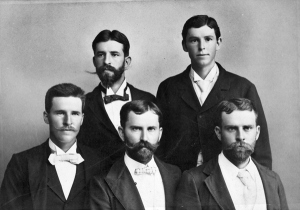
The facial hair photo on the UTSA blog happened to be of some real people featured in a chapter of An Ostrich Plume Hat, the completion of which is now interrupted by the writing of two other books. At any rate the photo is of the Goeth brothers – my favorite two going by the confusing initials, C.A. and A.C.
Edward Wilhelm Goeth, a rancher; Conrad A. Goeth, a lawyer; Adolph Carl Goeth, a merchant; Max A. Goeth, a rancher; and Richard A. Goeth, a doctor, from the UTSA Libraries Special Collections
Read about the Goeths’ involvement with Texas politics – part fact, part invention – here.
When immersed in fiction, I can close my eyes in the tub and hear my characters talking to one another. While writing nonfiction, bath time means my mind is submerged in thoughts of those innumerable trails of crumbs beckoning me to follow in wildly divergent directions.
Several chapters somehow have managed to emerge from my keyboard, so perhaps an end is in sight.
For now, I know I need to just keep awkwardly dog-paddling, trying not to drown in the details. This book is not supposed to be like digging my own grave.
It has a song. A song recorded on August 30, 2013.
Well, okay. The book doesn’t own it.
But the song surely will become the official one of Phil Hardberger Park Conservancy, supportive caretaker of the former farmland on which Max and Minnie Voelcker spared the trees shading walkers and runners in Phil Hardberger Park.
This is what the vocalist, Michele McMurry, wrote about “Last Farm in Town” on August 31:
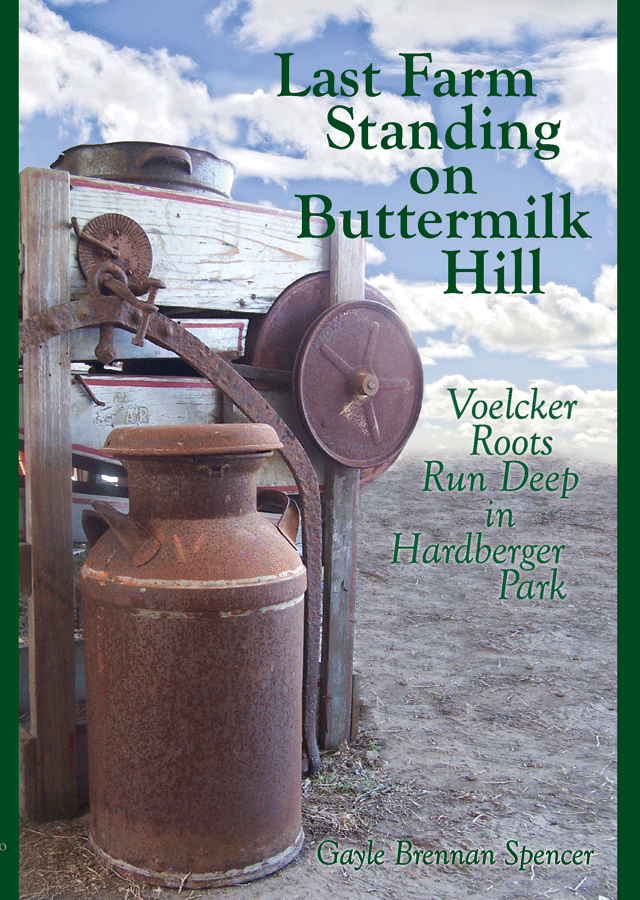
Doug (McMurry) and I recorded this song, which he wrote as a tribute to Phil Hardberger Park and the rich roots of the Voelcker dairy farm. Doug was inspired by a book titled “Last Farm Standing on Buttermilk Hill,” written by friend and colleague, Gayle Brennan Spencer.
As you may know, Doug is very involved with parks as a director of the Phil Hardberger Park Conservancy and former chairman of the City of San Antonio Parks and Recreation Board.
The neat part was Doug playing my dad’s 1964 Martin (D28) guitar.
Enjoy …
“The Last Farm in Town” by Doug and Michele McMurry…
Oh, and the photo in the video is the interior of Max and Minnie’s milking barn.
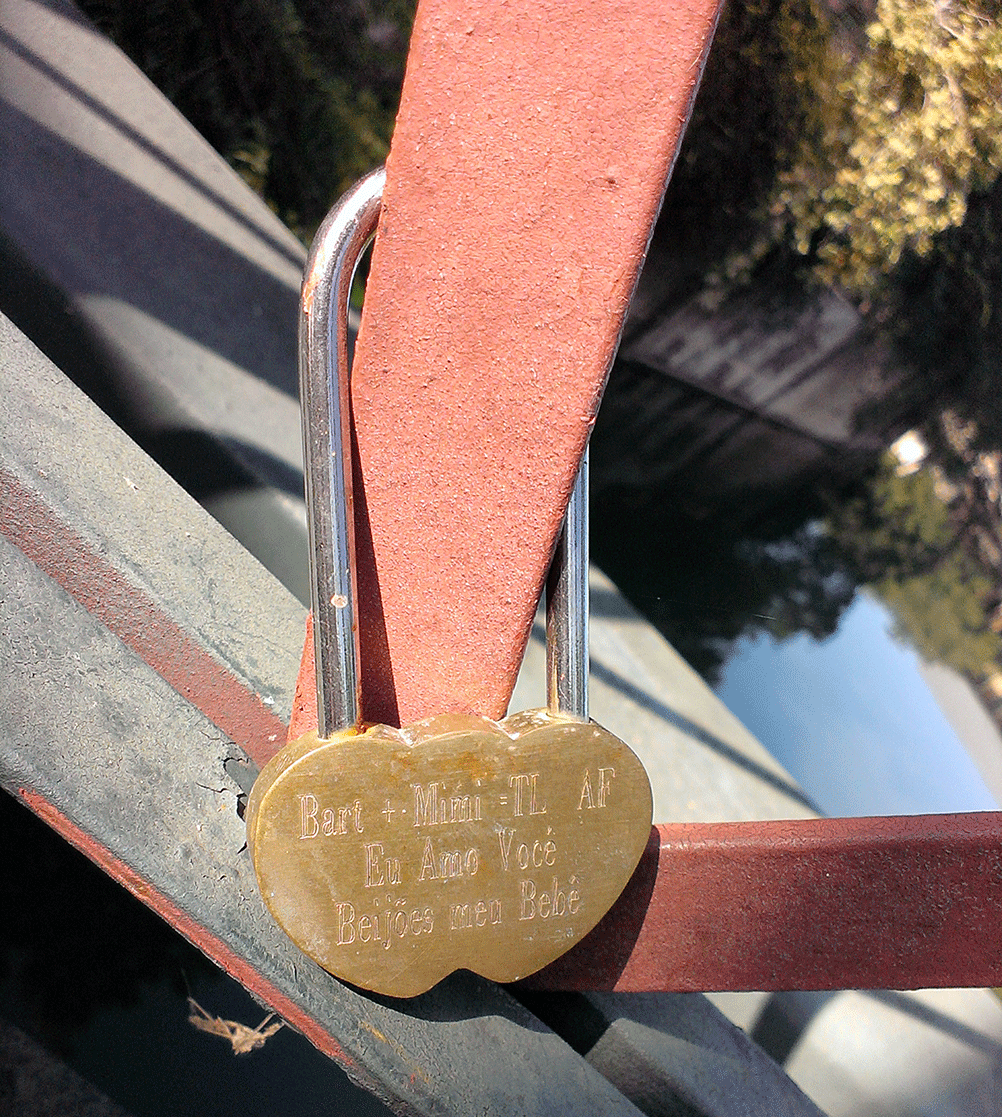
Been watching “Bart + Mimi” for a while on morning walks, waiting to see if their public proclamation of love in Portuguese would multiply as love locks on bridges have around the world.
Multiplication is not desirable. A solitary lock is much more romantic, and cities where historic bridges are targeted struggle to cope with the weight of the demonstrations of love.
At first, I thought writing this blog would take much research into these cases, but fortunately “Mr. and Mrs. Adventure” spared me a lot of googling. They recently posted a blog on padlocked proclamations, including such sites as Via dell’ Amore in the Cinque Terre and the narrow 1828 Pont de l’Archevêché in Paris.
A few years ago according to The Independent, Parisian officials took action, only to be quickly reconquered by determined lovers:
A year after their mysterious disappearance, the “love-locks” of Paris are back on the city’s bridges, more plentiful and vibrant than ever despite lingering suspicions that unromantic officials from City Hall may again swoop with their wire cutters and remove the tokens of couples’ love….
In May 2010, Paris Town Hall expressed concern over the growing number of love-locks, saying: “they raise problems for the preservation of our architectural heritage”. It’s not only the Town Hall that expressed doubts; from time to time a dejected ex-lover has been seen desperately hacking at a padlock with a pair of pliers.
Shortly after this announcement, the bridge was found all but bare following a nocturnal clean-up.
Since the disappearance, lovers have shown their indignation by building-up collections once more….
The narrow pedestrian bridge in the King William Historic District on the south side of downtown Bart and Mimi selected to share their beijoes certainly looks the part. Some call the Johnson Street Bridge the O. Henry Bridge. Built in 1983, it replicates an earlier one removed from this spot during inartistic flood-control work completed in the 1960s. The 1880 bridge had been moved to Johnson Street from its original location on Commerce Street, where it served as an inspirational setting for writer Sidney Porter, or O. Henry.
This slideshow requires JavaScript.
While the moniker O. Henry might sound romantic, his morbid short story of suicidal consumptives set on the former Commerce Street Bridge was not. The following is from his Fog in Santone:
The drug clerk looks sharply at the white face half concealed by the high-turned overcoat collar.
“I would rather not supply you,” he said doubtfully. “I sold you a dozen morphine tablets less than an hour ago.”
The customer smiles wanly. “The fault is in your crooked streets. I didn’t intend to call upon you twice, but I guess I got tangled up. Excuse me.”
The purchaser of the morphia wanders into the fog, and at length, finds himself upon a little iron bridge, one of the score or more in the heart of the city, under which the small tortuous river flows.
But Bart and Mimi’s lock has triumphed over the inherited gloom, assuming its role as one of San Antonio’s quills:
If peculiarities were quills, San Antonio de Bexar would be a rare porcupine. Over all the round of aspects in which a thoughtful mind may view a city, it bristles with striking idiosyncrasies and bizarre contrasts.
Hopefully, their en amo voce will remain a single quill and not inspire a wave of others to turn the little footbridge into an obese bristling porcupine.


 Postcards from Barton Springs