The harem’s full, but I don’t mind.

The Mister with his turquoise tart, photo courtesy of the San Antonio Blues Society, www.sanantonioblues.com
The Mister with his turquoise tart, photo courtesy of the San Antonio Blues Society, http://www.sanantonioblues.com

Wonder what the older girls think when the Mister introduces a new one into the harem, watching as he lovingly caresses the curves of the latest arrival.

Not one of them has been a part of his life for more than 20 years, except for one with such a wimpy, wispy voice he rarely touches her. No electric sparks fly through her veins.

The flaming red-haired Gibson girl always thought she was his favorite, even after he brought in the skinny, slender-hipped, bleached-blonde.

But then came the gaudy one from Austin with a gypsy-sounding name wearing all that turquoise.

The Gibson girl was confident she could triumph over the tackily clad Mother-of-Toilet-Seat one who likes to lazily lay across his lap, but that turquoise tart?

The gypsy thought she won his heart, but his love was fleeting.

The room is so crowded; yet he found a way to squeeze in one more.

This one, like the gypsy, is young. The child of guitar-maker Chuck Thornton belonged to Jay Wright, who broke her in, then struggled to part with her.

Wright loved her so much, he almost made her a cover girl before letting her go. When the Mister snapped her up on eBay, Wright wrote to him gushing about her attributes and telling him how lucky he was to have her.

gasWright also sent the Mister the book he published about living with “G.A.S.,” or “Guitar Acquisition Syndrome,” an addictive affliction affecting many men who obsessively keep adding to their harems.

The book, featuring the Mister’s newest acquisition on the page just before its table of contents, is a manual. A tongue-in-cheek primer not for curing the addiction, but for justifying it. It’s filled with how-to hints for hiding the disease’s symptoms from your significant other. A litany of excuses and ruses, such as this one:

Display your guitars in different rooms. Spread them out – to a bedroom corner for one, beside a TV or piece of furniture in another room, in a closet, or under a bed. A herd never looks as large dispersed as it does clustered together in one room.
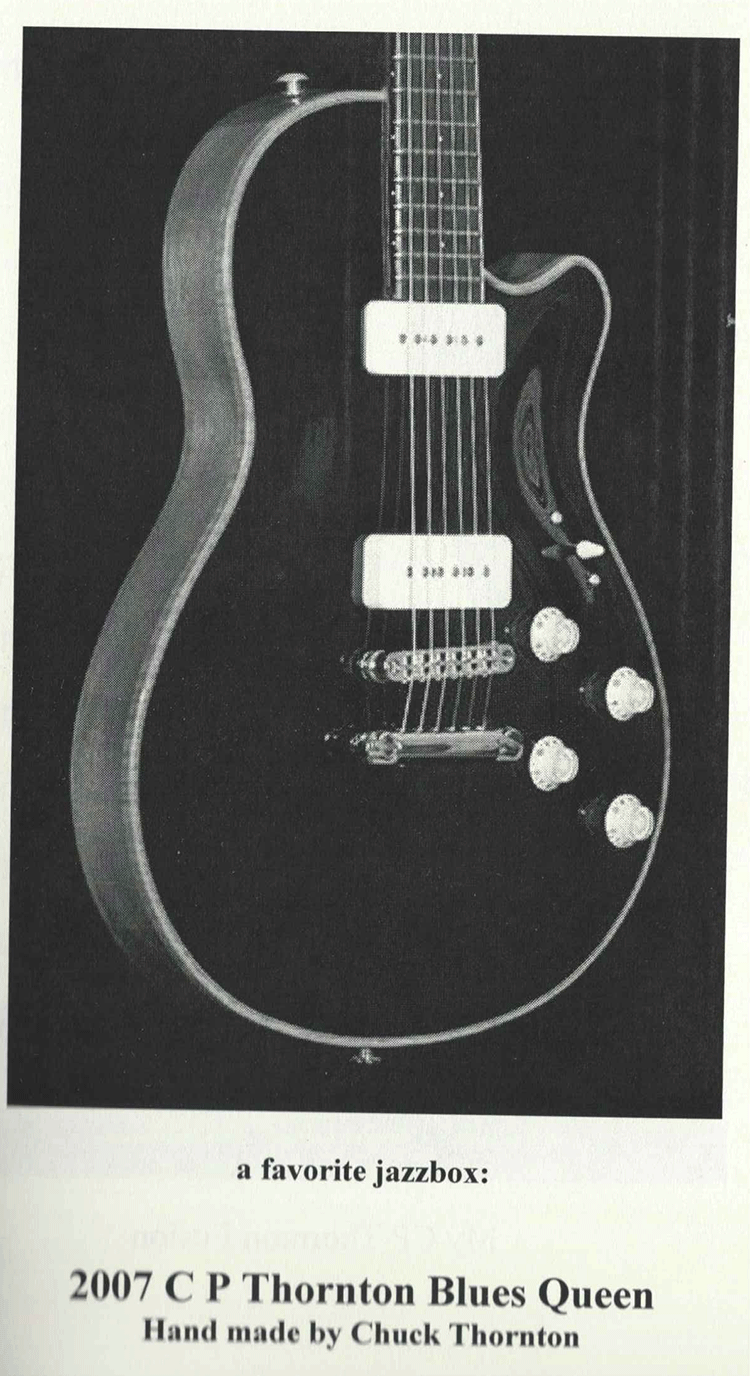
Wright's former mistress now belongs to the Mister
Wright’s former mistress now belongs to the Mister

The Mister needs no excuses. Someone married to a writer needs a major outlet of their own.

So how do I feel when the Mister’s in his lair and I overhear him making one of his girls sing, even scream, loudly?

Hey, I’m upstairs tapping away on my keyboard humming along.

I say keep playing those blues, bearing in my mind what he said before one of those significant birthdays:

Some men get new wives when they turn 40; all I want is an electric guitar.

Okay, that was an understatement. He wanted more than that first redhead.

But no need to hide or thin out the herd.

Surely the space in that music room is maxed out by now….

holy%20cards%202
Holy Cards No. 2, “She said no man of hers was going to sell his soul to the devil: Santa Cecilia at the Crossroads?,” digital collage by Gayle Brennan Spencer, http://www.postcardssanantonio.com/holy-cards.html

And, if I did object?

I think I might hear a loud chorus of “I’m gonna sell the bitch’s car and buy myself a cool guitar.”

And visit the After Midnight Blues Band at www.bluesinsanantonio.net.

Postcard from San Miguel: What borders mean to children

panchorabbit

Art from Duncan Tonatiuh’s Pancho Rabbit and the Coyote

I was not a real Mexican, and I was not a real American.

Benjamin Alire Saenz

That’s how author Benjamin Alire Saenz recalled his feelings as a young boy growing up in Mesilla, New Mexico, and crossing weekly into Ciudad Juarez for flat-top haircuts. Staring at the giant flags fluttering over the bridge:

I wondered if the American eagle was that much different than the Mexican one.

kentucky-clubSaenz is the author of Everything Begins and Ends at the Kentucky Club, a collection of short stories winning a PEN Faulkner Award for Fiction. A former Wallace Stegner Fellow at Stanford University, Saenz chairs the Creative Writing Department at the University of Texas at El Paso.

“Juarez Doesn’t Stop at the Border” was the title of the powerful keynote address he delivered two nights ago at the San Miguel Writers’ Conference. The visibly affected crowd quickly rose as one the second he finished the final sentence of the emotionally charged presentation. It was the topic on everyone’s lips the next morning as attendees flocked to the bookstore to purchase recordings to share with others.

Saenz’s talk was preceded by an introduction to Duncan Tonatiuh, the artist/author who designed the conference posters. Although Tonatiuh is young – he graduated from college in 2008 – he already has several award-winning books to his credit.

In an article in USA Today, Mark Krikorian, executive director of the Center for Immigration Studies, labels Tonatiuh’s Pancho Rabbit and the Coyote: A Migrant’s Tale “propaganda.” But the author of the fable, in which the coyote stands in for those who smuggle immigrants into the United States from Mexico, believes he has created a bedtime story to which many children in North America can relate.

At the Writers’ Conference, Tonatiuh screened a short video made for him by a fourth-grade class in Austin, Texas.

Many a Kleenix was lifted up to dab away a tear.

It appears Tonatiuh’s book provides a key for teachers to encourage children of immigrants to open up and discuss their experiences.

Perhaps Pancho Rabbit serves as an even more valuable tool for helping children of American-born parents understand and empathize with the issues confronting some of their classmates.

Oh, I’m sorry Mr. Krikorian. Is that “propaganda?”

Update posted on March 19, 2014: Duncan Tonatiuh will be appearing from 11 to 11:30 a.m. in the Children’s Book Tent at the San Antonio Book Festival on Saturday, April 5.

Postcard from San Miguel: A victimless crime

What could a purse mean to a gringa

who can stay in a house on a hill?*

A house with more bedrooms than people,

if maid and gardener count little.

Three-hundred and twenty-five pesos?

Food for the family to the native;

so little to the graying gringa.

The journal with illegible garble?

Trash to the native;

irreplaceable to the writing gringa.

An iPad demanding a code to enter,

rendered impotent in a house with no wi-fi?

Trash to the native;

legions of lost words to the writing gringa.

That plastic card bearing a name

obviously not of an hombre Mexicano?

Trash to the native;

precious lost time to the aging gringa.

Cancelling the card and requisite changes,

all those shopping links and autopayments.

Unimaginable repercussions to the native;

in his eyes, a victimless crime.

And maybe so,

compared to such a hardscrabble life.

Loss of trust means nothing

to someone with no reason to trust life.

And what’s 325 pesos to a gringa

who can stay in a house on a hill?

The hopeful arm stretching out the driver’s side window

failed to snatch the satchel clutched tightly to her chest.

No food for the table of the native;

unrecoupable words saved for the writing gringa.

*Apologies for this format, so awkwardly written by one unaccustomed to verse. Blame it on poet Ellen Bass. Emerging under the spell of her reading during the Writers’ Conference in San Miguel de Allende, prose seemed prosaic. But the awkward prose to which followers are accustomed will resume after sleeping off her influence.