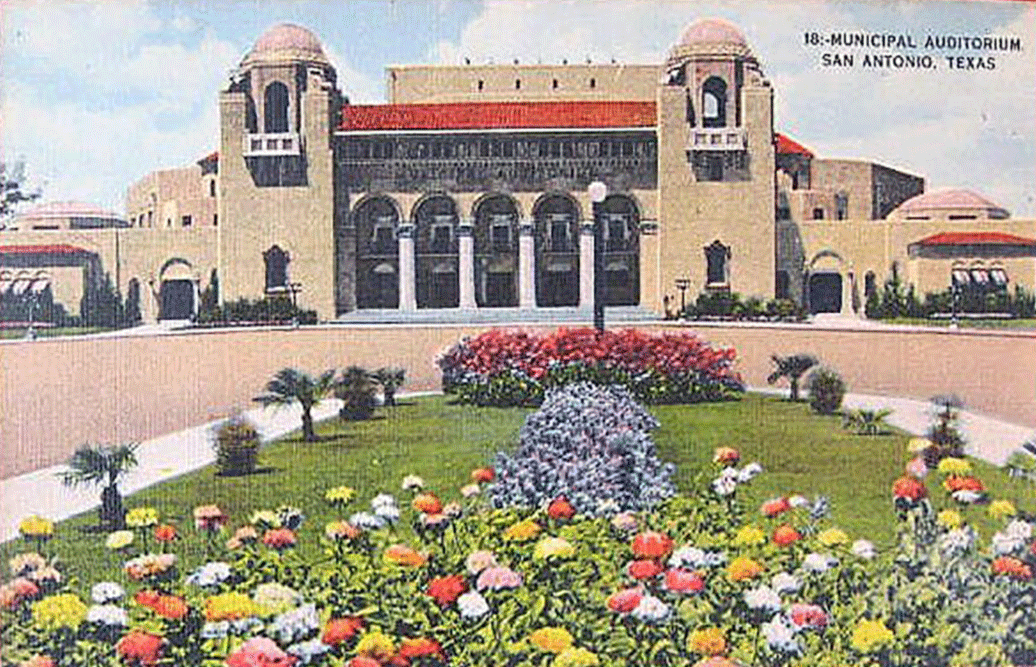
Adding a Contemporary Backdrop to a Municipal Landmark

A flood control project eliminating some of the bends of the San Antonio River as it snaked through downtown created a new plot of land enabling the City of San Antonio to cobble together the real estate needed for the Municipal Auditorium, with a distinctive Spanish Colonial Revival profile designed by architects Atlee B. Ayres, Emmett Jackson and George Willis. The $1.2-million Municipal Auditorium opened, lit “from pillar to post” according to the San Antonio Express, on April 19, 1926, with the Texas Pioneers’ Ball:

The result is an auditorium which Mayor Tobin declares without reservation is the finest in the country. Every sort of modern, practicable device has been installed to make the building the last word in structures of its kind….

Since its doors opened, the Municipal Auditorium hosted a huge variety of events – high school graduations, political rallies, boxing matches, concerts, Elvis, Fiesta coronations and even “midget women’s” wrestling – meaning many San Antonians have strong sentimental attachments to it. Which translated to emotional opposition when architects returned with recommendations that demolition of almost all but the distinctive façade would be required to create a facility appropriate for theatrical and musical productions of today. Layered atop the normal historical concerns was sensitivity over its prominent River Walk location.

But the stunning, contemporary solutions presented by the architectural team of LMN of Seattle and Marmon Mok of San Antonio won over many and secured approval.

Was fortunate enough to take a tour guided by Steve Souter and Morgan Williams of Marmon Mok this past week, and the transformation is amazing. Wood paneling the color of a Stradivarius violin is combined with cutting-edge programmable lighting around the upper decks of seating.

This slideshow requires JavaScript.

When the Municipal Auditorium opened in 1926, the Express bragged about its seating; although it doesn’t sound as though fire codes on the number of people who could be stuffed into a room were quite as rigid as today:

The capacity of the auditorium is 6,000 persons who can be seated in the comfortable opera chairs. In event of an extra large attraction, more than 3,000 persons could be seated in extra chairs in the auditorium and on the stage. The stage alone can accommodate 500 people seated in chairs of 1,000 standing. The opera chairs in the auditorium alone represent an investment of $60,000. They are all extra large chairs, 20 inches across the seat. There are 18 oversize chairs for extra large persons. Such big people can find chairs that will accommodate them comfortably if they ask especially for them.

Seating on the ground floor in what will be the Tobin Center for the Performing Arts easily will top that, although not numerically. The main theatre will accommodate 1,750. The wooden ground floor in the photos represents a $12-million investment. But it’s a rather magical floor. Each segment contains seating on its flip side and can be individually rotated and/or elevated to allow for a multitude of configurations. Found a handy-dandy video of this online (Don’t be misled by the video heading; the operation of the Tobin seating will closely resemble that of this theatre in British Columbia.).

For a more intellectual analysis of the Tobin Center’s assets, turn to Mike Greenberg.

The first year’s bookings for the Tobin are as diverse as the Municipal Auditorium entertained and can be found here. The doors will swing open for the first events in September.

(Thanks for providing some of the interior shots, Janet and Allison.)


Postcards from San Miguel de Allende: Redirecting Grafitti Artists, Part Four

Part One, Part Two and Part Three

Some people see the arroyo of Obraje running through San Miguel de Allende as a squalid ditch, a place to dump household garbage when one fails to heed the bell of the municipal trucks collecting trash. It diverts floodwaters away from Colonia Guadalupe during the rainy season, but during the much longer dry season it serves as a shortcut for many, including children attending one of several schools bordering the arroyo. The area, well below street level, also is a magnet for those engaged in drug deals or other dangerous liaisons. And those armed with spray paint.

Former San Antonian Colleen Sorenson looks at the ditch and sees something different. She sees Paseo del Rio or pathways like those along the Mission Reach of the San Antonio River. The graffiti-covered walls of buildings backing up to the arroyo represent additional blank canvases for more constructive artistic expression. Muros en Blanco, ecologically concerned residents of San Miguel de Allende and city officials began meeting, and change is happening.

This slideshow requires JavaScript.

Bulldozers were clearing away debris in February, when these photos were taken.

According to an article by Antonio de Jesus Aguado in Attencion San Miguel, Edgar Bautista, head of the city’s Urban Development Department, said:

“The perspective is touristic…,” and it fulfills the development goals of the Millenium, the priorities of which are security, health and education. The idea is to turn the arroyo into a patio-garden within the city, a tourism corridor, “in other words, a park that would generate a new ecosystem as important as Parque Juarez.”

Colleen was working on another arts festival, but, in addition to the mural projects lining the arroyo, the event would involve the schools in Colonia Guadalupe and carry strong environmental messages to foster a spirit of community stewardship.

Looking forward to seeing the transformation next time we return….


Ominous omens keep flying by…

OMEN, n. A sign that something will happen if nothing happens.

Ambrose Bierce, The Devil’s Dictionary (1911)

No matter what, it’s the San Antonio Book Festival’s fault. Writing about some of the authors scheduled to appear there sent me back to a post from long ago about Jake Silverstein’s book, Nothing Happened and Then It Did, which had sent me delving back into The Devil’s Dictionary. Hence the omen reference. Add to that overstimulation from listening to five full sessions of authors talking followed by the Literary Death Match.

National Park Service photo of red-tailed hawk

This past Thursday morning, the Mister and I headed southward for our morning walk. A hawk swooped onto a tree not 15 feet in front of us. It was a newly planted tree on the Eagleland stretch of the San Antonio River, the name of which comes not from sightings of eagles but from the Brackenridge High School’s mascot.

The branches of this 12-foot tree were not big enough to successfully support a hold-onto-your-chihuahua-size hawk; so, before we could even zip out and focus the smartphone, he flew off. While we were fiddling like dummies with the smartphone, the hawk caught something white now dangling helplessly from the hawk’s claws.

I wasn’t thinking omen yet. But a mile or so later on the Mission Reach by Lone Star, we saw another hawk swooping through the sky. We were impressed by a two-hawk day because we rarely even spy one.

But that afternoon, there was a third flying across 281 right in front of me as I headed to a meeting.

Three hawks. Now that seemed ominous to me.

Some people view hawks as messengers. Messengers bearing warnings, not usually glad tidings. I was afraid to even begin to surf the internet to find out what it would mean if three were trying to deliver news to me. I elected to prefer the theory that the hawks just happened to live nearby; it was meal time; and I was passing through their grocery store.

The next afternoon was warm. We had the doors on the second floor wide open. I kept hearing noises, though home alone.

Bravely going back up the stairs to the third floor, I found the source. A sparrow clinging to the shade on the south bank of windows.

I’m thinking omens again. Some people believe a bird flying into your house is a sign of death. I prefer the belief it means a loved one is trying to communicate with you from the grave. That seems more comforting.

Unfortunately, the windows on the third floor do not open. I was pondering how I was going to convince the sparrow to go back down a floor to the open doors when the sparrow spied this:

spring-green

The bank of windows on the north side. Well, the sparrow went for it as fast as his wings could flap through the length of the house.

Smack. Thud.

I’m thinking serious omen.

A bird breaks his neck flying into your window, particularly while inside the house? Not a good sign. A harbinger of death.

But a break came. A major stroke of good luck. When the sparrow hit the glass, he fell smack into the middle of the trashcan beside my desk onto a soft bed of kleenix, ever-present during this season of pollen.

I was able to cover him with a jacket and cart him out to the back porch. Upon my removal of the cover, he sat there stunned for quite a while. He had been tricked by those very same green leaves once, and, no fool, he wasn’t going to race toward them again. After about 30 minutes, he trusted his surroundings and fluttered home.

Surely that trumped all prior gloomy warnings.

I fretted a bit all weekend but finally decided no news was good news.

brokenwindowOur daughter solved it all inadvertently with an email with this photo attached. Aha, the sparrow must have been trying to tell me there had been a storm in Austin, and a branch blew into their house and smashed a window. Phew.

And then, on the phone later, she told me about the impending death. The Mister’s Infinity that had passed her way was in the process of passing away.

The Mister was sad. He loved that car.

But I was jubilant. Those hawks were only trying to tell me the Infinity was dying. I can handle that. I never even learned to find it in a parking lot; one silver sedan looks just like all the others to me.

I’m not paying attention to messages from birds again though; no matter what that pair of coots on the Mission Reach seems to be trying to say. The foreboding row of dark cormorants perched on the dam won’t scare me.

And those herons and egrets? They and all the other birds who didn’t use to flourish here are only here because our environment is improving everyday as the San Antonio River Improvements Project matures.

clawThe Mister and I just happen to walk right across their dining room table, often interrupting a crawfish feast, as we head southward.

And, that sparrow spared by the bed of kleenix absolutely has to be a sign of good luck.

April 29, 2014, Update: The flock of wild parrots that are spied around Southtown periodically just spent about 10 minutes fluttering around a cypress tree outside my window. Spectacular. Wish they would stay, but I think even that temporal a siting is a good sign.