
Quando finisce la partita il re ed il pedone finiscono nella stessa scatola.
The English translation would be: When you finish the game, the king and pawn end up in the same box. In other words: we all meet the same end.
“Best Italian Proverbs,” Rome, Food, Travel
There appears no shortage of ancient Catholic churches in Naples. Yet even by the 16th century, their walls, floors and underground catacombs were oversubscribed by the faithful demanding interment inside. Something needed to give.
Clever undertakers found a solution. They began digging up older remains, the ones of souls long forgotten, to free up space for the newcomers. The ancient bones were carted away discreetly to shallow graves in an enormous system of caves – natural caverns extended by ancient Greek and Roman tunnels and quarries for building materials for the city.
Then came the plague of 1656, decimating the population. The spiraling number of corpses led to their mass disposal atop the existing shallow graves in the caves.
The anonymous pile might have been forgotten were it not for an end-of-the-century flood washing all the bones out and depositing them helter-skelter on the streets below. The bones were returned to the cave, which then was deemed a more official location for disposing of deceased paupers.
An 1837 cholera epidemic swelled the number of residents unceremoniously dumped together in disorderly fashion. The charnel house became known as the Cemetery of the Fountains – Cimitero delle Fontanelle.


In 1872, a priest took pity upon all of the remains of the departed, many tossed inside without receiving their last rites. He had them sorted and arranged in a more orderly fashion, which attracted renewed interest among compassionate Catholics.
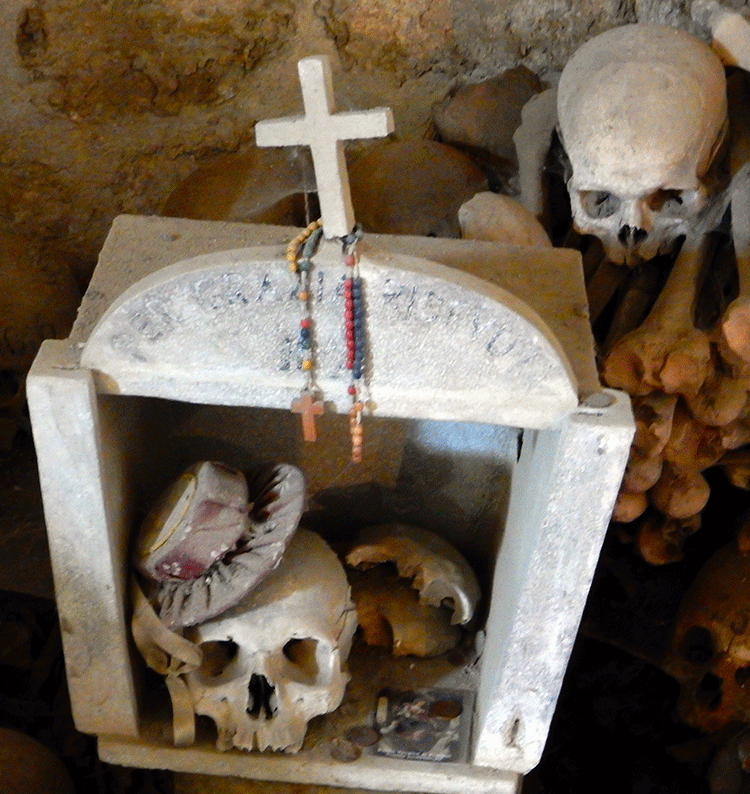
A cult arose, as people began to lovingly adopt skulls – capuchelle – of the abandoned souls – pezzentelle – in return for protection. They assigned the unknown names that appeared to them in dreams. They cleaned them, brought them small tokens of their affection, and kept them company.
Then, in 1969, the Archbishop of Naples decreed the practice fetishism and closed the entire ossuary to visitors. The deprivation of visitation rights to ancient adopted kin proved unpopular.
The cemetery was restored in early 2000 but was only unlocked for visitation a couple of times a year. Following protests including an overnight occupation, the cavernous space was reopened on a daily basis in 2010.
Only spotted one caregiver inside. She dashed down the entire length, her boyfriend lagging a ways behind. She stopped mid-right in the last chapel. Obviously, she only had eyes for but one skull amongst the abundance. She stooped to present something to her capuchelle, murmured a word or two, and then dashed back out as quickly as she entered. Her fidanzato rushed to keep up.
As you wander in the dimly lit chambers with bare rock walls and soaring ceilings, the space feels as hallowed as that of any ornately gilded church nave. The named capuchelle do indeed began to assume personalities of a sort, indicating that no two skulls are alike. They all are individuals; each with a story.
As in Mexican cemeteries on the first days of November, by the time you leave, keeping company with the dead no longer appears as bizarre. Eerie, yet somehow soothing.
And there are 30,000, 40,000, maybe even 50,000 more skulls stacked up, waiting for adoption.
Update on October 28, 2020: AtlasObscura has released a video touring Fontanelle.




 Postcards from Barton Springs