Postcard from Rome, Italy: A literal definition of a marriage made in heaven

But bright Cecilia raised the wonder higher:
When to her organ vocal breath was given,
An angel heard, and straight appeared
Mistaking Earth for heaven.

“A Song for Saint Cecilia’s Day,” John Dryden, 1687

Music the fiercest grief can charm,
And fate’s severest rage disarm:
Music can soften pain to ease,
And make despair and madness please:
Our joys below it can improve,
And antedate the bliss above.
This the divine Cecilia found….

“Ode on Saint Cecilia’s Day,” Alexander Pope, 1708

Some time in the first or second century, the daughter of a wealthy family in Rome was betrothed to a young pagan. A Christian, Cecilia was dragging her feet about entering into the arranged marriage, fasting and pleading with God and the Virgin Mary to help her preserve her virginity. Definitely not the vow a prospective groom envisions.

As the musicians played at the feast celebrating the wedding, Cecilia stared upward, focused on serenading the heavens with the song in her heart. Valerian, the groom, was miraculously understanding when she explained her wedding night plans to him did not include consummation of their marriage.

Cecilia claimed she had an angel protecting her. A little suspicious, he asked for proof. She directed him to the third milestone on the Appian Way and to be baptized by Pope Urban I (died in 230). Valerian complied and, upon his return, saw her guardian angel with her, crowning her head with roses and lilies. In addition to his religious conversion, he accepted her vow of chastity.

Valerian’s enthusiasm was so great, his brother followed suit. Christianity was far from the official religion in Rome at the time, so Valerian and his brother busied themselves gathering the bodies of executed Christians and providing them with burials. This chore kept them quite occupied until their dedication attracted too much attention, and they themselves became martyrs.

Cecilia then threw herself more fervently into spreading the word, converting more than 400 pagans to the still somewhat new religion. Until…

… you know where this is leading, she attracted attention of those in power. But Cecilia’s angel did not let her succumb quickly to the efforts to dispose of her. First condemned to death by “spa,” she was locked in the baths with the heat and steam stoked up unbearably high. She emerged unfazed, so a more direct approach was taken.

Chop off her head. The executioner swung his axe three times. Despite profuse bleeding, her head remained in a semi-attached state. This afforded Cecilia time to make arrangements to distribute any remaining wealth to the poor and to donate her home in Trastevere for a church. Pope Urban I complied.

In the 800s, Pope Paschal I rebuilt the church. Desiring to locate Saint Cecilia’s remains and transfer them to her church, the pope searched the catacombs. After a vision, he finally located them and those of her husband and brother-in-law. Saint Cecilia’s original robes, blood-soaked, were at her feet; she was clothed in gold. All three bodies were moved to the church.

While the mosaic in the apse from that period survives, much remodeling followed. Fast forward to the 1500s, Cardinal Niccolo Sfrondrato (1535-1591), later becoming Pope Gregory XIV, was trying to confirm the location of the remains of Santa Cecilia.

Workers uncovered a marble coffin and opened it in front of the cardinal and, even more conveniently, sculptor Stefano Maderno (1576-1636). And there she was. Santa Cecilia incorrupta. The first Catholic saint recorded as emerging in this totally preserved state, further demonstrated by the fact that she had rolled over to a more comfortable position on her side.

Word spread like wildfire in Rome, and the cardinal was fortunate to escape being crushed by the crowds eager to view their patron saint of music, still cloaked in golden cloth. Maderno recorded this miracle by sculpting a realistic depiction of her body for the altar. But her actual body was reinterred elsewhere in the church.

The Mister is wise. A sign on the left side of the church offered entrance to the basement for a couple of euros, and he said, “Never turn down an invitation to visit the crypt.” And he proved so right.

Down underneath the church are ancient crypts and the remains of an old tannery, but then you stumble into a magical space. Arcades and walls covered with glittering mosaics heralding Saint Cecilia’s final resting place.

The Mister’s fingers seem to be gliding across his travel guitar’s strings more effortlessly ever since.
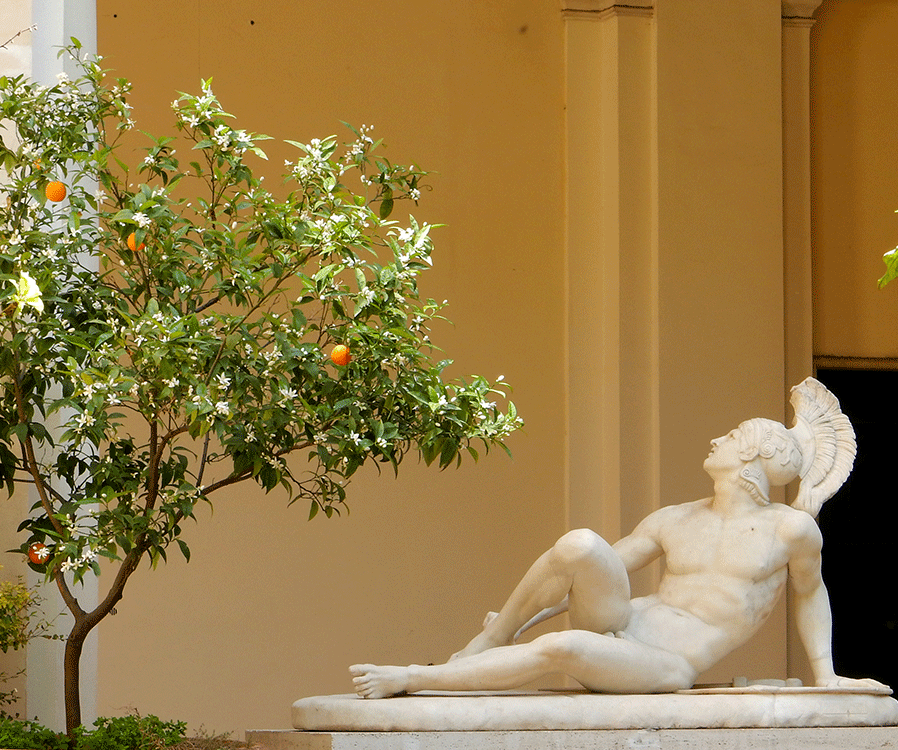
 

Postcards from Rome, Italy: Poseurs hanging out on almost every corner

Not surprising, Rome is well populated with sculpture.

Some offering comfort and protection. Some looking, quite frankly, bored. Many scantily clad.

Here are some shots of a few we encountered rambling around her streets.


Postcard from Rome, Italy: Stumbling around colorblind

Time out. I wandered around Rome for almost three weeks before it hit me in the face, just as we were about to exit the Diocletian Baths. The sculpture above, the photo included in the prior post, did it.

I had been viewing remnants of ancient Rome in black and white, completing forgetting photographs in magazine and newspaper articles about exhibitions making the rounds in the United States a decade ago. The ancient Etruscans, the ancient Greeks, the ancient Romans – they had no inhibitions about applying color to their art. We have been brought up in an art world dominated by the influence of Renaissance artists reviving classical sculpture using the whitest of marble.

Writing in the Smithsonian Magazine in 2008, Matthew Gurewitsch describes how our color-blindness would shock the ancients:

But we can guess that Phidias would be brokenhearted to see his sacred relics dragged so far from home, in such a fractured state. More to the point, the bare stone would look ravaged to him, even cadaverous.

Listen to Helen of Troy, in the Euripides play that bears her name:

My life and fortunes are a monstrosity,
Partly because of Hera, partly because of my beauty.
If only I could shed my beauty and assume an uglier aspect
The way you would wipe color off a statue.

That last point is so unexpected, one might almost miss it: to strip a statue of its color is actually to disfigure it.

I was still processing this concept as we wandered through the National Etruscan Museum of Villa Guilia (more to come later), where we encountered a couple reclining on their sarcophagus, circa 500+ years B.C. The accompanying text mentioned that the “twin” to this housed in the Louvre actually shows remnants of colors.

But the Louvre couple (on the right) still does not burst into a full technicolor-type bloom. Based on decades of work by Vinzenz Brinkmann of the Glyptothek Museum in Munich, Germany, replicas of ancient statues colorized are probably as shocking to our senses as people accustomed to black-and-white films almost 80 years ago felt in theatres viewing the vividly bright yellow brick road in the midst of The Wizard of Oz.

This Carsten Muller video for Capitol City Media Design helps somewhat with visualizing the changes:

I got on an absurd jag in Rome of photographing statues of lions (more later). They are everywhere. I am so conditioned to thinking of them from a monochromatic perspective, I never once pictured the ancient ones in what to me is amusement-park merry-go-round colors, as is this reproduction of a Greek lion Brinkmann uses in exhibitions.

Color changes our perceptions about ancient civilizations. But ouch, with the following description in mind, would you really want to see the featured relief of Mithras or the statue of Mithras pictured below fully restored in color?

Diocletian Baths
Statue of Mithras, Diocletian Baths

But my imagination fails to make the Crayola transition on its own. My color-blinders remain in place unless confronted by the images side by side.

Which brings me back around to San Antonio. And her missions. The Native Americans herded into the flocks of the Spanish friars nearly three centuries ago were not monochrome in their tastes.

Years back, I rudely shoved through a motion at a San Antonio Conservation Society board meeting for the society to go on record supporting “colorizing” the outside of one mission the way the Native Americans originally did. The not-well-thought-out motion probably still languishes at the bottom of a list of active motions.

I would withdraw it now in favor of a different approach. Illuminate the facades of Mission Concepcion and Mission San Jose often and on a regular basis, if only for an hour at a time right after sunset to show for those of us who stand colorblind in front of these incredible landmarks failing to envision the imprint of our Native American population on them, and, by extension, the city San Antonio has become.

The City of San Antonio has worked several times now with the San Antonio Missions National Park to spotlight the missions “Restored by Light.” The photograph on the left of Mission Concepcion colorized was taken by Bonnie Arbitter and appeared in The Rivard Report, September 8, 2017. Scott Ball took the second one of Mission San Jose that appeared in The Rivard Report, September 6, 2017.

Please let the light shine on these more often.

Meanwhile, this unimaginative soul will return to viewing Roman antiquities in monochromatic tones. Am hoping your imagination adds a richness to the palette where applicable.