‘More Flags. More Fun.’

But in whatever language, why should Cinco de Mayo matter to Texans?

That is the question posed to numerous children by reporter Vianna Davila in the San Antonio Express-News

Here is my answer.  If the neighboring Mexican Army under the command of General Ignacio Zaragoza had not defeated the French at the Battle of Puebla in 1862, undermining the power of the French-installed emperor, Maximilian (read C.M. Mayo‘s The Last Prince), who knows what flag might have ended up flying over Texas?  Perhaps, the ambitious Emperor Napoleon III might have used Mexico as a stepping stone to seize major portions of the United States, vulnerable and weak following years of civil war.

In Texas, the collective historical memory is selective.  Six (or more according to some historians) flags should mean more than a theme park.  And the American flag has only flown over this state half as long as those of Spain and Mexico. 

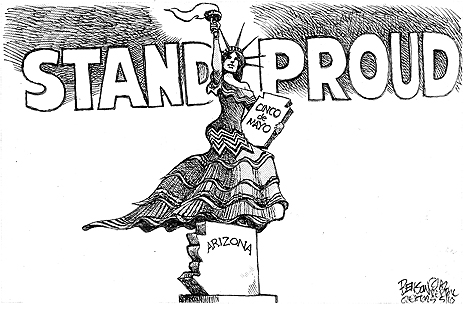
And at least this is not Arizona, whose “free to be” “brand essence” tourism campaign now rings hollow.  Below is cartoonist Steve Benson’s Cinco de Mayo greeting from The Arizona Republic.
The rich cultural mix in San Antonio makes this a great place to live.  As the Six Flags website says:  “More flags.  More fun.”

Note added on July 13:  C.M. Mayo now has a second blog for those seriously researching the “French Intervention” in Mexico and also provides podcasts online of some of her presentations on both her writing and writing in general. 

When I went to link to her new blog, came across an entry about Don Miles’ Cinco de Mayo.  The post also contains the news that Austin already is planning a four-day celebration of the 150th anniversary of the Battle of Pueblo, including a reenactment of the battle itself, for May 2012.   Will San Antonio sit back and be upstaged?

Guarding the Guardians

Reporter Scott Huddleston of the San Antonio Express-News dropped this gem near the end of his story about the Daughters of the Republic of Texas efforts to trademark “The Alamo:”

Along with the “Allies” campaign, which raises money for Alamo preservation, operations and educational programs, the DRT hopes to collect funds for a new library building on the grounds that eventually could stand seven stories high.

Seven stories high?  And I have been blogging over a banner blocking the entrance to the grounds and the pop-up on the plaza?

Surely San Antonio’s viewshed ordinance protects us from these guardians in need of guarding: 

The purpose of a Viewshed Protection district is to establish regulations to protect, preserve, and enhance views and vistas. The City of San Antonio has many views and vistas of historic places, landmark buildings, and other sites of cultural importance which have always been important to the city.  These views will continue to be amenities and assets of great value to the city, its people, and its economy. 

New development in the vicinity of these important places is usually beneficial, but when construction becomes too tall and begins to overwhelm or intrude, in scale and mass, the main view or vista of a smaller place of significance, then the viewshed located behind the significant property should be protected. 

Viewshed Protection districts are overlay districts that will be used primarily for unique situations regarding views and vistas that are not adequately covered by the standard zoning districts.  No part of a new structure, sign, tower, roof top equipment, or other appurtenance shall be permitted to encroach into any designated viewshed as set forth in this ordinance unless an encroachment was approved legally before the effective date of the Viewshed Protection ordinance.  If the maximum height allowed in any zoning district within the city differs from the height permitted by a protection district, the more restrictive height limitation shall apply.

San Antonio currently has one (1) Viewshed Protection district: Alamo Viewshed (VP-1).  This Viewshed Protection district lies behind the main entrance to the front door of the Mission San Antonio de Valero (The Alamo), a local Exceptional Landmark and a National Historic Landmark.  A brass disc monument named VP-1, Alamo Viewshed, has been set to mark the viewpoint origination in Alamo Plaza in front of the Alamo Chapel….
(see Ch. 35-337 of the Unified Development Code for full boundary description).

If not, fix it quickly.

May 13 Update“Another Battle Brews at The Alamo”

June 1 Update:  The Texas Historical Commission’s response to DRT’s plans:  page 1, page 2 and page 3

October 28 Update:  The Daughters of the Republic of Texas are only $40 million away from building a three-story addition to the Alamo grounds….

Preserving the Art of ‘Papel Picado’

The American translation I grew up with is hardly picturesque – brightly colored plastic triangles strung along roadways, noisily flapping in the breeze in vain attempts to motivate you to “stop here for gas” or “trade in your car today.”  But, as with many humble or utilitarian objects in Mexico, banners were elevated to a form of art and signified celebrations important to the community.  Papel picado, or punched paper, artists use hammer and chisel to punch designs out of stacks of up to 40 layers of tissue at a time.

As part of the San Antonio Conservation Society’s celebration of Historic Preservation Month, a display of papel picado, or punched paper, by artist Kathleen Trenchard is on exhibit in the Visitors Center of The Steves Homestead.  While her work includes traditional papel picado banners, Kathleen’s contemporary interpretation of the art form includes portraits, buildings and major public art installations – at the AT&T Center, the South Texas Blood and Tissue Center and the Grand Hyatt Hotel.  Kathleen also designed the official Fiesta pin for the Conservation Society’s major fundraiser, A Night in Old San Antonio, or NIOSA.

The legendary printmaker and satirical cartoonist Jose Guadalupe Posada (1852-1913) created his oft-reproduced “La Calavera Catrina” to satirize the lifestyle of the upper class in Mexico in the late 1800s.  In one of the works on exhibit at the Steves’ Visitors Center, Kathleen crafts a skeletal “self-portrait” as a dancing partner of La Catrina.  

“Portraits” of architectural landmarks featured in the exhibit include the Bexar County Courthouse, the Japanese Tea Garden, the silos at Blue Star and the Pig Stand.  The one must suitable for the cause of preservation follows the satirical style of Posada:  “Demolition:  1123 Brooklyn.”

In recognition of her artistic perpetuation of this form of Mexican folk art, the Conservation Society will bestow its Lynn Ford Craftsman Award upon Kathleen at its Historic Preservation Awards Dinner on Friday, May 14.  The Conservation Society established the award in 1978 in honor of Lynn Ford, a craftsman, cabinetmaker, builder and teacher.

Preserving the Art of Papel Picado will be on display at the Visitors Center located behind The Edward Steves Homestead and House Museum, 509 King William Street, through June.  The Visitors Center and Museum are open daily, but hours vary depending on scheduled tours.  For more information, telephone 210.225.5924.

Tickets for the Conservation Society’s Awards Dinner are $75 for individuals or $600 for a table of eight.  For reservations, telephone 210.224.6163.  To find out information about other Preservation Month activities, visit www.saconservation.org.

So what could the “prodigious poster” learn from a form of art where what is eliminated paints the picture?  Cut.

Added on May 3:  Great article on the area of Puebla known for papel amate