‘Skyscrapers Soon to Stand Where Wolves Once Howled’

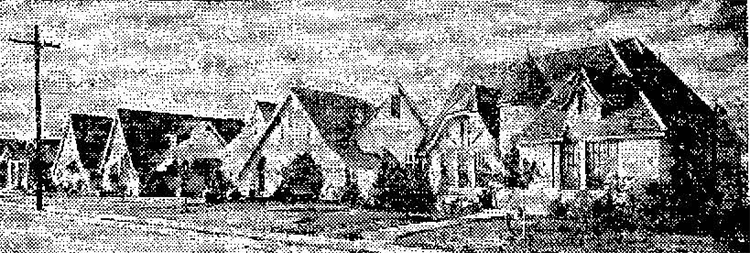
The 1928 headline was a bit premature for the neighborhood, but we did live in their shadow briefly. Or at least the shadow of the freeway. Right there on their street. Ostrom. As close to 281 as possible. Yet in the midst of a neighborhood of fairytale cottages.

You’ve probably driven by it often, yet not through it. The freeway, the golf course, Mulberry and the river cut it off from any through traffic.

The River Road neighborhood. Filled with eccentric little cottages inhabited by some of San Antonio’s most wonderfully eccentric characters.

Some of these modern-day opinionated residents quickly would have taken sides in the “Goat Case” as covered by the San Antonio Daily Light on June 8, 1889:

Mrs. V.C. Ostrom, a well known lady of San Antonio, who has made herself quite famous in San Antonio by her untiring efforts in the cause of temperance and prohibition, was in court yesterday afternoon and all hands concerned had a lively time of it. This lady sued Jose Rodriguez, a neighbor living near San Pedro springs for damages for allowing his flock of goats to devastate her garden. Rodriguez’s goats have long been a nuisance to dwellers of the new fourth ward, even down to Marshall street, and time and again the city, through its recorder, has imposed light fines upon him for violating the ordinance in allowing said goats to run at large. Alone and unaided the lady attempted to defend herself against the evil and, what with the lawyers of the defendant and the crowd of spectators whose sympathies, on account of her prohibition sentiments, were decidedly against her, she had a hard time of it, and it may as well be mentioned, Rodriguez’s lawyer also had a pretty hard time of it.

But Sarah Hummer Ostrom and her daughter Frances were firm in their beliefs. They were willing to put their money on the table to spread the Good Word. They helped build and run a place of worship in their yard on Jones Avenue to minister to those who lived in the quarry area in “houses of tin strips, flattened-out tin cans and waste lumber.” According to a November 23, 1913, article in the San Antonio Light, they:

…set up a little mission among the jacals of Mexican squatters in the rock quarry district and spread the Christian Gospel among the lowly sons and daughters of the Moctezumas.

…she (Mrs. Ostrom) “works at her religion.” She does not save it merely for Sunday use.

This slideshow requires JavaScript.

But growing crops and saving souls on their farm soon yielded to the surrounding pressures to grow houses instead. Bess Carroll’s copy in an April 1928 edition of the San Antonio Light is so dramatic, I decline to edit her descriptions of a booming city stretching northward:

Over many a road blazed by adventurers, long ago, the huge stride of progress has marched into San Antonio, leaving great monuments in its footprints. And now this Titan whose breath is the stream of power, whose blood is an electric flow, has followed an old wagon road to the door of an ancient farmhouse.

Though phantom wolves may still howl their hymns to the moon there, San Antonio’s last prairie is being linked to the heart of her business being.

Beside the banks of the San Antonio river, where a tented city once stood buried in the mist of prehistoric oblivion, steam rollers snort and machinery does its superhuman work as the geographical end of St. Mary’s street is gradually dragged along by iron horses – the street-building equipment of the city of San Antonio – to meet Jones Avenue….

For the gigantic march of development is taking its parade of houses and money down an old Indian trail, across the path of the ragged Texas army of 1836, and along the course of what was, until recently, a shady country lane….

Along Jones avenue wide acres of oats and grain stretched out “once upon a time,” and only a short while ago the last remnant of the sole surviving farm gave way at last to development. That was when Miss Frances Ostrom, 1910 Jones avenue, converted the old Ostrom farm into a residence district known as “The French Village.”

When V.C. and Sarah Ostrom bought their nine-acre farm in ’69 they acquired water rights issued by the crown of Spain to this land when San Fernando cathedral was still young. But because it occupied a rise in the flat prairie surrounding it, the Ostrom farm very seldom “took the water” from the Upper Labor Ditch, a canal dug in early times for irrigation purposes….

(Miss Ostrom recalled) “The nearest store was Costanola’s, occupying the site of the present Robert E. Lee hotel; it was in the brush. Brackenridge park was largely a pasture. Later Rubiola’s ‘country store’ opened; soon after came a rural saloon. It was not until about 1885 that any houses were built on the North Side this far out. The mule car street ‘railway’ caused some development.”

The last stone of the Ostrom farmhouse was torn down in 1926. It had been a typical old stone house – four rooms and an eight-foot hall….

Land that had been green and virgin once was paved for the first time, in April, 1926. The last of the old prairie, plowed by oxen when at last its fertile acres were claimed by civilization, had its face covered over with a black veil of asphalt. It had been widowed, verily.

Now an avenue of trade will link the lost furrows of the Ostrom farm with San Antonio’s downtown district. In 1927 alone eight million dollars, according to real estate estimates, were spent in new building alone on St. Mary’s. Included in the principal buildings are: The Plaza hotel, Public Service building, Aztec theater, Smith Brothers-Young building – which is to be the tallest office structure in Texas – and the San Antonio Drug company, St. Mary’s Catholic church, The Gunter building, the Real estate building, Builder’s Exchange, Travis building, Lanier hotel, Commercial Loan and Trust company and the Brady building.

The picturesque houses of the “French village,” with roof lines mimicking those of major chateaus, albeit miniature in scale, still line several of the narrow streets, scarcely wide enough to accommodate two-way traffic, in the River Road neighborhood. Park in Brackenridge Park one day and follow trails across Mulberry to walk among the cottages and along the tree-lined banks of this natural portion of the San Antonio River. You will understand why the neighbors feistily defend this magical spot against any additional modern-day incursions.

‘So Doth a Little Polly,’ sayeth this Lamar

mockingalamo

In June of 1920 I received the degree of Bachelor of Arts with Honors in Mathematics and Economics, a title which, coupled to the name of Lucius Mirabeau Lamar the Third, was of such resounding grandiloquence as to bring from the assembled students faculty and families (who else would be there in the boiling muggy Texas sun?) a burst of applause embracing, I knew well enough, a component of irony. It did sound good, as some of the movie false fronts look good, but there was mostly air behind it.

From Shards by Lucius M. Lamar, 1968

And this before Lucius M. Lamar, III, (1898-1978) added a law degree.

It is not surprising someone so willing to self-mock would choose a conscientiously pretentious name for the protagonist in a pride-before-the-fall, the-grass-is-always-greener, be-careful-what-you-wish-for fable, So Doth a Little Polly, woven for his five-year-old-niece and seven-year-old nephew.

Jesus Francisco de Assisi Sensontle.

This tale of a San Antonio mockingbird did not bow to monosyllabic rhyming words first-graders could read. No, it was a vocabulary-stretching story rippling with multiple layers of bicultural meaning and accompanying music ranging from “Hinky Dinky Parlez Vous” to Handel.

Sensontle, or Don Sensontle as he preferred to be called, wintered on Alamo Plaza, convinced he reigned over all other feathered creatures. He believed his singing so awe-inspiriting he was “astonished at his own virtuosity” (Notes in the margin recommend the accompaniment of a toy flute here.).

One day a sparrow, Cecil, asked if Sensontle had read the recent news from Austin in the paper:

“A gentleman never reads,” replied Sensontle with dignity, being innocent of that clerical accomplishment.

“Perhaps not,” went on Cecil, ignoring the implication….

The news Cecil the sparrow was trumpeting was that the mockingbird had been proclaimed the State Bird of Texas.

Pompous pride over this tribute soon led to a downturn in Sensontle’s popularity among the birds of the plaza (pompous chords followed by a fast march).

Frustrated, Sensontle flew to a home on Zarzamora Street to visit his caged cousin, Maria Ysabel Dolores Soledad Sensontle, “a handsome and engaging young fellow, whose somewhat effeminate name had been bestowed by his captors under a misapprehension as to his sex.”

Yearning for an easy life, Sensontle negotiated to change places with his cousin for a year.

youtube video posted by zxtkain

A year later Maria returns and perches on the branch of a fig tree near his former cage. Sensontle desperately pleads:

“Kindly release me.”

“Come,” said Maria, “your morals have improved at the expense of your manners. You should ask no labor of me until I have got my wind.”

“I ask nothing save the fulfillment of your promise, which is a sacred duty you should perform at once, tired or not. Be quick, let me out!”

“Patience, cousin, patience,” soothed Maria.

And then.

And that’s the problem.

Twelve dried, yellowed, longer-than-legal-sized typewritten pages.

The end of the story is missing, scattered somewhere amongst the shards left in the wake of closing the Mister’s parents’ household. Lost. Along with copies of other “children’s” works produced by Lucius, including “Hardboiled Harry.”

We are hoping the Mister’s great-uncle passed the stories down orally to his own children and are mailing “So Doth a Little Polly” to his daughter tomorrow.

Please. Let us know if Sensontle lived to fly freely lording over the Alamo once again….

Jimmie Draper: Rain, shine, sleet, heat

mariachi-festival

This post needs a soundtrack. Nothing would be more fitting than San Antonio high school students belting out mariachi music, so please play this while you read. For Jimmie.

1968. I think James Miller Draper, Jr., was there when the Paseo del Rio Association started, raising his hand to volunteer to do whatever it took to get attention for the River Walk.

It might be hard to imagine now, but the few businesses opening along the river were desperate. There were times when the only live things walking down the sidewalk in the heart of the river bend were pigeons. Things were so dull, there was even a night when some bored unnamed river operators shot fish. With guns.

Jimmie served as president of Paseo del Rio Association twice, in 1975 and 1984. But assumption of that responsibility is minor compared to his continual presence through thick and thin for more than four decades.

The coldest mornings in December always were the Fridays we placed luminarias along the river’s banks. Bob Buchanan made the coffee, and Jimmie brought the doughnuts. Without fail. For decades. Nancy Hunt, current executive director of Paseo del Rio Association, said that even last year Jimmie rode the bus downtown to deliver sweets to those delivering bags to the river’s banks.

No weather forecaster was more accurate than the first night of the annual Great Country River Festival the first weekend in February. Guaranteed sleet. Jimmie was always there.

The event closest to his heart always, though, was the Fiesta Mariachi Festival. It was his. I believe he was the first and only chair of the festival for more than 40 years. He threatened to retire one year. Paseo even threw him a party to recognize chairing the event 25 years or so. That just made him sentimental and mushy about the whole thing, so he kept coming back. Every year, he gave up four nights of Fiesta to meet the high school students boarding the barges. Without fail. Until this past year. Being 86 is a pretty good excuse for easing up a bit.

Generally Jimmie had the patience of Job. The time he really lost it, although not publicly, was at City Hall. The Paseo’s contract with the city in the late ’70s required we continually appear before Council to request approval for each event.

It should have been routine, but poor Mayor Lila Cockrell had a rather rowdy bunch to try to keep corralled. Those were colorful times.

I could almost see the hairs on the back of Jimmie’s neck bristle as a councilman went off on a rant about gringos being in charge of putting on a mariachi festival.

Then there was without a doubt the most incredible remark I ever heard at City Hall. Councilman Joe Webb interrupted the diatribe: “Mariachis. Cucarachas. What’s the difference? They’re all the same to me.”

Councilman Bernardo Eureste leapt to his feet and challenged Councilman Webb to duke it out. The scuffling councilmen went out in the hall to settle things, but were restrained before striking any serious blows.

Permission to stage the admission-free festival was granted, but, on the way out of City Hall, Jimmie said that was it. He would never go back there and be insulted like that again.

But he kept on volunteering again and again and again. Rain, shine, sleet, heat. No matter.

Gringo Jimmie might not have been known for shouting loud gritos in public, but, in those early years working with Belle San Miguel, his belief in bolstering the talents of young musicians gave fledgling programs in public schools a stage on which to shine. Before there were statewide competitions, the Mariachi Festival was the event inspiring students to strive for professionalism in their performances. Jimmie loved to see students board the barges, proudly wearing their festival medals from each year they had participated.

This spring will bring the 44th annual Fiesta Mariachi Festival. Jimmie was there for 42.

luminaria

Light a luminaria for Jimmie this holiday season. If it goes up in flame, it’s his unselfish and generous soul flying up to heaven.