Postcard from Ferrara, Italy: The magnetic pull of cemeteries

Taking a little sabbatical in the midst of writing the final chapter of a book about the families living around the Coker Settlement, an assignment that has me digging, figuratively speaking, through the graveyard for long-buried clues about their lives.

So where did we accidentally wind up on our first day in Italy trying to walk off the fog from staying awake all night to fly across the ocean? A cemetery.

A beautiful, parklike cemetery with acres and acres of Renaissance-style arcades and mausoleums. The grounds of Certosa di Ferrara originally belonged to a Carthusian monastery founded in 1461, but the monks found their compound within the walls of Ferrara when Ercule d’Este, now resting there, expanded and fortified the city in 1492. The final blow, however, was delivered by Napoleon when he confiscated all church lands at the end of the 1700s.

With such wonderful names engraved there  – Chiavissimo Zabardi, known for his austere ideals and honest work before he died in 1910; Achille Valli, an early publicista who departed this world in 1915; Illuminata and Giuseppe Solovagione, with their photos perched atop a whole family tree of their descendants who later joined them – I could have wandered for hours wondering about their stories.

Yet, this was our first day in Italy. How could I spend it among the dead?

So the Mister tugged gently on my arm, and we left to begin exploring the more vibrant areas of Ferrara in Emilia Romagna, Italy.

Cemeteries are such peaceful places, but, after all, we will have much more time than we desire to spend in one later. Much later, I hope.

Something old, something new along the Mission Reach

In the early 1700s, Native Americans dug an elaborate system of irrigation ditches, or acequias, to water the farmlands surrounding the string of missions founded by Spanish friars. According to an article written by Jose A. Rivera in the Southwestern Historical Quarterly in 2003, the farmlands near Mission San Juan Capistrano were served by this system:

… until the spring of 1958, when a channel improvement project relocated the bed of the San Antonio River two hundred feet away from the headgate of the San Juan Acequia. In the process of straightening, widening, and deepening the river, the site of the original saca de agua (the historic San Juan Dam) was buried with excavated dirt and rubble. The new channel was too far away and deep to supply water to the San Juan headgate by way of gravity-flow irrigation as had been the practice for more than two hundred years.

Secularization of Mission San Juan Capistrano in 1824 included close to 500 acres served by San Juan Acequia. This land was granted to:

… military officers from the Bexar garrison, a former military chaplain, and four women, each coveting the quality of agricultural lands available at this mission site.

It took subsequent landowners decades of litigation and negotiations to regain their water access following the 1950s’ flood-control work undertaken by the U.S. Army Corps of Engineers and the San Antonio River Authority. The oldest water rights in Texas, Rivera writes, finally were restored in 2001, ahead of the San Antonio River Improvements Project.

Now, a short jog off the west bank trail of the San Antonio River Improvements Project leads through a field of wildflowers back to the ancient stone arched acequia, topped once again by water flowing into the restored ditches nourishing neighboring fields. The 13 miles of the recent river project, including the Mission Reach, represent a monumental effort by the Corps, the River Authority, the City of San Antonio and Bexar County to restore the river ecosystem to a more natural, healthy state. The wildlife, fisher-folks, hikers, runners, bicyclists and paddlers using it attest to their success.

Only a stroll away is a contemporary addition to the river’s banks, “Whispers.” In 2015, the San Antonio River Foundation contributed this site-specific sculpture by Belgian artist Arne Quinze to the Mission Reach project. (Read more about Quinze’s sculpture here.)

Lush greenery and wildflowers carpet the banks all along the Mission Reach. Hope you get a chance to walk and explore it before spring is overtaken by the summer heat.

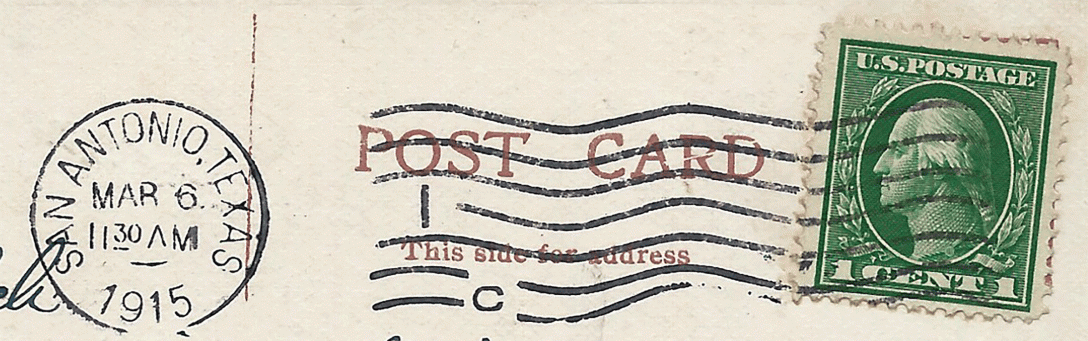
Postcards from San Antonio a Century Ago

San Antonio is so different from Dallas, Houston, Austin…. Probably because those other major Texas cities were not even dots on the map before the fall of the Alamo. San Antonio just kicked off its planning for the city’s tricentennial events.

San Antonio was part of Mexico. It’s in her genes.

That is what drew me here from Virginia Beach, a city so far removed from Mexico that it did not even offer a taco for sale until I was 17. Well, that and the Mister.

I’ve been sitting on these postcards, widely available, for a long, long time for many reasons. They are controversial.

They illustrate how Mexican San Antonio was. Some of these snapshots can be viewed as showing our affection for that connection:

Mexican Chili Stands. For the sake of olden times the Mexicans are allowed to set up their tables and camp stones on the Plazas and serve their native dishes in the open air; such as Chili Con Carne, Tamales, Enchiladas, Chili Verde, Frijoles and Tortillas, etc. As day dawns and the lamps show dimmer, these queer hotel keepers put out their fires and folding their tables “silently steal away” until another night.

But, unfortunately, many of these postcards illustrate the prejudice that arose in us after the Texas Revolution:

Mexican mansions showing the primitive way of the peons, who are supposed to be the happiest people on earth.

Even Tejanos born and raised in San Antonio who supported the Texas Revolution found themselves viewed with condescension by newcomers flooding into the Republic of Texas, immigrants from the United States. Natives were regarded as foreigners.

Painful periods of prejudice should never be erased from our history books. Sometimes looking in the rearview mirror keeps you from veering off in the wrong direction. Some of today’s politicians need to do that because the rhetoric indicates a failure to learn from our past mistakes, a willingness to repeat them.

The historical connection of San Antonio and Mexico embedded in the city’s DNA is cherished and celebrated, particularly as we head toward our tricentennial commemorations. It’s a flavorful recipe unduplicated and a major ingredient in what makes San Antonio such a remarkable place to live.

(I’d incorporated some of these images in collages a while back: http://www.postcardssanantonio.com/tex-mex.html.)