Is this a picture worth a thousand words? 99 cents?

Another Say Si Small Scale Art Auction approaches, which reminds me I have been blogging away for almost a year. I wanted to make a statement.

At the end of 2009, I decided to mount a visual protest against the visual clutter surrounding Alamo Plaza. A picture’s worth a thousand words.

Had not Delacroix’s unveiling in Paris in 1824 of his monumental “Massacre of Chios” swayed public opinion in Europe toward intense loathing of the Turks for slaughtering 10,000 Greeks? If the painter had chosen instead to depict the earlier savagery of the Greeks at Tripolitsa, might Europe have supported the Turks instead?

Inspired to try to motivate someone in the world to clean up Alamo Plaza, I assembled two of the ugliest collages ever created by combining photos snapped around the plaza.

Well, to put it mildly, Delacroix was more successful. Maybe my works are too small in scale. Maybe it’s because I have no bare-breasted women up front and center. Okay, I admit it. You can’t have known Delacroix personally; yet you know I’m no Delacroix.

So I switched strategies to attack by blog. The press is a powerful weapon.  After much haranguing, not much progress to report. Okay, I admit it. I am no great poet either.

Alas, even Lord Byron thought the sword mightier than the pen and found himself among the inspired volunteers traveling in resplendent uniforms in 1824 to join Prince Mavrocordato at Missolonghi. Byron wrote:

                    The sword, the banner, and the field,
Glory and Greece, around me see!
The Spartan, borne upon his shield,
Was not more free.

Awake! (not Greece–she is awake!)
Awake, my spirit! Think through whom
Thy life-blood tracks its parent lake,
And then strike home! ….

If thou regrett’st thy youth, why live?
The land of honourable death
Is here–up to the field, and give
Away thy breath!

Byron perished soon after, and most of Europe then seemed to pay attention to his call to support Greece.

I’m just not willing to sacrifice my life for signage. So I’ve come full circle and have donated “We’ve Lost the Alamo” for Say Si to include in the benefit auction on February 25.

My initial thought was that someone would see it and be so offended he or she would buy this print and insist it be hung at City Hall. If first impressions are important, why is this what we show more than 2.5 million visitors every year? Maybe that person should order another print for the office of the Convention and Visitors Bureau to show them that no matter how sleek the ads are trying to sell San Antonio this is the reality of what is here. Why the pair of prints should be in the office of every city council representative, every member of the Historic Design and Review Committee, in the home of every officer of the Daughters of the Republic of Texas and every member of the board of directors of the San Antonio Conservation Society and in every office at the Texas State Historical Commission. Governor Rick Perry himself should have to look at this every single day. I never should have limited this edition of prints to only 25.

Okay, that is not going to happen. I decided to make my point, though, about the general appearance of Alamo Plaza by valuing the price of the print as that of the frame only – $20. As I drove off, I thought I should have requested its value be 99 cents.

As I felt guilty about using Say Si’s fundraiser as a political forum, I donated two more marketable prints based on “San Antonio Song” to make up for “We’ve Lost the Alamo.”

And, fortunately for Say Si, a multitude of artists stepped forward once again to contribute art you actually will want to have in your home. The work is all up for preview prior to the auction, or view it online in advance. Call 210-212-8666 to reserve a ticket for Friday, February 25 – $40 per person in advance, or $50 at the door.

Someone at Say Si felt sorry for the lowly valued print, “We’ve Lost the Alamo,” and decided to up its value to $45. Guess it’s coming back home with me to inspire me to keep typing. Here go another 700 words….

February 26, 2011, Update: Even “We’ve Lost the Alamo” found a new home, and the buyer really got the message without having to read the 700 words above.
Cheez Doodles as Art

Blame the arrival of The McNay’s Impressions in the mail for making me veer off in this direction….  

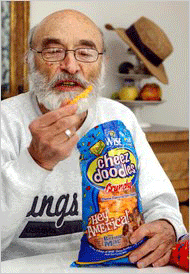
Photograph of Morrie Yohai by Bill Davis of Newsday reproduced in The New York Times

Where was I the day Morrie Yohai died? 

I have no idea.  I completely missed his death in early August. 

Maybe it wasn’t big news in Texas.  San Antonio is Cheeto-land, staked out by Charles Elmer Doolin in 1948.   

But I’m originally from the East Coast.  We ate Cheez Doodles before the Frito-Lay invasion, and Yohai was the man credited with their invention.  Although I can’t locate a copy of the image online, his obituaries all repeat the claim he proudly kept a photo of Julia Child fondling Cheez Doodles on display.

Wonder what makes them such an artificially bright orange.  DADT.  Know I outgrew grabbing bags of these out of vending machines long ago, but the memory of attempting to keep control of the steering wheel with slimy, orange-encrusted fingers is still strong.  In a 2008 interview, artist Sandy Skoglund said: 

The manipulation of food in terms of shape, color, taste, and so on, has achieved highly unnatural results.

Au gratin bather: Doodle-lover from http://www.davesdaily.com/pictures/267-cheesedoodles.htm

An ounce of these baked puffs actually provides 15 percent of your daily calcium needs, but analysis beyond that definitely ruins the pleasure.  DADT.  According to doodle fun facts, that pleasure is significant enough for people ignoring the nutritional warnings to consume the equivalent of 36 Olympic-sized pools filled with Cheez Doodles each year, or the equivalent weight of 1,000 African elephants – 15-million pounds.  If you laid these Cheez Doodles end-to-end you could munch your way all the way from downtown San Antonio to the top of the steps of the Texas State Capitol.

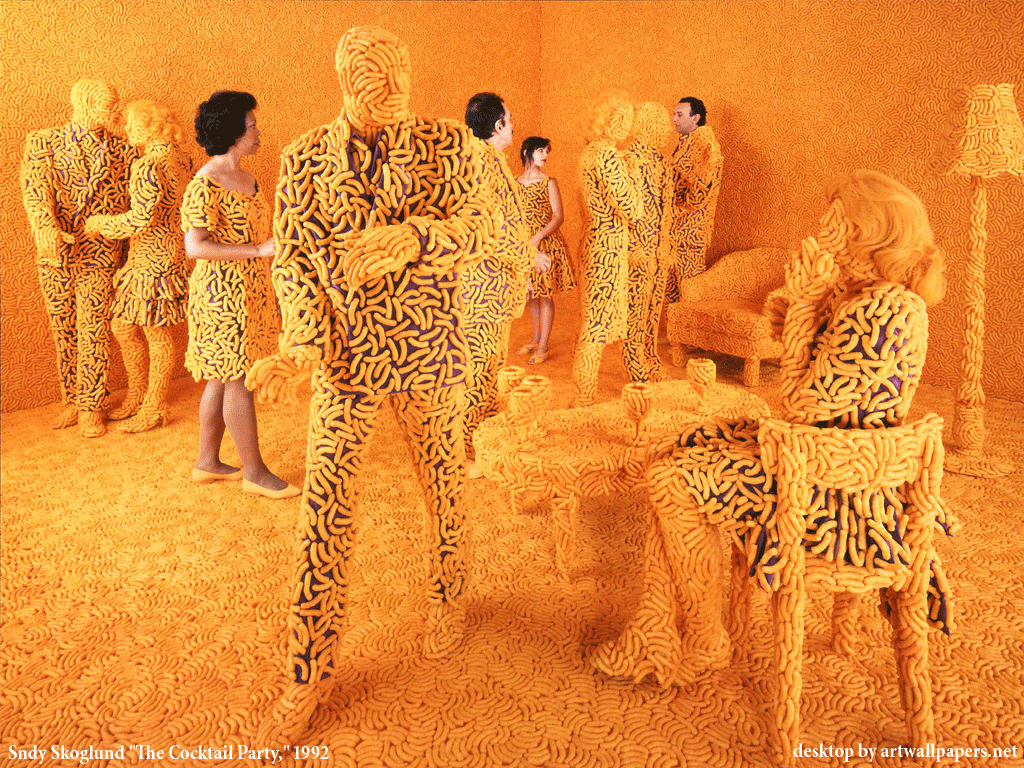
Sandy Skoglund's "The Cocktail Party"

Have no idea how many Cheez Doodles Skoglund used to create “The Cocktail Party,” a cheesy (apologies)  installation recently acquired by the McNay Art Museum.  But I don’t think the writer for the McNay cares for Cheez Doodles much:

“The Cocktail Party” evokes decadence as Sandy Skoglund transforms reality into a garish dream world where mass-produced food products threaten to consume. 

Makes the Doodle people in Skoglund’s installation sound as though they are pod people from a horror film.  But Skoglund herself makes food seem a logical medium: 

…I used the subject of food to create a common language.  After all, everyone eats.

On PBS, Skoglund explained how art became her chosen path: 

…the interesting thing for me is the ultimate sanity of allowing yourself to behave insanely.  When I think back to why I became an artist, it was all about feeling I wasn’t normal….  Even before…I knew what an artist was, I was interested in creating my own worlds.

Before Skoglund gets too far into her lecture at the McNay on Sunday, January 30, I hope she will quickly provide the answers to the low-brow, trivial Cheez-Doodle questions that, left lingering, might distract some small-minded listeners from focusing on her meatier, more meaningful remarks.  Questions such as:

  • Do rodents or roaches ever crawl into museums to nibble away at the Cheez?  
  • You created this piece a number of years back, are these still the original Doodles?
  • When you were taking the photograph, how did the models walking on them keep from crushing Doodles?
  • And, if these are the original Doodles, are they one of the frightening foods that, left undisturbed, will never, ever disintegrate?

Okay.  If I promise not to ask any of these, can I get past the guards?

Update on March 3, 2011: Installing oodles of doodles is no easy task. Watch the time-lapsed video of the staging of “The Cocktail Party” at the McNay.

Looking for a feel-good holiday story? Don’t click here.

Hola my Teresa, I’m thinkin’ of you now in San Antonio.
I have 27 dollars, and the good luck of your picture framed in gold.
Tonight I’ll put it all on the fighting spurs of Gallo del Cielo,
Then I’ll return to buy the land Pancho Villa stole from father long ago

Gallo del Cielo by Tom Russell
 
Men lay down their bets on their roosters on this plate produced in San Antonio by San Jose Pottery.

I’ve listened to Joe Ely weaving the sad tale toward the inevitable death of El Gallo countless times.  It’s tragic, but I dismiss it as more of a folk tale than a current event. 

After all, one of my favorite possessions is a cockfighting plate produced in San Antonio by Ethel Harris’ San Jose Pottery

And I find it amusing to reflect on San Antonio’s rough and tumble past as evidenced in the pages of the 1911-1912 edition of The Blue Book, a visitors’ guide to the city’s red light district.  In addition to a multitude of brothels just south and west of City Hall, there were at least two cock pits – Ogden’s and Monterrey – located on South Santa Rosa.  I even incorporated their ads in one of my Blue Book series of prints:

The Blue Book No. 2. The Blue Book's listings for cock pits on South Santa Rosa Avenue in downtown San Antonio is combined with images of roosters and a period map of the area. Edition of 25. 10 1/4 x 3 1/4 inches.


“Mayor Callaghan crowed at City Hall during the week, but spirited fights could be found just two blocks to the west on weekends.”

The palenque, or cock pit, in Real de Catorce

The palenque, or cock pit, in the former ghost town of Real de Catorce remains one of my favorite landmarks to explore.  But that is made easier because I was not with my husband and his younger brother when they stumbled upon men placing their bets on an actual cockfight there. 

During one of our jaunts to Mexico, I tried to convince my husband we should buy the ruins of the palenque in Mineral de Pozos, a former ghost town near San Miguel de Allende, to incorporate in a retirement home for us (one of many ill-conceived notions expressed during more than three decades of marriage from which he wisely has managed to divert my attention until common sense returned, albeit always on a fleeting basis). 

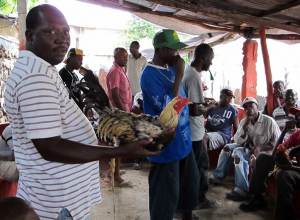
"A Competitor and His Cock," Haiti, June 2010, photograph by Vic Hinterlang

Our friend Vic pulled out his camera in Haiti this past June to document a cockfight at Delmas 31.  When he lagged on posting a follow-up, I feared he was hooked and was out training a cock of his own.  But my fears were groundless; he simply was flying back to Austin.

Cockfighting is something I prefer to pretend only occurs in the past tense, or, at least, takes place in some other country.  The world is becoming a kinder, more gentle place (dream on, Gayle).  But, in support of this argument, Spanish Catalonians recently enacted legislation drawing an end to their deeply entrenched tradition of bullfighting. 

Periodically, media intefere with my naive theories.  The other day, I made the mistake of reading Brandi Grissom’s coverage of cockfights, and their aftermath, outside of Dallas for Texas Tribune

One by one, Domanick Muñoz pulled bloody and battered bodies out of a pile of feathers, claws and beaks. Roosters that were still gasping for life….

The posted videos are not for the faint of heart.  Grissom makes it impossible to continue in a state of denial.  Cockfighting is not something that should be included in “It’s a Texas thing.”

Update Posted on February 8: Had to add this cautionary tale – “Man Killed by His Own Cock” (my headline)

Update Posted on March 17: Oscar Barajas, who recently wrote a post about his father’s disappointing cock, forwarded this link to “La Muerte de un Gallero.”

Update on May 22, 2011: Bobby Jones calm defense in Texas Monthly of his livelihood, breeding game birds, seems blood-chilling to me. “Harvesting” is the professionals’ word for cockfighting:

…what goes on at harvesting facilities is no different from what you see at a golf course, the rodeo circuit, or a bass tournament. It’s a gentleman’s wager, like betting on a football game.

As part of his explanation of legitimacy, he claims that gaffs for cockfighting were brought over on the Mayflower. But, his best point is:

No, what I’d like to see is a law that gives rural counties the power to decide what they want, instead of being told what to do by people in cities. Why are people in areas like Houston and Dallas, where there’s practically no morality, able to dictate what we do in rural areas, when they know nothing about it?

Poor guy:

Politics often gets in the way of my livelihood.