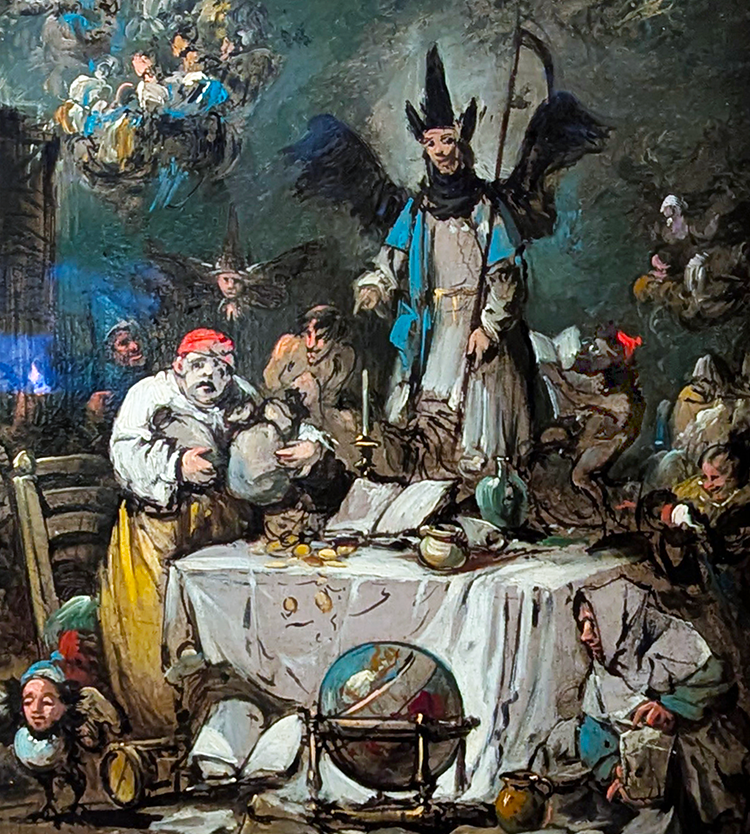
Above: Detail of “Allegoric Capricio,” Eugenio Lucas Velazquez (1817-1870), 1852, Lazaro Galdiano Museum.
Vispera de Todos los Santos. The hallowed eve preceding two holy days in the Catholic Church: All Saints’ Day and All Souls’ Day. Or, for the superstitious, La Noche de Brujas, when the witches fly.
Today, it appears Spain has succumbed to the highly contagious American-style celebration of Halloween. With all its horror-film-like bloody mess.
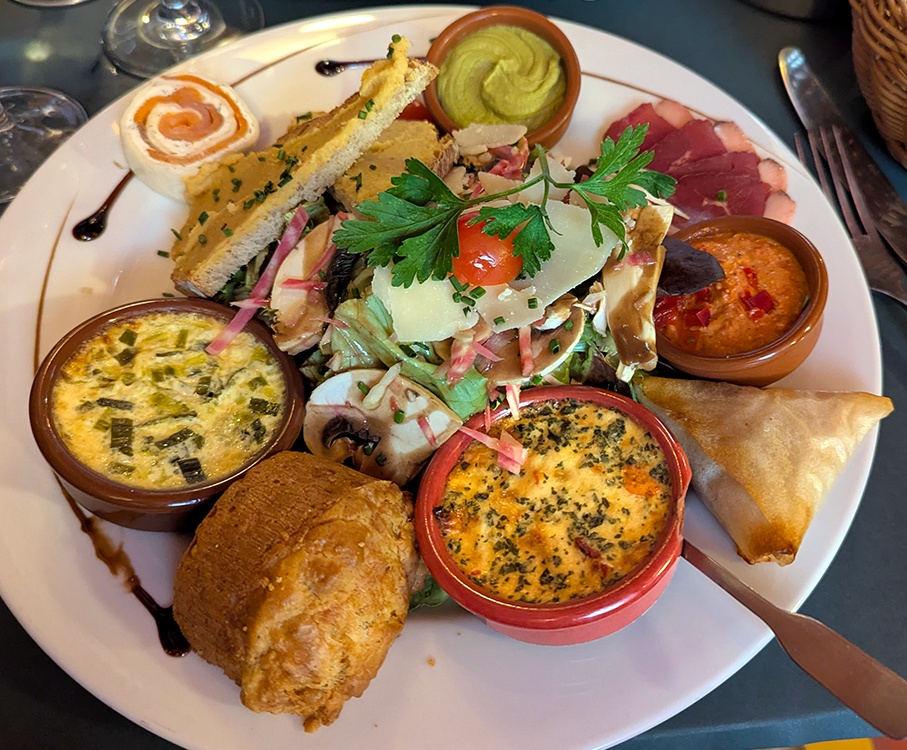
Above: Perfect for the indecisive, a sampler platter at L’Epicerie Restaurant.
We didn’t stay in Avignon many days, so the list of restaurants we experienced is shorter than normal. Don’t be confused by the inclusion of two unrelated epiceries. Both have pleasant outdoor seating, but the food experience is totally different.
L’Epicerie de Ginette is more a cafe than a restaurant, but its seating on the tree-shaded plaza across the street is ideal for people-watching. Caramelized goat cheese on toast atop a salad was substantial, while a croque monsieur was spartan, a slim slice of ham and a paucity of cheese. The luscious raspberry custard tarte represented redemption. Perhaps best to stick with dessert and people-watching.
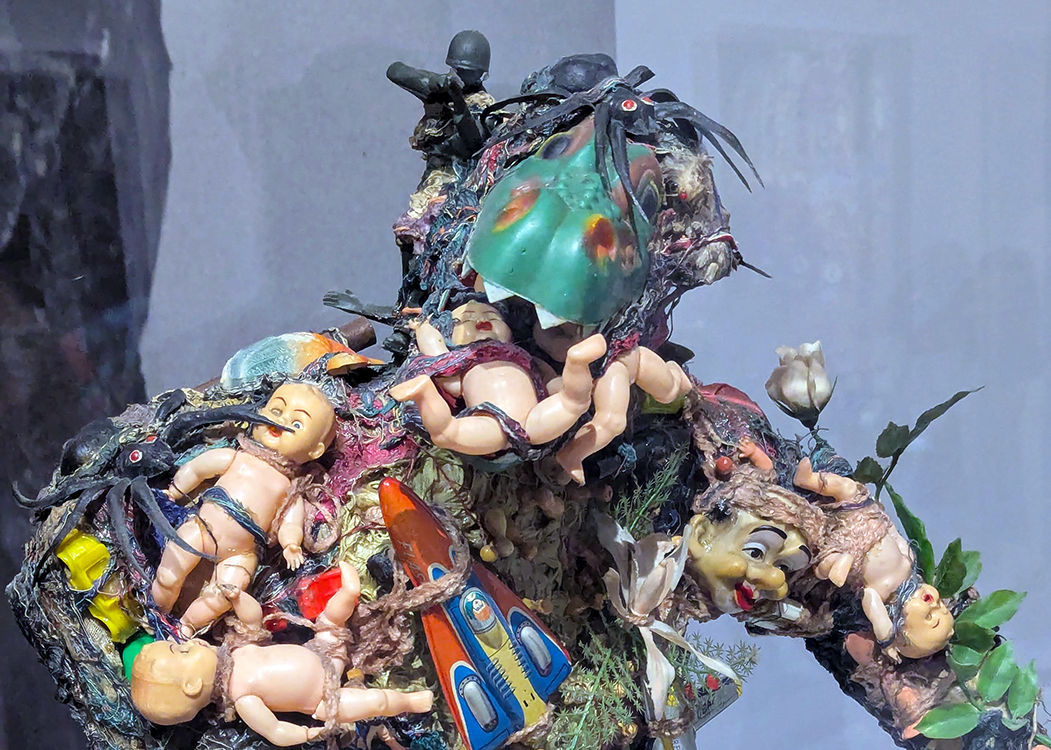
Above: Detail of “Monster Crocodile,” a 1964 assemblage by Niki de Saint Phalle.
I wanted [the fountain] to have charm, with the colors of Niki…. I wanted sculptures like street performers, a little bit like a circus, which was at the heart of Stravinsky’s style itself when in 1914 he had his first encounter with jazz….”
Jean Tinguely (1925-1991)
With bright primary colors twirling around squirting water in all different directions, the 1983 “Stravinsky Fountain” by Niki de Saint Phalle and husband Jean Tinguely ignited a public space between the Pompidou Center, housing the National Museum of Modern Art, and the Gothic-style Church of Saint-Merri. Viewing the flamboyant fountain evokes a childlike joyful feeling in even the most jaded adults.
Above: “Stravinsky Fountain,” Niki de Saint Phalle and Jean Tinguely, Paris, France, 1983.
That whimsical, playful exuberance bubbling up in the fountain and her jubilant plump “Nanas,” with figures resembling my own, meant I failed to take a serious look at her art. I must have been in a teenage trance to miss the media coverage when she exhibited a giant Nana “Hon” with an entryway for attendees between her widespread legs.
Underestimating Saint Phalle’s talents for decades was a mistake. An exhibition this spring at the Caumont Center for Art in Aix-en-Provence altered my misconceptions.




 Postcards from Barton Springs