Chin’s enormous prickly pear umbrella offers shelter along the Mission Reach

WHEREAS, A native of the American Southwest and the Sonoran Desert region of Mexico, the prickly pear cactus provided nourishment to the earliest inhabitants of those regions, and both the sweet, fleshy fruit and the broad, flat stems were incorporated into tasty dishes; and

WHEREAS, Tunas, the prickly pear fruit, and nopales, which are made from the stem, have since become staples of the Mexican diet, and their growing popularity in Lone Star cuisine can be attributed to Texans’ appreciation for unusual and distinctive foods; and….

WHEREAS, This adaptable plant can survive under many different environmental conditions, and thus can be found from the hill country of Central Texas to the windswept plateaus and arid mountains of West Texas; because it thrives in a harsh climate that few plants can bear, the prickly pear cactus is often grown as forage for cattle and has had a tremendous positive impact on the vital Texas cattle industry; and

WHEREAS, Rugged, versatile, and uniquely beautiful, the prickly pear cactus has made numerous contributions to the landscape, cuisine, and character of the Lone Star State, and thus it is singularly qualified to represent the indomitable and proud Texas spirit as an official state symbol; now, therefore, be it

RESOLVED, That the 74th Legislature of the State of Texas hereby designate the prickly pear cactus as the official state plant of Texas.

1995 Texas House Concurrent Resolution

Viewed from the east side of the San Antonio River, the graceful arch indeed appears a portal to pathways on the other side. But Mel Chin‘s “CoCobijos” changes appearance as you approach and circle it.

Commissioned by the San Antonio River Foundation to link the Mission Reach of the river to nearby Mission San Jose, the massive steel sculpture represents the pads of two arching prickly pears joined together.

The prickly pear theme arose from two of Houston-born Chin’s first impressions of the area. Interviewed by Jack Morgan for “Texas Standard” on Texas Public Radio, Chin explained:

One: “I was looking at the roofs of the mission and I found that there was a whole planting of them, a bunch of them that have been growing there since the 1930s.”

Two: “After visiting the site… I noticed how hot I was.”

And since: “There’s nothing stronger than the state plant of Texas, I believe.”

Now: “There’s two of them coming together to create a shelter from the sun and a habitat for live cactus growing above.”

According to the San Antonio River Foundation website, Chin reflected about the resiliency of prickly pear and how the plant historically has nurtured people and animals. The lacey steel picado patterns echo the internal structure of nopal pads.

About the same time “CoCobijos” was unveiled in this semi-rural setting, according to Glasstire, Chin was taking over Times Square and several other spots in New York City with multimedia works portraying frightening potential results if global warming is allowed to continue into the future uncontrolled.

The New York installations are gone, but you need only head south from downtown along the San Antonio River to view Chin’s masterful piece of public art now a permanent part of San Antonio’s landscape.
Postcard from Nervi, Genoa, Italy: Two modern art museums near the seaside

There was a little girl,
Who had a little curl,
Right in the middle of her forehead.
When she was good,
She was very good indeed,
But when she was bad she was horrid.

Henry Wadsworth Longfellow (1807-1882)

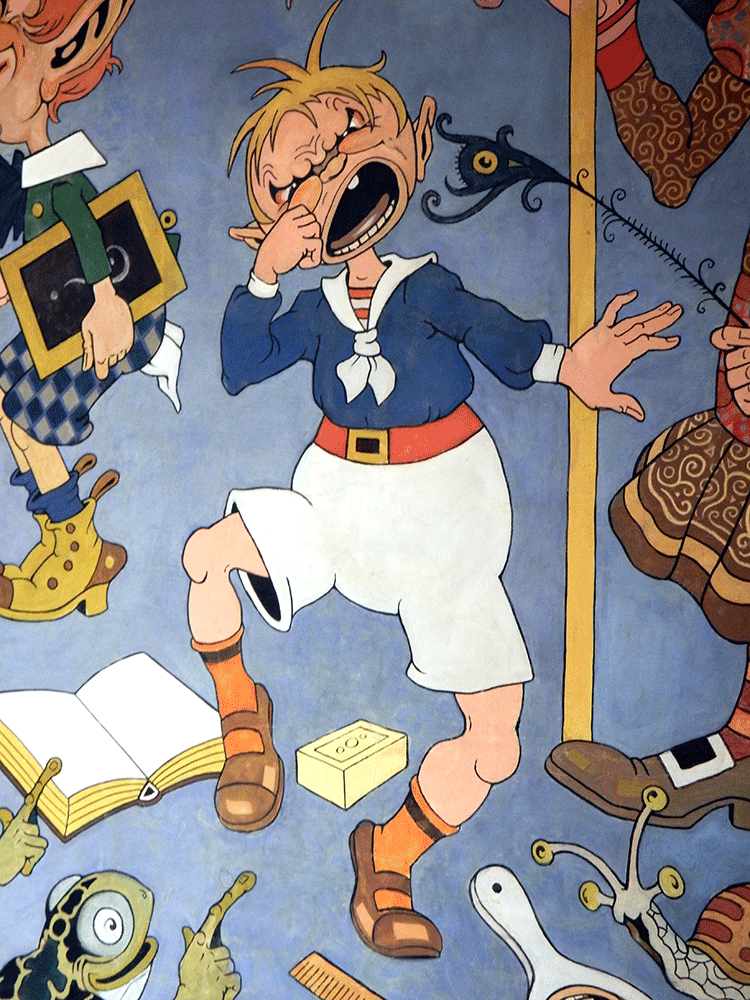
With one wall depicting sweets and attention lavished upon a good child and another the unpleasantness awaiting a naughty boy, Antonio Rubino (1880-1964) transformed a child’s room into illustrations seemingly plucked from the pages of a collection of nursery rhymes. The 1921 bedroom with a “City of Dreams” is but one of the unusual galleries encountered in Wolfsoniana, located in the seaside suburb of Genoa, Nervi. Here, among other things, we learned the Battle of Flowers is not unique to San Antonio; Ventimiglia is known for its Battaglia di Fiori.

The collection of art dating from 1880-1945 in this new museum reflects the interests of Miami-born Mitchell Wolfson, Jr. He opened the first museum showcasing his passions in 1995 in the Art Deco District in Miami Beach. As Wolfson became increasingly attached to Genoa, he moved some of his immense personal collections there. He considers himself, according to the Wolfson Collection website:

…a conservationist because of my desire to discover, but not possess. The challenge is to save endangered objects that are ignored or not held in admiration by others….

Before I decide to buy an object I think whether it belongs to the narrative or not. Truth and beauty don’t interest me particularly. I am interested in the language of objects….

It is the goal of my collection: “to make people think.”

…but I’m not interested in what you think: I shall simply be happy to have stimulated the birth of an idea within you, of a souvenir, a dream.

Mitchell Wolfson, Jr.

Nearby in the 15th-century Villa Saluzzo Serra, the Galleria d’Arte Moderna focuses on artwork from the beginning of the 19th century to contemporary. The base of the museum’s holdings came from Prince Oddone (1846-1866) of Savoy’s collection. The avid collector, a son of King Vittorio Emanuele II (1820-1878), was sickly and died at the young age of 19. The City of Genoa actively acquired art between 1912 and 1950 from the Venice Bienniale and Rome Quadriennale exhibitions, and some of Wolfsoniana’s overflow is on display in the villa as well.

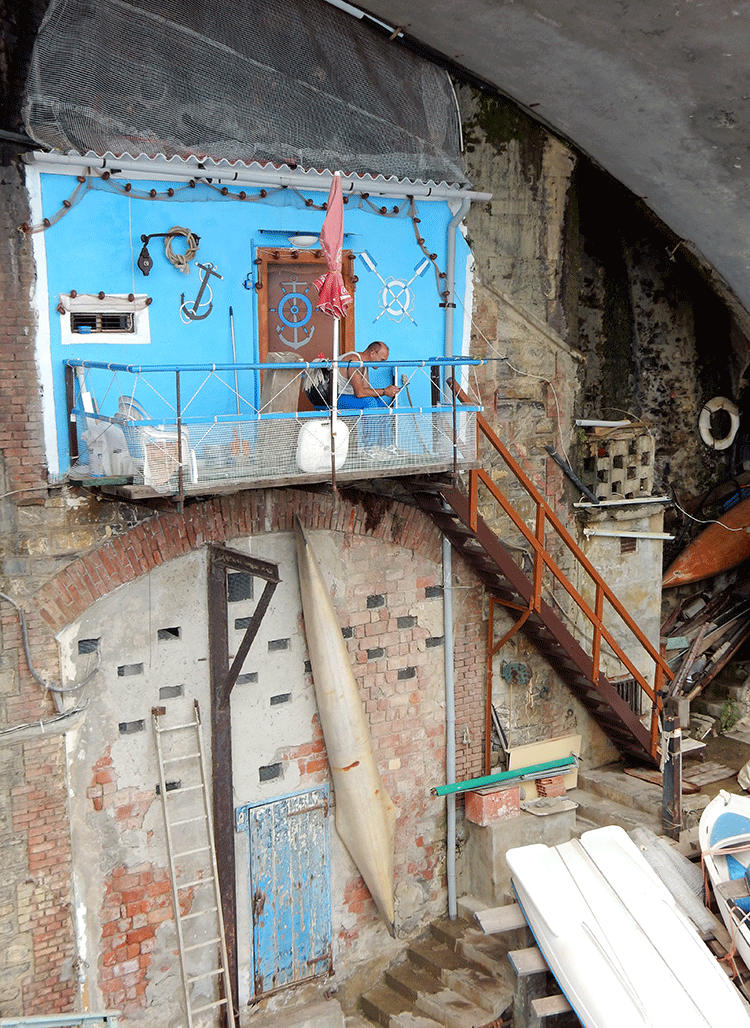
Postcard from Nervi, Genoa, Italy: Seaside perch home to fishermen and the wealthy

The day was gray. Then it was sunny. It was the kind of day that couldn’t make up its mind, wavering back and forth. The lushly planted 22-acre grounds of Parchi Di Nervi and some of its museums were closed, as groundskeepers and museum staff refluffed everything after the wear and tear of the three-week-long Euroflora 2018, an event attracting 285,000 people to the park.

But none of that spoiled the outing to Nervi, a fishing village and seaside retreat now considered part of Genoa and only a short commuter train ride from its center. Handsome art nouveau or Liberty-style villas line her streets, and several museums (more later) welcomed us and one or two other visitors.

Named for the Brazilian-born wife (1821-1849) who fought alongside Guiseppe Garibaldi (1807-1882) in every battle he waged until she was felled by malaria, the winding mile-and-a-quarter long Passeggiata Anita Garibaldi hugs the rugged cliffs plunging down to the sea and provides stunning views at every turn. All of this so dramatically different from Genoa with its harbor full of freighters and cruise ships.

Taking a stairway down even closer to the sea than the passeggiata, we found an outside table perched on the balcony of Bagni Medusa for sampling some of the seafood the local fishermen haul in fresh daily.