
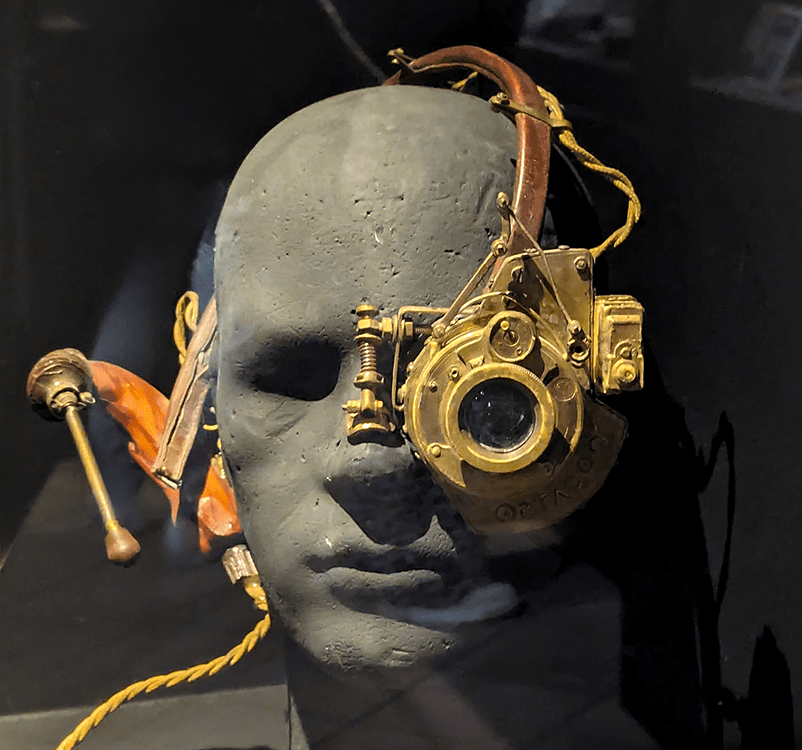

Above: Mechanical eye and listening device used by cyborgs in The City of Lost Children, 1995, Musee de Cinema et Miniature
I’ve always been a fan of science fiction, of models used in cinema. But I prefer miniatures, to dream a little…. I freeze frames of moments in life, places that touch me.”
Dan Ohlmann interviewed by Ludivine Corporal, “His Miniatures Have Been Wildly Successful for Years in This Renowned Museum,” Actu France, November 17, 2024
Dan Ohlmann’s construction of realistic miniatures is more time-consuming than it even looks, yet, by 1990, he had accumulated a substantial enough collection to open his Palais de la Miniature. As his fascination with set-design continued, he expanded to the acquisition of film memorabilia, costumes and props. A lot of them.
With a museum bursting at the seams and attracting an increasing amount of international attention, a Swiss fan arose as a major beneficiary. The donor purchased an early 15th-century Renaissance inn and turned it over to house the collection in 2004 – Le Musee de Cinema et Miniature.
Continue reading “Postcard from Lyon, France: Film trivia challenge”



 Postcards from Barton Springs