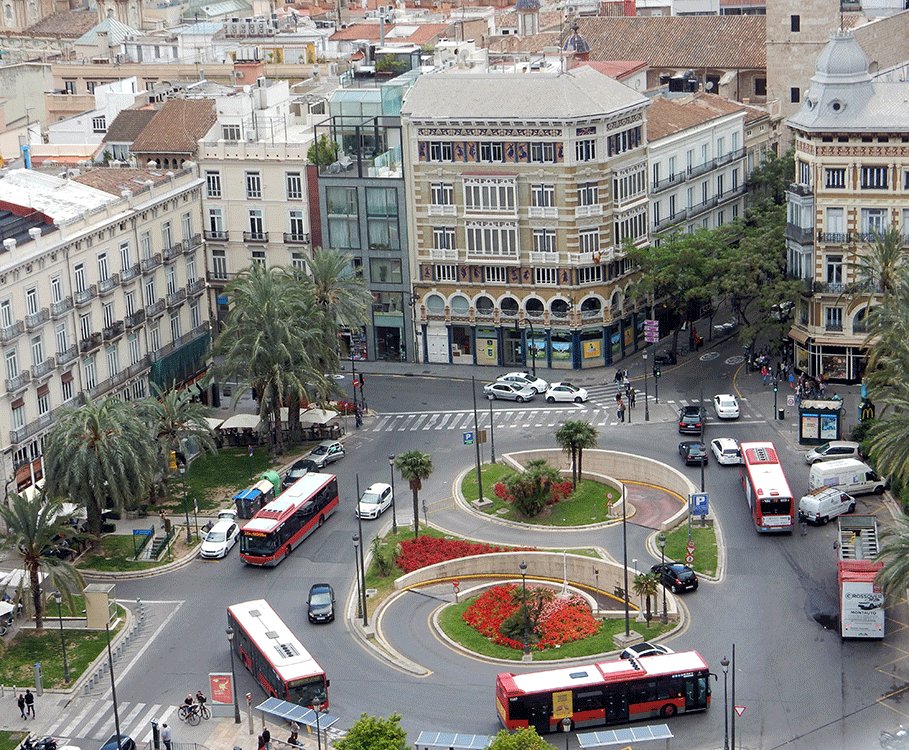
Valencia was a beautiful spot to spend part of our spring this year, and I still am making my way through a pile of photos. Here is a random assortment of more impressions snapped during our wanderings.


Gayle Brennan Spencer – sending random thoughts to and from South Austin
Valencia was a beautiful spot to spend part of our spring this year, and I still am making my way through a pile of photos. Here is a random assortment of more impressions snapped during our wanderings.

I attempted to rise, but was not able to stir: for as I happened to lie on my back, I found my arms and legs were strongly fastened on each side to the ground; and my hair, which was long and thick, tied down in the same manner. I likewise felt several slender ligatures across my body, from my armpits to my thighs. I could only look upwards, the sun began to grow hot, and the light offended mine eyes. I heard a confused noise about me, but in the posture I lay, could see nothing except the sky….
…I could not sufficiently wonder at the intrepidity of these diminutive mortals, who durst venture to mount and walk on my body… without trembling at the very sight of so prodigious a creature as I must appear to them.
Gulliver’s Travels by Jonathan Swift, 1726
There lies Gulliver, sprawled out flat on his back in the five-mile-long linear park created in the dry bed where the River Turia once flowed, helpless as Lilliputian children slide down his hair and scamper all over him. Gulliver’s Park occupies only a small portion of the tree-filled park with ample trails for walkers, runners, joggers and bicyclists.
Bridges, both historic and contemporary cross overhead, keeping modern-day vehicles from interfering. An earlier post focused on recent architectural projects designed by Santiago Calatrava anchoring one end of the Jardines del Turia, but the sculptural bridge arching over the park in the photos below was completed for his hometown about 15 years earlier.
While the linear park is huge, the narrow streets in the heart of Valencia are linked by a huge patchwork of pocket parks and plazas. These urban spaces are highly prized and used by the residents.
When a crumbling structure is removed leaving an open spot developers view as prime, neighbors revolt, trying to claim it for open space. Protest banners hang from buildings abutting one such fenced-off area. They claim the site contains archaeological ruins and should be preserved as an open plaza for public use.


My favorite sign of revolt appears to be somewhat of a vigilante park. Neighbors seem to have taken over the fenced-in property, adding plantings, handmade playscapes, seating groups and whimsical touches. The occupiers kept the gate locked and seemed to have a somewhat regular schedule or social network for nearby families to gather in their cloistered nook in the city.
Pity the developer who tries to usurp the turf now integrated into the surrounding community’s fabric. He might find himself as helplessly entangled in the locals’ Lilliputian web as Gulliver.

Soon after King James I of Aragon secured Valencia from Moorish rule in the 1200s, work began on the Royal Convent of Our Lady of Carmen. It and the adjacent Church of the Holy Cross are at the heart of the neighborhood referred to as Carmen, but, no matter that we frequently crossed the plaza in front of them, we never found the church doors unlocked.
Today, contemporary art exhibitions fill the interior of the former convent, with spacious galleries surrounding two large open-air patios of the Carmen Cultural Center.


Characterized by its explosive fireworks and papier-mache figures set ablaze at the end of the festival, Valencia’s Las Fallas seems a natural partner to get into the spirit of the Burning Man Festival in Nevada. In 2016, artists from Burning Man visited Valencia in the spring, and artist representatives of Las Fallas visited and contributed a major art installation to Burning Man in the summer. Instead of burning it, though, the Valencians returned with their “Renaissance” piece, and the openwork one-room “building” was displayed in the middle of one of the courtyards of the Carmen Cultural Center.
The cardboard structure of “Renaissance” echoes the architectural details of the windows of Valencia’s Silk Exchange, and the outer skin was decorated with faces made from molds of masks created years ago for Las Fallas. The mosaic flooring was composed of 25,000 pieces assembled by volunteers from the Torrent neighborhood in Valencia. The photos above of “Renaissance” in the desert setting of Burning Man are photos of photos from the exhibit. To see better and more interesting images from the cultural interchange, visit Pink Intruder.
While visiting the Carmen Cultural Center, the Mister spotted the clever W.C. sign for me. It was quite a welcome sighting, as the cross-legged figures captured my feelings perfectly.
 Postcards from Barton Springs