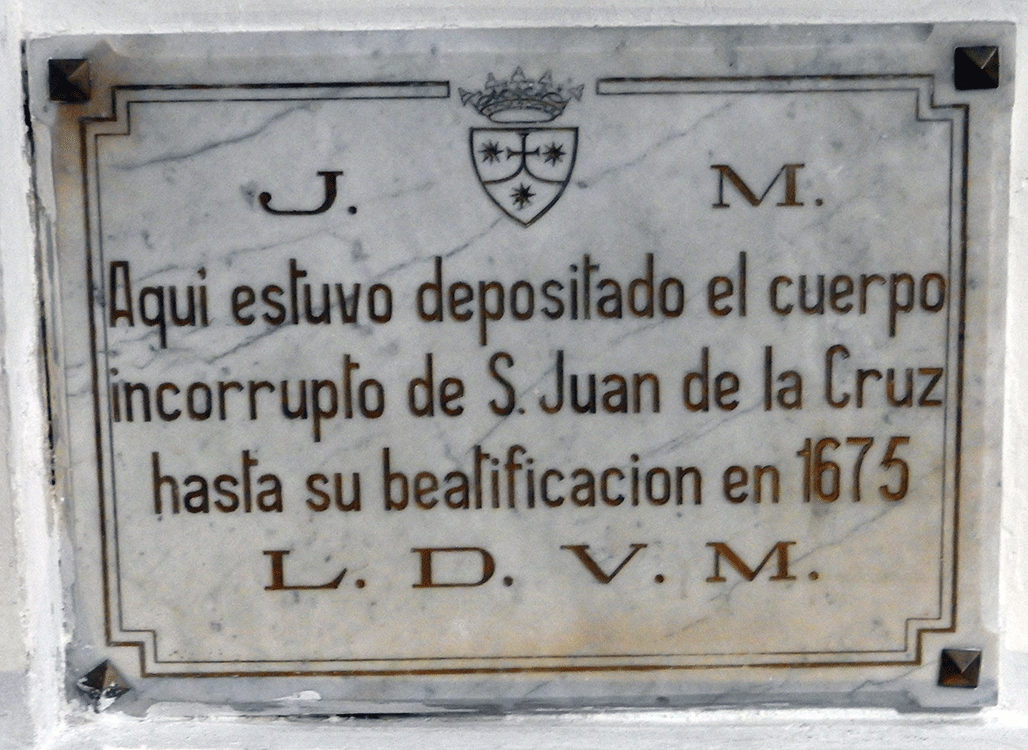
Postcard from Segovia, Spain: Saintly mystery, a case of incorruptu disruptus?

San Juan de la Cruz (1542-1591) and Santa Teresa de Avila (1515-1582) figure prominently in churches in this portion of Spain. Disagreements with Moors and pagans represented only a portion of the conflicts facing Roman Catholics.

Juan and Theresa ran counter to many of the early Carmelites for their insistence upon deprivation among the order, promoting the discalced discipline, meaning a shoeless existence, in addition to religious contemplation in isolation. Those other Carmelites thought they deserved shoes, and a few more basic luxuries, in exchange for their devotion.

The complicated politics involving different orders of Catholics are so far beyond comprehension based on the simplistic teaching of Roman Catholicism to children in the United States. We always went barefoot whenever possible and often when impractical in Virginia Beach, but I’m fairly certain that had little to do with where we stood on the discalced argument within the church. And Father Habit certainly would not have let us attend Mass in a shoeless state; he definitely was a no-shoes, no-host kind of priest. Otherwise, Catholic surfers might have caught one last wave and tracked sand all the way up to the altar.

But one quickly senses in Europe, all Roman Catholics are not alike. Religion is more complicated than those Hail Mary’s and Our Father’s we repeated somewhat mechanically following weekly confessionals.

But enough uninformed diversion about those distinctions.

Segovia is filled with Romanesque churches existing in the shadows of the Cathedral.

But I might have to go back to the claim of the plaque at the head of this post. “Incorruptu.” That means San Juan’s body remained intact, miraculously even after burial. However, that proclamation ignores all the harvestings by those who wanted to retain some of his miraculous powers in close geographical proximity.

According to Catholic Online:

The morning after John’s death, huge numbers of the townspeople of Úbeda entered the monastery to view John’s body; in the crush, many were able to take home parts of his habit. He was initially buried at Úbeda, but, at the request of the monastery in Segovia, his body was secretly moved there in 1593.

The people of Úbeda, however, unhappy at this change, sent representatives to petition the pope to move the body back to its original resting place. Pope Clement VIII, impressed by the petition, issued a Brief on 15 October 1596 ordering the return of the body to Ubeda. Eventually, in a compromise, the superiors of the Discalced Carmelites decided that the monastery at Úbeda would receive one leg and one arm of the corpse from Segovia (the monastery at Úbeda had already kept one leg in 1593, and the other arm had been removed as the corpse passed through Madrid in 1593, to form a relic there). A hand and a leg remain visible in a reliquary at the Oratory of San Juan de la Cruz in Úbeda, a monastery built in 1627 though connected to the original Discalced monastery in the town founded in 1587.

The head and torso were retained by the monastery at Segovia. There, they were venerated until 1647, when on orders from Rome designed to prevent the veneration of remains without official approval, the remains were buried in the ground. In the 1930s they were disinterred, and now sit in a side chapel in a marble case above a special altar built in that decade.

Sounds like a major case of incorruptu disruptus.
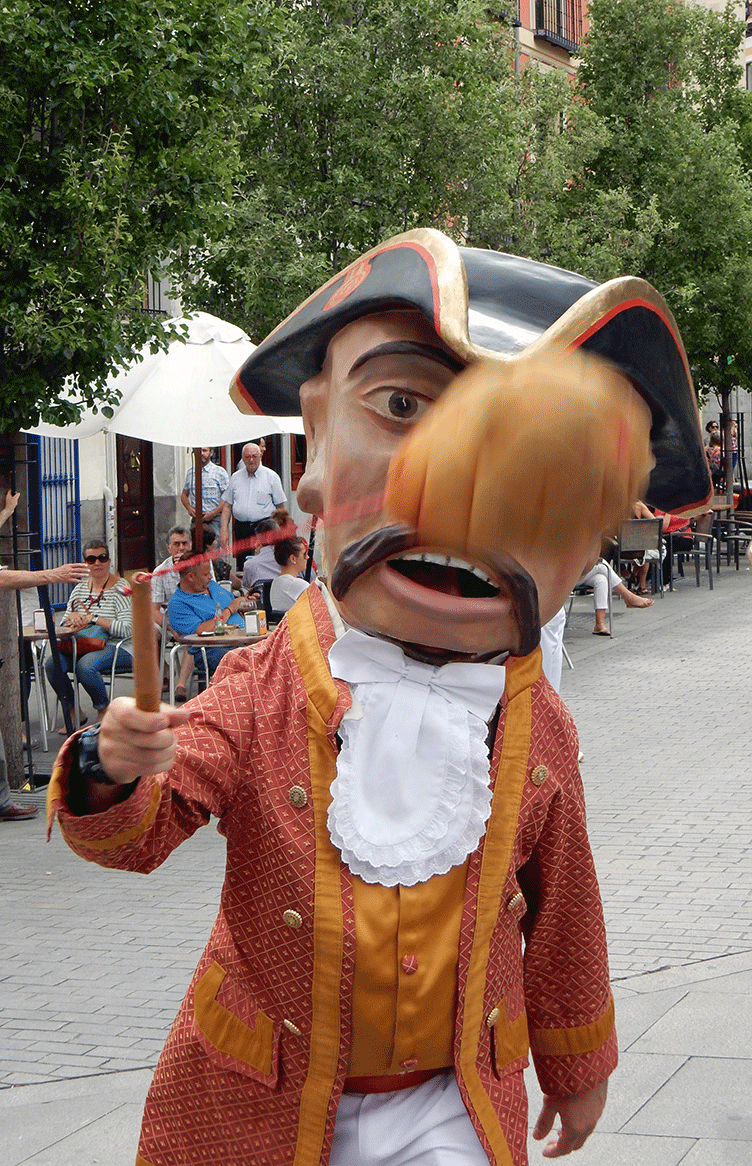
 

Postcard from Madrid: Gigantes y Cabezudos parade to greet us

We arrived on a holiday, a three-day weekend for Madrilenos as they honor their patron saint, San Isidro Labrador (1070-1130). San Isidro was credited with hundreds of miracles, but the one most coveted by working stiffs? Angels would fill in for him, kindly taking over his plowing while Isidro lost himself in religious meditation and prayer.

Madrid has changed a lot since adopting the patron saint of farmers as its own. Arriving here after staying in small cities surrounded by farmland, we were shocked and a bit overwhelmed by the city’s size, both in the scale of the buildings and the number of people. Major sidewalks and pedestrian-only streets were packed.

But celebrations for San Isidro Labrador brought things back to a more human scale for us. The first thing we encountered was a hokey, hometown, colorful parade of Gigantes (Giants) and Cabezudos (Big-Heads) weaving through the streets. One of the shorter advance enforcers, a big-nosed Kiliki, hurled his foam weapon at Mister photographer; the event would be at home in any small town in Mexico.

San Isidro’s remains still reside here, or most of them, behind nine locks in the church bearing his name. Only the King of Spain has the key, and even he is not allowed access without the approval of the Archbishop of Madrid.

The high level of security might seem extreme, but even royalty can’t be trusted from temptation to take a bit of a saint home with them to provide a few miracles needed around the kingdom. Supposedly, Charles II had one of San Isidro’s teeth pulled to keep underneath his pillow. And what of San Isidro’s wife, Santa Maria de la Cabeza? Her head used to be trotted out and paraded around every time the farmers in the area needed rain.

Which brings us back to the parade of big-heads on May 14, followed by the saint’s official day on May 15 that began with many Madrilenos donning traditional fashions of yore and ended with an explosion of fireworks.

Postcard from Segovia, Spain: Suckling piglet box checked off

They are everywhere. Their eyes seem to follow you wherever you walk in Segovia, demanding you stop and carve into one. Segovia takes great pride in regarding itself as the capital for roasting tender little piglets not yet weaned from their mothers. No part of a piggy goes unused. Dogs in Spain would be so lucky as to get those big bags of dried pig ears found in pet stores in the United States; those are fried up for tapas here.

Rather than a stuffy, formal restaurant, we chose a place popular with locals and with more of a mom-and-pop feel, Meson Don Jimeno. I gamely gave into sampling a piglet – tender, succulent, juicy from the fat of its crispy skin. Mama sow should be pleased with how flavorful her baby tasted, but after a couple of bites I was looking around for vegetables. Meaning more than the accompanying fried potatoes. The roasted pork was preceded by judiones de la granja, a traditional hearty stew stocked with giant beans enriched by saffrony chorizo.

El Fogon Sefardi was much more formal, even though it was filled with families celebrating Mother’s Day over a three-day weekend. The Mister hoped to repeat his experience with eggplant and honey in Granada several years ago, but, alas, a heavy tempura batter overpowered the eggplant here. Our stacked fish entrée was more successful, and dessert was a welcome simple baked apple.

While the service was old-school at Restaurante Jose, almost directly below our apartment on Plaza Mayor, the intimate dining room was filled with regulars engaged in exuberant conversations. Starters included a bean and clam stew and seasonally prevalent white asparagus wrapped in smoked salmon. We followed this with a rich lamb stew and a nicely grilled fish.

Totally strayed from traditional Spanish fare at La Juderia, know for Indian and Pakistani flavors. Vegetable pakora provided a nice intro, followed by vegetable biryani and daal. Dessert was a bowl of refreshing chunks of pistachio ice cream.

Still recovering from my piglet encounter, we ventured into the vegetarian Restaurante Azabache. Although I’d recommend the spot, we erred by ordering two too-rich dishes, a vegetable cannelloni and an eggplant dish, tomato-sauced and cheese-topped to the point they looked identical.

Which made the platter of grilled vegetables at La Tasquina all the more appreciated. The fish soup was wonderful, as were the mussels in a rich, saffron broth.

While roasted suckling pig traditionally steals the show in Segovia, the city’s contemporary cuisine is much more diverse.