Postcard from Cordoba, Spain: Mezquita Catedral

The Cathedral of Cordoba is dedicated to Our Lady of the Assumption, yet even the city’s Catholics tend to refer to it simply as La Mezquita, the Mosque.

A Roman temple once stood on this site, but it was torn down with its building materials recycled for construction of a Visigoth church. The Moorish conquest in the 8th century resulted in another teardown and recycling of materials, particularly columns.

Cordoba became the headquarters of the independent Caliphate in Spain, and a golden age of construction burst forth to create a capital to rival the splendor of Damascus and Constantinople. This meant the mosque must be enormous.

The interior boasts approximately 850 granite jasper and marble columns. As the handsome columns were too short to attain the desired height, the arches they supported were topped with a second tier of arches, all in a striking pattern alternating red brick and white stone. A shell-shaped ceiling carved from one block of marble crowns the gilded Mihrab, the original center for prayer, at the heart of the Mezquita.

King Ferdinand III (1199-1252) reclaimed Cordoba from the Moorish rulers in 1236, and the mosque immediately was consecrated as a Christian place of worship. The original Gothic altar inserted in the middle of the former mosque was expanded and modified to reflect later and Renaissance and Baroque styles. The architectural encasement of the original minaret masks its origins. A full Renaissance nave popped up above the existing roofline during the reign of King Charles V (1500-1558). Some say the king was displeased with the resulting intrusive architectural assault upon the stunning structure.

Lawrence Boheme offers a tale involving a 1,000-mile round trip for the bells of Santiago de Compostela to symbolize the historical rivalry between the Spain’s Christians and Muslims at this site:

At the height of Muslim power, during the Omega Caliphate at the end of the 10th century, the fearsome warlord Al-Mansur led a bloody raid through northern Spain, going as far into Christian territory as Santiago de Compostela. On the loose in the great pilgrims’ city, the Moor had the audacity of riding his horse into the cathedral and letting it drink from the font of holy water, outraging the Christian townsfolk; then, even more insultingly, he had the church’s bells carried 500 miles south to Cordoba, where they were melted down to make lamps to illuminate the Great Mosque.

When, two and a half centuries later, in 1236, the Castillian King Ferdinand the Third (“The Saint”) reconquered Cordoba, his first action, to avenge the humiliation caused by Al-Mansur, was to have the lamps carried back to the shrine of Saint James, where they were melted down to make a new set of bells.

Postcard from Cadiz, Spain: Friendly since Phoenician times

This Phoenician woman appeared so friendly in the Cadiz Museum, as though welcoming us to town. Her wave in this post can be considered “adios” because these snapshots are our parting ones.

Love the sensuous Solomonic columns we encountered in random locations, the colorful azulejos benches and the braid left in a church alongside milagros. I had never seen a braid offered in gratitude for a prayer believed answered outside of churches in Mexico.

Next stop Cordoba.

Postcard from Cadiz, Spain: Favorite aunt hanging by strings for generations

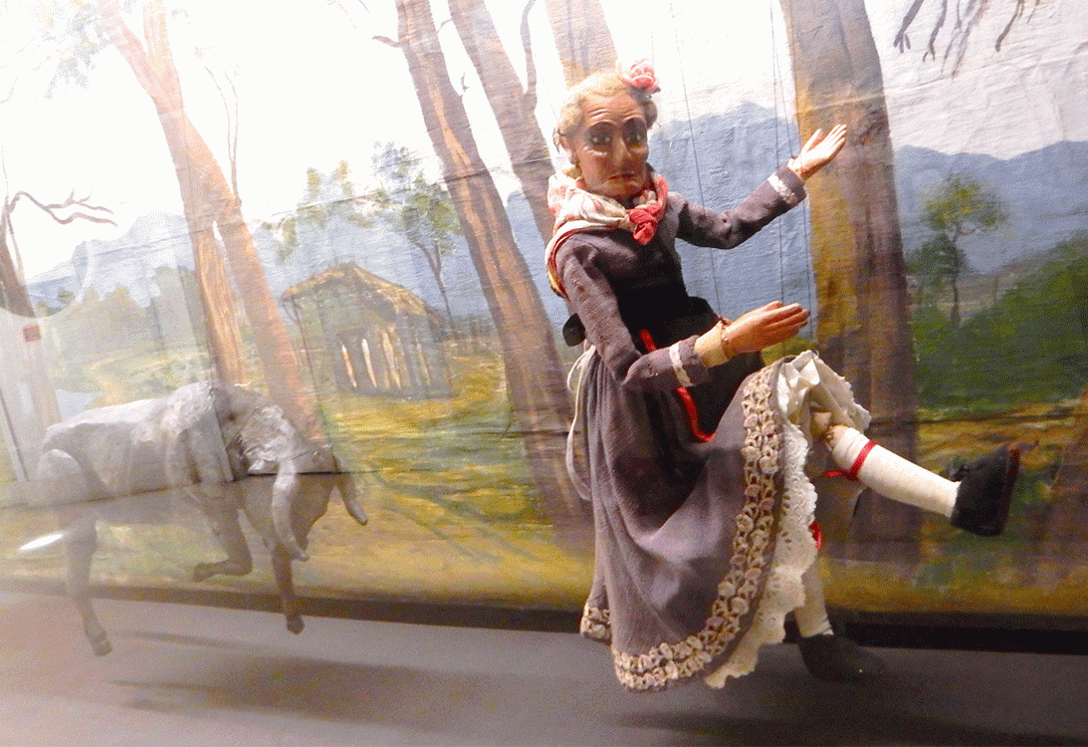
Tia Norica

“Corre, corre, Tia Norica.” Tia (Aunt) Norica first pranced across a stage for audiences in Cadiz in the early 1800s.

With a cast of carved wooden figures, artist Pedro Montenegro began staging plays to entertain audiences in 1815. Early shows included the story of the Nativity, Isabel II and Libertad. Tia Norica soon managed to work her way into every play, becoming the audience favorite. The star marionette even merited her own comic sketch, El Sainete de Tia Norica.

The puppet company continued through the years under various directors. Electric lights and retablos for backdrops were added for productions by the early 1900s. And new plays and puppets continued to expand the repertoire.

Some of the charming rod and string puppets made their way to the permanent collection of the Museo de Cadiz in 1978.

“Descendants” of these puppets still are used for festival performances, so Tia Norica retains legions of fans.

No puppeteer is even needed for these older puppets to enchant. My imagination has assigned Tia Norica a voice similar to Robin Williams portraying Mrs. Doubtfire – with a Spanish accent.

The figure of Sancho Panza astride his donkey makes one wonder if the Cadiz puppeteer’s version of Miguel de Cervantes’ classic skipped over Part II, Chapter XXVI, when Master Pedro stages a puppet show for Don Quixote. In the book, Don Quixote was carried away during an attack by Moors in Master Pedro’s play:

Don Quixote, however, seeing such a swarm of Moors and hearing such a din, thought it would be right to aid the fugitives, and standing up he exclaimed in a loud voice, “Never, while I live, will I permit foul play to be practiced in my presence on such a famous knight and fearless lover as Don Gaiferos. Halt! ill-born rabble, follow him not nor pursue him, or ye will have to reckon with me in battle!” and suiting the action to the word, he drew his sword, and with one bound placed himself close to the show, and with unexampled rapidity and fury began to shower down blows on the puppet troop of Moors, knocking over some, decapitating others, maiming this one and demolishing that; and among many more he delivered one down stroke which, if Master Pedro had not ducked, made himself small, and got out of the way, would have sliced off his head as easily as if it had been made of almond-paste….

Don Quixote did not leave off discharging a continuous rain of cuts, slashes, downstrokes, and backstrokes, and at length, in less than the space of two credos, he brought the whole show to the ground, with all its fittings and figures shivered and knocked to pieces, King Marsilio badly wounded, and the Emperor Charlemagne with his crown and head split in two.

A miniature practice round for the windmills that lay in the knight’s path down the road. So happy Tia Norica was spared such an encounter.