Adding a Contemporary Backdrop to a Municipal Landmark

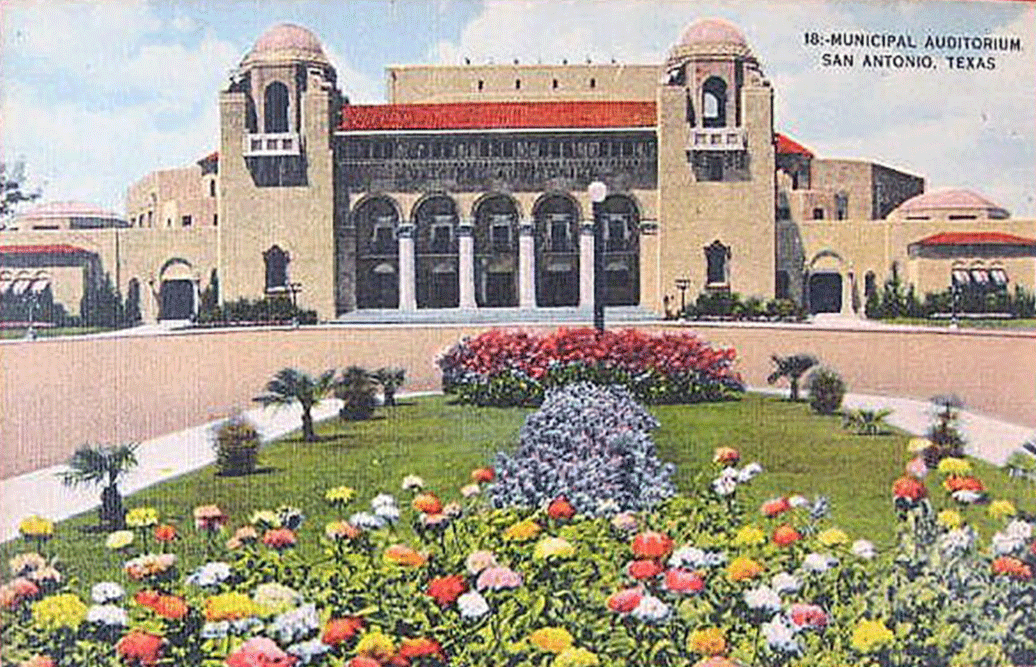
A flood control project eliminating some of the bends of the San Antonio River as it snaked through downtown created a new plot of land enabling the City of San Antonio to cobble together the real estate needed for the Municipal Auditorium, with a distinctive Spanish Colonial Revival profile designed by architects Atlee B. Ayres, Emmett Jackson and George Willis. The $1.2-million Municipal Auditorium opened, lit “from pillar to post” according to the San Antonio Express, on April 19, 1926, with the Texas Pioneers’ Ball:

The result is an auditorium which Mayor Tobin declares without reservation is the finest in the country. Every sort of modern, practicable device has been installed to make the building the last word in structures of its kind….

Since its doors opened, the Municipal Auditorium hosted a huge variety of events – high school graduations, political rallies, boxing matches, concerts, Elvis, Fiesta coronations and even “midget women’s” wrestling – meaning many San Antonians have strong sentimental attachments to it. Which translated to emotional opposition when architects returned with recommendations that demolition of almost all but the distinctive façade would be required to create a facility appropriate for theatrical and musical productions of today. Layered atop the normal historical concerns was sensitivity over its prominent River Walk location.

But the stunning, contemporary solutions presented by the architectural team of LMN of Seattle and Marmon Mok of San Antonio won over many and secured approval.

Was fortunate enough to take a tour guided by Steve Souter and Morgan Williams of Marmon Mok this past week, and the transformation is amazing. Wood paneling the color of a Stradivarius violin is combined with cutting-edge programmable lighting around the upper decks of seating.

This slideshow requires JavaScript.

When the Municipal Auditorium opened in 1926, the Express bragged about its seating; although it doesn’t sound as though fire codes on the number of people who could be stuffed into a room were quite as rigid as today:

The capacity of the auditorium is 6,000 persons who can be seated in the comfortable opera chairs. In event of an extra large attraction, more than 3,000 persons could be seated in extra chairs in the auditorium and on the stage. The stage alone can accommodate 500 people seated in chairs of 1,000 standing. The opera chairs in the auditorium alone represent an investment of $60,000. They are all extra large chairs, 20 inches across the seat. There are 18 oversize chairs for extra large persons. Such big people can find chairs that will accommodate them comfortably if they ask especially for them.

Seating on the ground floor in what will be the Tobin Center for the Performing Arts easily will top that, although not numerically. The main theatre will accommodate 1,750. The wooden ground floor in the photos represents a $12-million investment. But it’s a rather magical floor. Each segment contains seating on its flip side and can be individually rotated and/or elevated to allow for a multitude of configurations. Found a handy-dandy video of this online (Don’t be misled by the video heading; the operation of the Tobin seating will closely resemble that of this theatre in British Columbia.).

For a more intellectual analysis of the Tobin Center’s assets, turn to Mike Greenberg.

The first year’s bookings for the Tobin are as diverse as the Municipal Auditorium entertained and can be found here. The doors will swing open for the first events in September.

(Thanks for providing some of the interior shots, Janet and Allison.)


That Crabby Old Colonel Cribby Condemned the River Walk to Years of Lowlife Nightlife

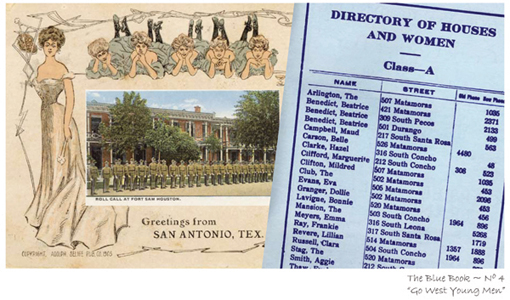
Blue Book No. 4, "Go West Young Men," Digital Collage by Gayle Brennan Spencer. Early 1900s' postcard of some of San Antonio's blue ladies is combined with a period mini-postcard image of "Roll Call at Fort Sam Houston" and a page from "The Blue Book."  The page is headlined "Directory of Houses and Women - Class-A" and lists the names and addresses of some of San Antonio's welcoming women in 1911.  Visit www.postcardsfromsanantonio.com.
Blue Book No. 4, “Go West Young Men,” digital collage by Gayle Brennan Spencer. Early 1900s’ postcard of some of San Antonio’s blue ladies is combined with a period mini-postcard image of “Roll Call at Fort Sam Houston” and a page from “The Blue Book.” The page is headlined “Directory of Houses and Women – Class-A” and lists the names and addresses of some of San Antonio’s welcoming women in 1911. Visit http://postcardssanantonio.com.

I had always heard the banks of the San Antonio River Walk were declared off-limits after dark for members of the military in San Antonio for many years, but I had never seen proof:

The area known as the “River Walk” is “Off Limits” during the periods 2400 hours to 0600 hours daily. It begins at Lexington Street, near the Auditorium, and extends about three hundred yards west of St. Mary’s Street, near the Plaza Hotel.

Office of the Provost Marshal, Fort Sam Houston, December 20, 1945

Melissa Gohlke, blogging for the Special Collections at the UTSA Libraries this morning, posted a 1945 list enumerating San Antonio’s lewd spots, so declared by order of Colonel Cribby.

off-limits-list

Although designed to serve as a warning to soldiers, this list was almost as efficient a guide for “those seeking a good time while in San Antonio, Texas,” as the 1911-1912 guide, The Blue Book. Col. Cribby’s list not only identified which places around town were “off-limits,” but why – whether because of immorality, prostitution, danger of venereal disease or gambling.

Gohlke’s post pertained to “San Antonio’s queer community,” but the list aided those in search of bisexual entertainment as well:

All a GI or WAC need do is read the list, understand the codes, and head out for a night of same-sex recreation. Ironically, the military imperative to regulate deviance facilitated the very behaviors such regulations were designed to stamp out.

Some of the same neighborhoods identified in The Blue Book were still hot spots flourishing under the eyes of lax local law enforcement three decades later.

The Blue Book No. 1, "See Sallie after the Alamo," digital collage by Gayle Brennan Spencer. The back cover of the 1911-1912 edition of "The Blue Book" reads "For Information of the Red Light District Ask Me. Meet me at the Beauty Saloon."  This image is combined with advertisements, including Sallie Brewer's, from an inside page of the guide to San Antonio's "Sporting District," a red light and an early 1900s' postcard of The Alamo. Visit   http://www.postcardsfromsanantonio.com/blue_book.htm.
The Blue Book No. 1, “See Sallie after the Alamo,” digital collage by Gayle Brennan Spencer. The back cover of the 1911-1912 edition of “The Blue Book” reads “For Information of the Red Light District Ask Me. Meet me at the Beauty Saloon.” This image is combined with advertisements, including Sallie Brewer’s, from an inside page of the guide to San Antonio’s “Sporting District,” a red light and an early 1900s’ postcard of The Alamo. Visit http://postcardssanantonio.com.

But what about today? This is from the fact sheet for visitors of participants in Lackland Air Force Base’s Basic Training Program:

Off Limits Areas and Establishments

The San Antonio Armed Forces Disciplinary Control Board has placed establishments off-limits to help maintain the health, morale, and welfare of Armed Forces personnel. Your Airman may not visit these  establishments and will know which ones they will not be able to service prior to town pass.

The River Walk has been family-friendly for decades, but now I am curious about what places in San Antonio are deemed too or lascivious or dangerous for today’s military. This list, not nearly as clear and complete a guide to local entertainment as the 1941 blacklist, is from a 2009 edition of the Lackland Talespinner:

The following locations are off-limits:

• Cracker Box Palace – 622 W. Hildebrand • Planet K – all locations in the following counties: Bexar, Atascosa, Wilson, Guadalupe, Comal, Kendall, Medina and Bandera • Voodoo Tattoo Parlor – 202 Aransas • Players Club (PC) of San Antonio – 8235 Vicar • Boys Town – Acuna, Mexico • Widows Web Bar and Night Club – Acuna, Mexico • The Up and Down Club – Acuna, Mexico

With no Blue Book or more detailed list available on base, what’s a newcomer in search of a little lascivious behavior to do?

It’s so simple nowadays. Just follow those huge “come-hither” billboards around north Loop 410 or grab a free issue of San Antonio Current for pages and pages of full-color “service” ads.

Wayfinding and New Accessibility Enhance River Walk Experience

Always hated to have to break the news to lost joggers asking for help, the ones who looked really ready to be back in their hotel rooms, that they had veered off about a mile in the wrong direction.  But lately, few are in need of assistance.  The $250,000 wayfinding system funded by the Convention and Visitors Bureau and designed by Marek-Hill of Houston seems to actually work.  For the first time since I have lived in San Antonio, there is an informative, logical and cohesive look to River Walk signage.

Ben Olivo of the San Antonio Express-News writes that Juliana Marek is a product of Alamo Heights High School who:

likens a good system to a bread crumb trail, that it’s impossible, or rather impracticable, to cram mounds of information into a single sign.

“What a good sign system does is break down the information in understandable amounts, because people can’t digest as much as they’re moving around,” Marek said. “You really, really have to try and simplify the information as much as possible.”

The signage also helps those wandering Paseo del Rio locate accessible routes, which, finally, most of the downtown River Walk is.  For years, many preservationists balked at altering Robert H.H. Hugman’s original designs to make accessible pathways, and the city shied away from the expense.  I must confess I, too, was skeptical architects could incorporate the necessary changes without damaging the aesthetic appeal. 

But Judy Babbitt, the city’s Access Compliance Manager, never quit in spite of strong opposition.  Judy always has been reminded on a daily basis where virtually every violation of the Americans with Disabilities Act is located downtown because she wheels it continually.  She literally has devoted decades to the campaign to eradicate unnecessary obstacles. 

According to the Public Works Department website, which includes accessibility maps: 

Since the early 1980’s, the City of San Antonio has been active in eliminating architectural barriers and in creating wheelchair accessibility to and along the River Walk. The City has improved more than 50 locations during these two decades, generating new ramps, pathways and, with the help of private businesses, new elevators.

As a frequent critic of the city’s tendency to “value-engineer” the character out of projects, I am totally bowled over by the sensitivity and quality of materials used in the new system of ramps.  They are handsome additions to the River Walk.  Sensitive areas, such as the stepping-stones by the fountain by Omni La Mansion del Rio, were not ruined.  The craftsmanship of the inserts eliminating the dangerous openings is exquisite. 

Like many pedestrians presented with the choice, I find myself often opting for the ramps over steps.  It feels good to stretch out one’s calves on the slight incline and reminds me what strength would be required to propel oneself up them using only arm-power.  Judy should have just challenged all the nay-sayers years ago to arm-wrestle her for the right to make Paseo del Rio accessible.  The paths would have been completed more than a decade earlier.   

Note Added on September 18, 2010More improvements ahead….

Update on January 27, 2012: The City’s efforts to make the downtown River Walk more accessible are receiving recognition:

The Governor’s Committee on People with Disabilities, in partnership with the Accessibility Professionals Association (APA), has announced the winners of the 2011 Accessibility Awards, which recognize businesses and organizations that go above and beyond the legal requirements to provide both physical and service accessibility to people with disabilities.

City of San Antonio Historic River Walk Downtown (San Antonio)
Owner: City of San Antonio
Design Professional: Beaty Palmer Architects, Inc – Michael Beaty AIA, Principal