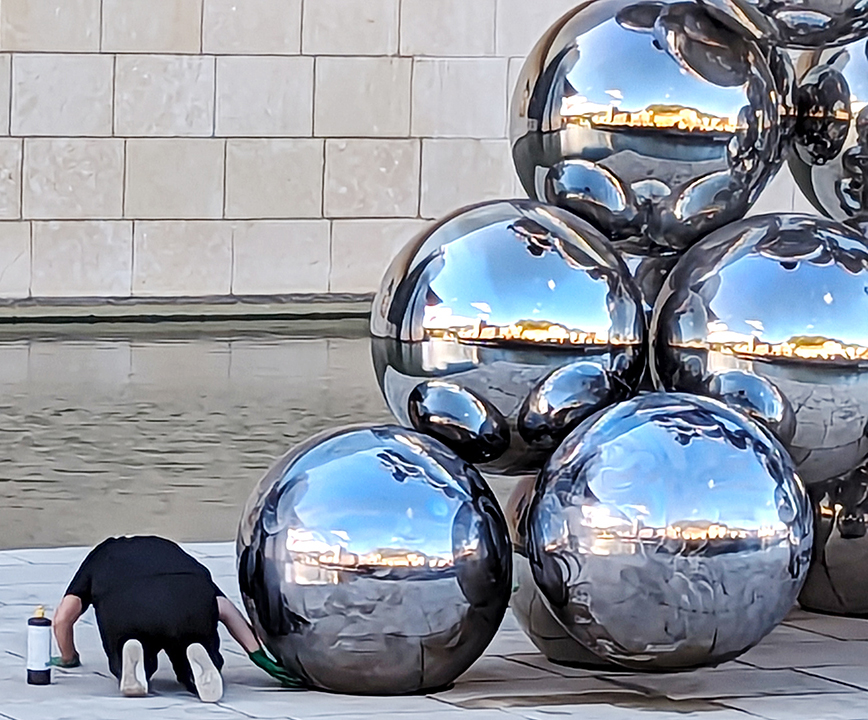
Above: Detail of “Tall Tree and the Big Eye,” Anish Kapoor
Guggenheim Bilbao has turned 25. While 25 years is but a small blip on my age chart, I feared it might prove too long to wait to visit architect Frank Gehry‘s monumental project. People described it as a ship, a giant flower, a fish with shimmering titanium scales. Would it simply seem dated, as much contemporary architecture does after a decade?
My answer is no! It’s a massive, awe-inspiring, sculpture – its scale rendering it overwhelming both inside and out. The deconstructive shapes seem not unlike the Pablo Picasso sculptures of women featured in a major exhibition while we were there. Or Richard Serra’s curvilinear weathered-steel sculpture, “A Matter of Time,” drawing people inside like a giant human mousetrap.
Even spectacular, large-scale artworks encounter difficulties asserting themselves inside the soaring sensuous interior. This is a building one would pay to explore even if there were no art inside.
Maybe that should not be a conflict up for debate. So often architecture is dumbed down by budget, with function superseding inspirational design.
Cities are the spearhead of the most outstanding experiences and the most daring behavior, the places where the greatest development of the arts takes place. Consequently many artists choose life in the city as one of the central features of their work, with the city (often) being understood as a collage of a host of discontinuous, fragmented memories and experiences, a confused labyrinth in which the inhabitants cross paths with one another but remain immersed in their own thoughts.
Jose Miguel G. Cortes, director of IVAM
From the balcony of the apartment we are renting in Valencia, we have a personal portal into Valencia’s Institute of Modern Art, better known as IVAM. Unfortunately, all this portal permits us to see is one of the museum’s stairwells; we have to walk around to the main entrance and pay to enter.
But “Lost in the City,” an exhibition drawn from IVAM’s extensive permanent collections, was a worthwhile place to begin our stay in Spain’s third largest city. Organized around themes, the show portrays more than a century of artists’ positive and negative reactions to the growth of metropolitan areas. The snapshots below capture a few of the included works, but I was derelict in recording many of the artists’ names.
reflection out front of IVAM
“Wanted,” Erro, 1999-2000
Julio Gonzalez
“Wrap around window,” James Casebere, 2003
Helena Almeida
interior stairwell in IVAM
Robert Rauschenberg, 1981
“Untitled (Oasis),” Gregory Crewdson, 2004
“Stadt des Orion,” Hannsjörg Voth and Ingrid Amslinger, 2002 – 2003
IVAM also introduced us to the works, “Corpus,” of Helena Almeida, a Portuguese artist renowned for her performance and conceptual art.
The original core of the institute’s huge collection of sculptures are by a Spaniard, Julio Gonzalez (1876-1972). Born into a family of craftsmen working in metal in Barcelona, Gonzalez yearned for more artistic expressions than construction projects allowed. Traveling to Paris to immerse himself in the thriving art community, he collaborated with Pablo Picasso in the 1920s on a series of metal sculptures that involved a mutual exchange of their creative expertise.
The harsher depictions of metropolitan scenes captured in many works in “Lost in the City” and our stark view of the museum’s portal stand in contrast to our current experiences in Valencia. The heart of this city is pedestrian and bicycle oriented. Our neighborhood is crisscrossed by a rabbit-like warren of winding narrow streets constantly interrupted by intimate plazas filled with lively cafes.
Despite its population of 800,000 residents, even strangers feel welcome in the warmth of such a walkable environment. Becoming lost under the stimulating spell of Valencia is an urban journey beckoning us daily.
Fortunately, the 1927 version of Fritz Lang’s Metropolis is not what life has become…. at least not here.
Between the mind that plans and the hands that build there must be a Mediator, and this must be the heart.



 Postcards from Barton Springs