Postcard from Siracusa, Sicily: From the Baroque to a modern landmark

Above: Chiesa del Carmine

Offering a quick glimpse of a few more churches in Siracusa.

There is a fairly consistent pattern in the history of the majority of these churches. They were built centuries ago; suffered substantial damage in the 1493 earthquake; and were rebuilt in Baroque style.

Continue reading “Postcard from Siracusa, Sicily: From the Baroque to a modern landmark”

Postcard from Siracusa, Sicily: Sturdy columns of Greek temple recycled by several religions

Above: Façade of the Duomo di Siracusa, or Cattedrale della Nativita di Maria Santissima

The chapel where some of Santa Lucia’s relics, featured in a recent post, are housed in the Cathedral of the Nativity of Mary Most Holy. A statue of her reigns up high on its façade to the right of the Virgin to whom the church is dedicated. Up on the left is San Marciano of Siracusa with San Pietro and San Paolo flanking the entrance down below.

Over the past 2,000 years, the history of Saint Marcian of Syracuse has become somewhat muddied. One version is that he was a follower of Peter the Apostle, who dispatched him to Sicily to preach in the year 40. His conversion rate was so high that the ruling Romans deemed him dangerous, and he was put to death. San Marciano became known as the first bishop of the city and is the patron saint of the archdiocese.

The “new” façade of the cathedral dates from after the 1693 earthquake and reflects the style categorized as High Sicilian Baroque. But the rest of the building has much deeper roots. The site was occupied by a 5th-century BC temple of Athena, possibly constructed under Dionysius I. Thirty-six substantial columns surrounded the outer perimeter of the temple – columns so substantial they withstood the devastating earthquake and can still be viewed on the north side of exterior and within the cathedral itself.

Continue reading “Postcard from Siracusa, Sicily: Sturdy columns of Greek temple recycled by several religions”

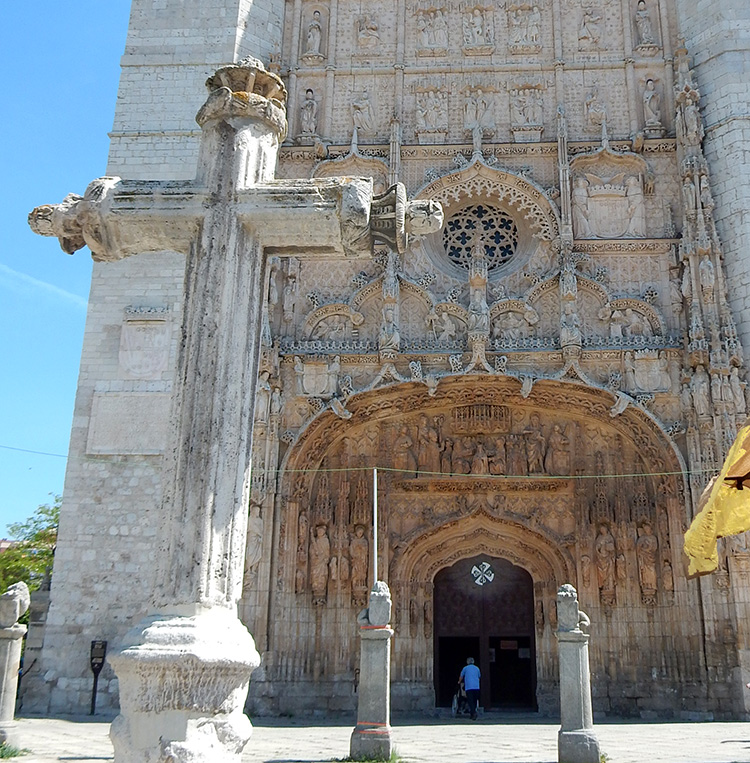
Postcard from Valladolid, Spain: Iglesias and a maligned queen

Above, Iglesia de San Pablo

Valladolid was flourishing in the 15th century when Isabella I, Queen of Castile, married King Ferdinand of Aragon in the city – an elopement with private ceremonies, as they were second cousins. With the city a favored spot for the Catholic royal family members to hold court, Pope Clement VIII elevated it to a bishopric, the center of an archdiocese.

Bolstered by this recognition, city fathers launched efforts to build a suitable cathedral, the largest in Europe. Architect Juan de Herrera (1530-1597) was commissioned for the design of Nuestra Senora de la Asuncion. Despite Herrera’s death, completion appeared possible with the official establishment of Valladolid as the capital of Spain by King Philip III (1578-1621) in 1601.

The rosy future dissipated as a royal advisor standing to personally benefit through his real estate holdings persuaded Philip of the need to move the capital back to Madrid in 1606. The cathedral budget was slashed – about 60 percent.

Continue reading “Postcard from Valladolid, Spain: Iglesias and a maligned queen”