Postcard from Puebla, Mexico: Culinary riches emerged from convents

Never thought “get thee to a nunnery” had an appetizing sound to it. But Puebla is different.

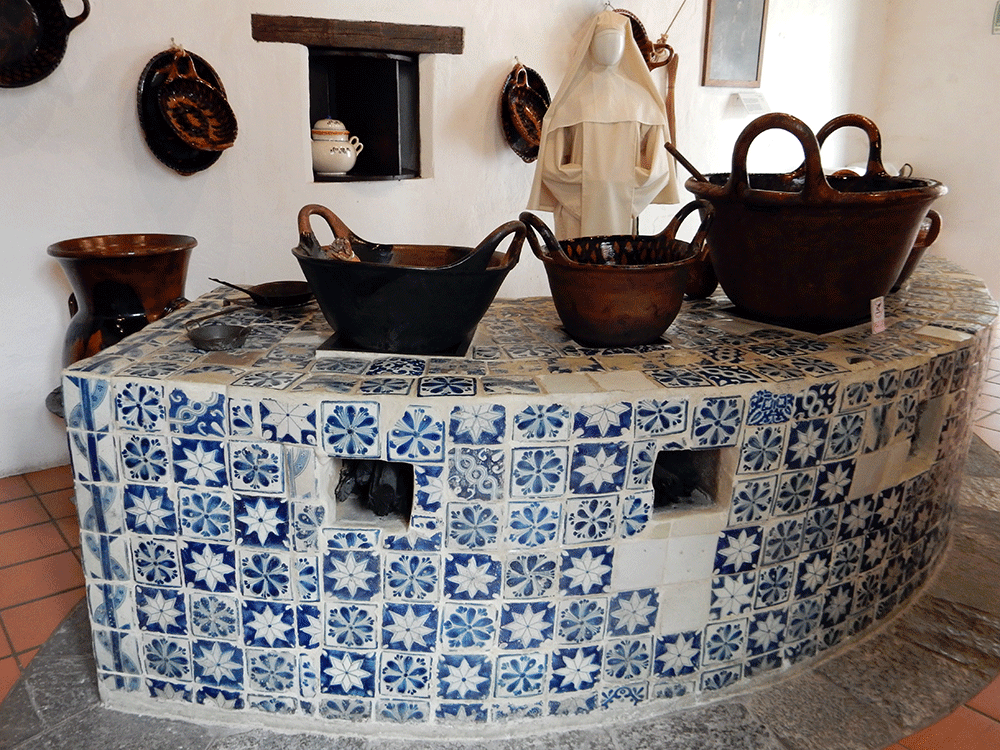
The Talavera-tiled kitchen of the former Santa Rosa Convent is reputed to be the birthplace of the richly flavored mole poblano, and the nuns of the former Convent of Santa Monica are credited with inventing the famous chiles en nogada in 1821 to celebrate Mexico’s newly gained independence from Spain. Reason enough to visit the former convents.

The early history of the building housing the Ex-Convento de Santa Monica is highly unusual. At the beginning of the 1600s, it served as a home for widows and wives whose husbands had abandoned them. Then its role switched as a place to isolate some of the city’s prostitutes; and then the usage seesawed back to a high school protective of young virgin girls in its charge. In the 1680s, it became a convent.

Santa Monica served as a convent for more than two centuries before the nuns had to go underground following the 1917 Constitution of Mexico. The façade of the convent was remodeled to appear as a house, but inside, behind a secret door, a group of nuns remained cloistered.

Supposedly, an antique dealer grew angry when the sisters refused to sell him paintings he desired. Inebriated in a bar, he began complaining about the nuns. A detective overheard him, and the closet convent was raided by police in 1934. The nuns were banished from the premises, and the government converted it to a museum for religious art.

Reviving the city’s reputation for nun-chefs, a new star recently arose in Mexico. Sister Florinda Ruiz Carapia became a fan favorite competing for a cash prize on Mexico’s version of Master Chef. Known as “Hermana Flor,” the humble nun who toils as a cook for seminarians in Puebla, reached the top five. Her popularity only increased because she was striving not for personal gain but to alleviate some of the debts accrued by her order of nuns, according to a story by Mark Stevenson in the San Antonio Express-News.


Perhaps if I tiled my kitchen, I’d miraculously be transformed into a good cook?
Postcard from Puebla, Mexico: Fortunate to encounter Kentridge’s multimedia exhibition

As a guiding principle, Kentridge embraces the notion of fortuna, which he describes as something other than cold statistical chance, yet something outside the range of rational control. In other words, we might understand this as a kind of directed happenstance, or the engineering of luck, wherein there is possibility and pre-determination. Fortuna alludes to a state of becoming wherein the work of art is endlessly under construction — even when encountered as a finished product by the viewer.

Lilian Tone, http://www.museoamparo.com

While we were in Puebla, a floor of Museo Amparo was devoted to “Fortuna,” a huge retrospective exhibition of work by William Kentridge. Born in Johannesburg, South Africa in 1955, the artist appears unsure of what he wanted to be when he grew up. Studying first politics and history, then theatre, then art until scrambling aspects of all of them into films.

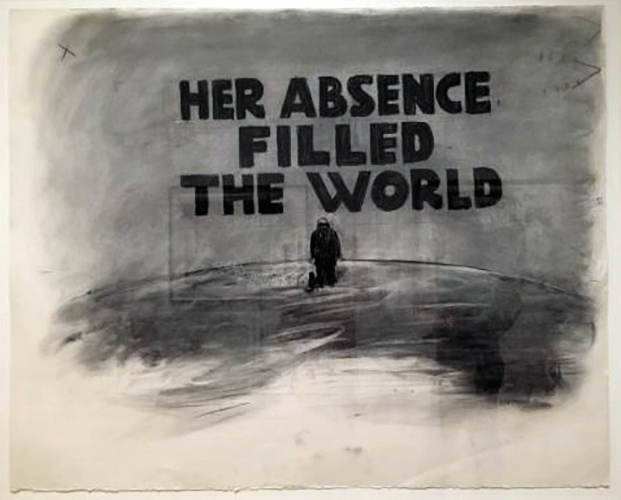
Kentridge’s charcoal works are as politically potent as those of Goya. His simple tribute after the death of his wife – “Her Absence Filled the World” – seems to unleash a gallery-filling howl of mourning.

We visited “Fortuna” twice, fascinated by Kentridge’s videos, sometimes incorporating his charcoal drawings in progress and/or the reverse and sometimes focusing on personal autobiographical interactions of him with himself. Life-size projections brought him pacing into the room with you (the Mister in the above photos), even though many were in black and white.

Below are two brief snippets plucked from the exhibition:


Really recommend making time for viewing this documentary, William Kentridge: How We Make Sense of the World. The thought process governing his artistic process is wonderful to watch unfold.

Postcard from Puebla, Mexico: Linking the art of the past to the present

Although an earlier post dragged you straight to the rooftop of Museo Amparo, that by no means indicates the inside of the stunningly rehabilitated former hospital dating from 1538 should be skipped.

The core of the museum’s collection is comprised of more than 1,700 Pre-Columbian artifacts. Many of the antiquities are on loan from the private collection of Jacqueline Larralde and Josue Saenz.

The museum also showcases contemporary art, striving to stimulate “dialogue between art, history, the present, the roots and the people of Mexico.”

So eerie that the man in the cone-shaped hat seemed to turn, smiling ever so slightly as he watched the video of his dancing descendants. If he had not suffered the misfortune of losing his hands at some point during the past several centuries (perhaps among “those things that fall through the cracks in the floor”), surely he would have clapped.