Postcard from Palermo, Sicily: Hands down, the best food we’ve found

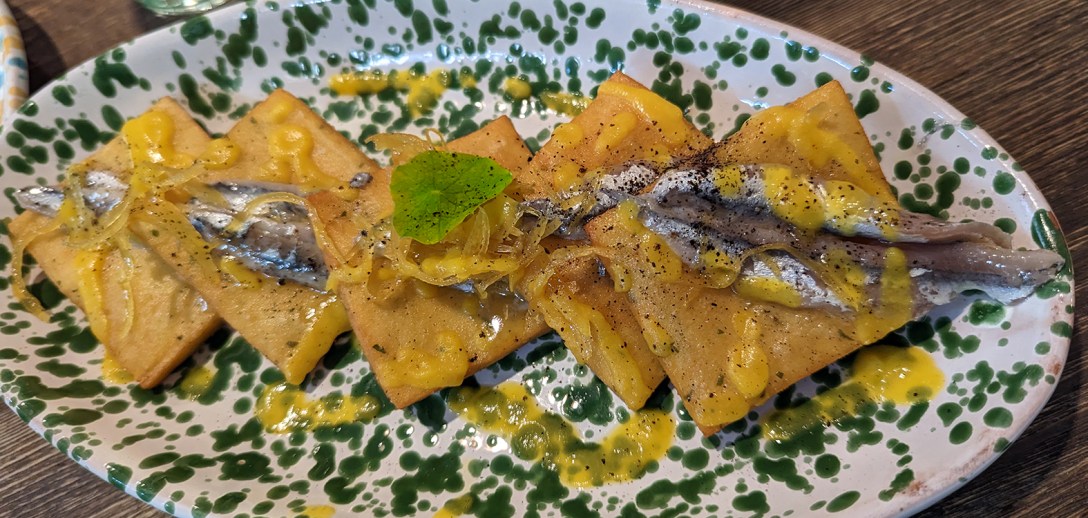
Above: Panelle with anchovies at Le Angeliche

(Part One can be viewed here.)

Odds are Le Angeliche is a restaurant you would never just happen upon, and, if you did perchance walk by its door, you’d still not take notice. Even trying to find it with google maps frustrated us a bit.

It’s located on a vicolo, an uninviting alleyway obscured by the crowded, sprawling El Capo Market. Produce sellers toss heaps of empty crates and boxes into the alley, and Le Angeliche’s door is just beyond that pile with hard-to-spot signage. Pass through the doors, and the hubbub of the market vanishes. The cozy bistro opens up onto a patio encased in lush greenery and a wall covered in blossoms.

This patio proved my favorite lunch spot in Palermo, as you can tell from the abundance of photos below. The menu reflects whatever’s fresh in the market, and we trusted the creative kitchen completely. Take what looks like a plain ball of rice below. The “naked rise” was studded with raw shrimp and topped with thin flakes of bottarga, a dried fish roe. Or panelle, chickpea flour fritters offered by street vendors, but thinner here and elevated by the addition of lemony anchovies.

Continue reading “Postcard from Palermo, Sicily: Hands down, the best food we’ve found”
Postcard from Genoa, Italy: Hey, don’t knock peanuts

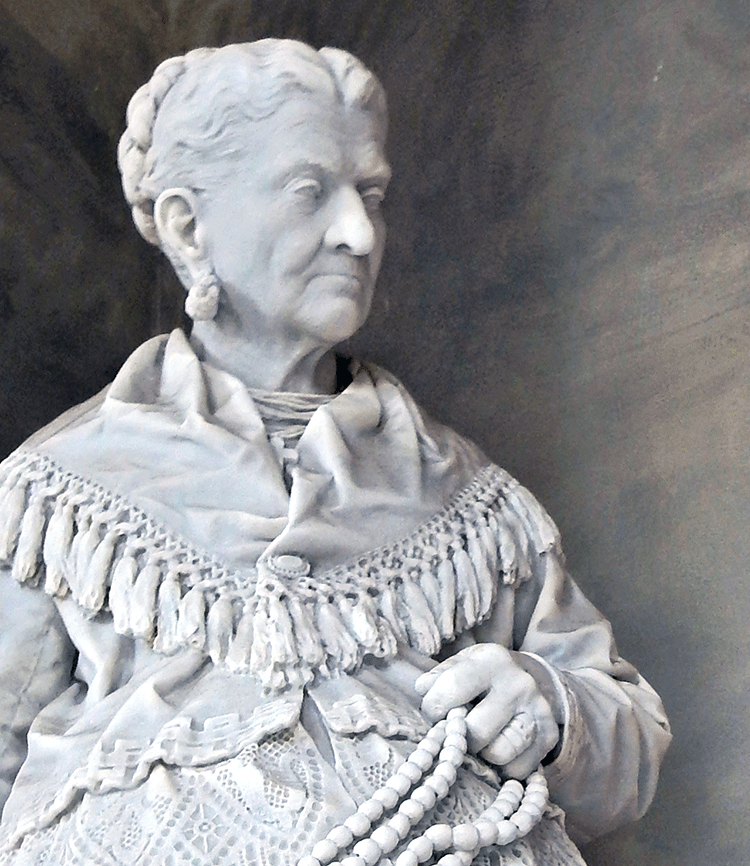
The graceful statue of Caterina Campondonico is among the most popular in the Monumental Cemetery of Staglieno because of how it was secured. Peanuts.

“It’s only peanuts” is an idiom that never made sense in our house. Peanuts meant everything to us. My father, Lawrence Conway Brennan (1918-1988), was deep in peanuts.

Not that we grew up in a peanut patch, but our father was treasurer of the Columbian Peanut Company in Norfolk, Virginia. His engagement in the nerve-wracking gamble of predicting peanut deliverables by the railcar-load, subject to all the possible whims of Mother Nature in several southern states, sent three girls to college.

Campondonico scrimped and saved lire throughout her life to commission Lorenzo Orengo (1838-1909) to sculpt this prime example of Bourgeois Realism art in 1881, prior to her death. She funded the monument, as fine as those of neighboring aristocrats, from a lifetime of sales of doughnuts and nuts on the streets and at fairs in Genoa. She clutches a rosary of hazelnuts and a pair of doughnuts in her hands. The restoration of the statue was completed in 2016 by American Friends of Italian Monumental Sculpture.

“The Peanut Seller” is far from alone in the 82-acre cemetery; she is in the company of more than 2-million other Genovesi. The cemetery opened its gates to welcome its first deceased occupants in 1851, and the majority of its monuments are from the period of the following hundred years.

In addition to Staglieno’s monumental pantheon and marbled halls for the dead, families erected individual house-like or chapel-like mausolea climbing up the surrounding hillsides on narrow “streets,” forming sort of a suburban village overlooking those resting down below.

If this abundance of photos fails to satisfy your taphophilia, you have a severe obsession. As do I. I finally added a separate category on this blog for locating and scrolling down through related posts: Haunting Graveyards.

And, maybe, in memory of Caterina “The Peanut Seller” and Connie, my father aka “Goober,” rethink that dismissive idiom. Perhaps even improve a few sayings. A peanut in the hand is worth two in the ground. A peanut sold can be a penny saved. The road to heaven is paved with peanut hulls.