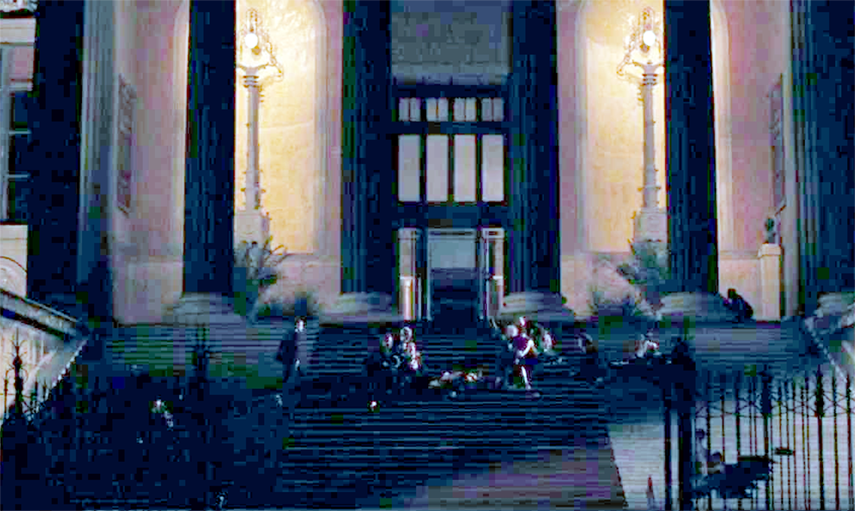
Above: Scene from The Godfather III shot on the steps of Teatro Massimo
Even if you have never seen The Godfather III, a spoiler alert scarcely seems necessary when revealing lots of bodies fall during the last few scenes of the film. You’d expect no less in any of Francis Ford Coppola’s trilogy of films revolving around the Corleone family.
But who knew a silent scream could be rendered so powerfully as Michael Corleone’s? The unheard-scream scene was rendered on the steps of Palermo’s Teatro Massimo Vittorio Emanuele, the largest opera house in Italy.
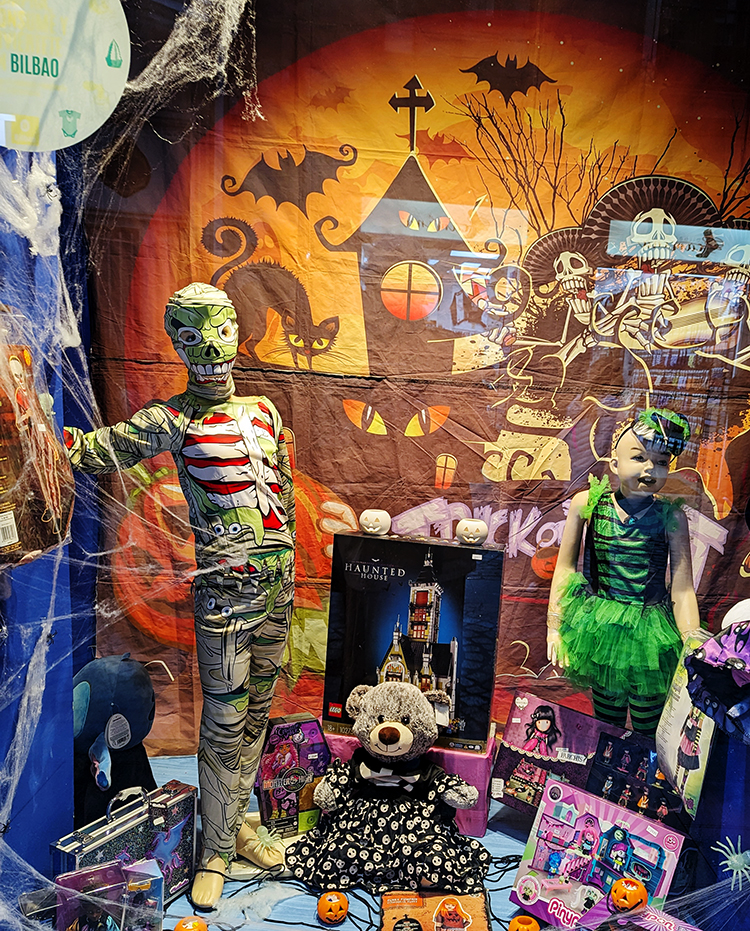
Store displays gave us advance warning American Halloween traditions had bridged the ocean to invade Europe.
Spain’s vulnerability is enhanced by the fact that Halloween is the eve of a national holiday – Dia de Todos los Santos, or All Saints’ Day. While not a full-scale conquest yet, Bilbao appears on the cusp of adopting costumes.
Bearing a pair of eyes on a platter, Santa Lucia, or Saint Lucy (283-304), watches all entering the Ex-Convento de Santo Domingo, home to El Museo de las Culturas de Oaxaca. The patron saint for safeguarding eyesight and writers, Santa Lucia always has ranked among my favorites.
Upon reaching what was considered a marriageable age, Santa Lucia opted to dedicate herself to God and pledge herself a virgin. Born into a wealthy family in Sicily, she began distributing her worldly goods to the poor.
Alas, Lucy’s mother previously had promised her daughter’s hand to a suitor, a man displeased with the dispersal of the family’s wealth perhaps more than the personal rejection. Vengeful, he reported her Christian beliefs to Roman authorities.
The Roman authorities sentenced Lucy to reside in a brothel and to be forced into prostitution. Divine intervention rendered her immovable, despite the soldiers’ repeated efforts to budge her in order to carry out the sentence. Thwarted, they gouged out her eyes and set her ablaze. But Lucy proved impervious to the flames so they resorted to ending her life by thrusting a sword through her throat.
This background is why Santa Lucia would seem ideal to offer temporary sanctuary to a Penny Siopsis’ powerful short film, Communion, relating to the end-of-life experience of a Dominican nun, Sister Mary Aidan (1914-1952). The Irish-born doctor, Elsie Quinlan, had devoted years to lovingly tending and healing Black South Africans in a clinic in New London, South Africa, when she turned her automobile into a public square in November of 1952.
Apartheid was institutionalized by the National Party of white rulers of the country, and public gatherings of Blacks were outlawed. The African National Congress spurred a protest in the square as part of the 1952 Defiance Campaign, and soldiers firing into the crowd killed several Blacks.
By the time Sister Aidan drove into the midst of the then angry mob, instead of recognizing a nun who had been helping them the rioters only saw yet another white person determined to harm them. She was stabbed seven times and set ablaze in her car.
The fire had fused my rosary beads….
“voice” of Sister Mary Aidan narrating Communion
The crowd still was determined to avenge the deaths of those shot by the soldiers. The first-person narration continues with the inquest:
Parts of my body were missing. Someone said a lady had a bread knife.
By the time police broke up the riot, the government admitted to fatal shootings of at least nine. Unofficial reports placed the number at closer to 200.
And that is all of the tragic tale I can bear to relate. What could be sadder than, as artist Siopsis described during a dialogue with artist William Kentridge, “being killed by people you love and who love you?”
“Drum/Tambor,” Samson Mudzunga, 1996
“Rain Prayers/Los Rezos de Lluvia,” Simphiwe Ndzube, 2018
El Museo de las Culturas de Oaxaca, Ex-Convento Santo Domingo
“Rain Prayers/Los Rezos de Lluvia,” Simphiwe Ndzube, 2018
“The Revenge of 400 Years Is Losing its Baby Teeth/La Vengaza de 400 Anos Esta Pendiendo sus Dientes de Leche,” Dan Halter
“Drum/Tambor,” Samson Mudzunga, 1996
El Museo de las Culturas de Oaxaca, Ex-Convento Santo Domingo
“Hacer Noche/Crossing Night,” Arte Contemporaneo del Sur de Africa, through February 5
“Rain Prayers/Los Rezos de Lluvia,” Simphiwe Ndzube, 2018
The film is part of “Hacer Noche/Crossing Night: Arte Contemporaraneo del Sur de Africa,” an exhibit at the Museo de las Culturas closing February 5.
The dancing skeletons visible in the background of one of the photo’s of Simphiwe Ndzube’s “Rain Prayers” are a frame from Kentridge’s short film “30% of Life/30% de Vida.”




 Postcards from Barton Springs