Postcard from Istanbul, Turkey: Controversies resurface with conversion of Chora

Above: Angels surround an image of the Virgin Mary and Child in a 14th-century Byzantine fresco in the dome crowning a side chapel of the former Church of the Holy Saviour in Chora, recently reopened as the Kariye Mosque.

I have no religion, and at times I wish all religions at the bottom of the sea. He is a weak ruler who needs religion to uphold his government; it is as if he would catch his people in a trap.” 

Mustafa Kemal Ataturk (1881-1938)

For many in Turkey, Mustafa Kemal Ataturk remains the most respected figure in the republic’s history. Banners bearing Ataturk’s image still flutter across streets and on buildings throughout Istanbul.

Following the defeat of the Ottoman Empire during World War I, Ataturk led a successful revolution against the Allied Forces to prevent them from dividing up Turkey as spoils of war. He abolished the Sultanate and then proclaimed Turkey an independent republic in 1923.

As the country’s first president, Ataturk launched a host of aggressively progressive reforms: free and compulsory elementary level education for all; equal rights for women; and secularization of the state. Later, both Hagia Sofia and Chora Church were converted into museums, demonstrating Turkey’s tolerance of different religions.

In 2020 to cement his support on the conservative right, President Recep Tayyip Erdogan succeeded in convincing the court to overturn Ataturk’s original decree and announced the conversion of both into mosques. The conversions were accompanied by a promise to keep the mosques accessible to those of all faiths.

Continue reading “Postcard from Istanbul, Turkey: Controversies resurface with conversion of Chora”
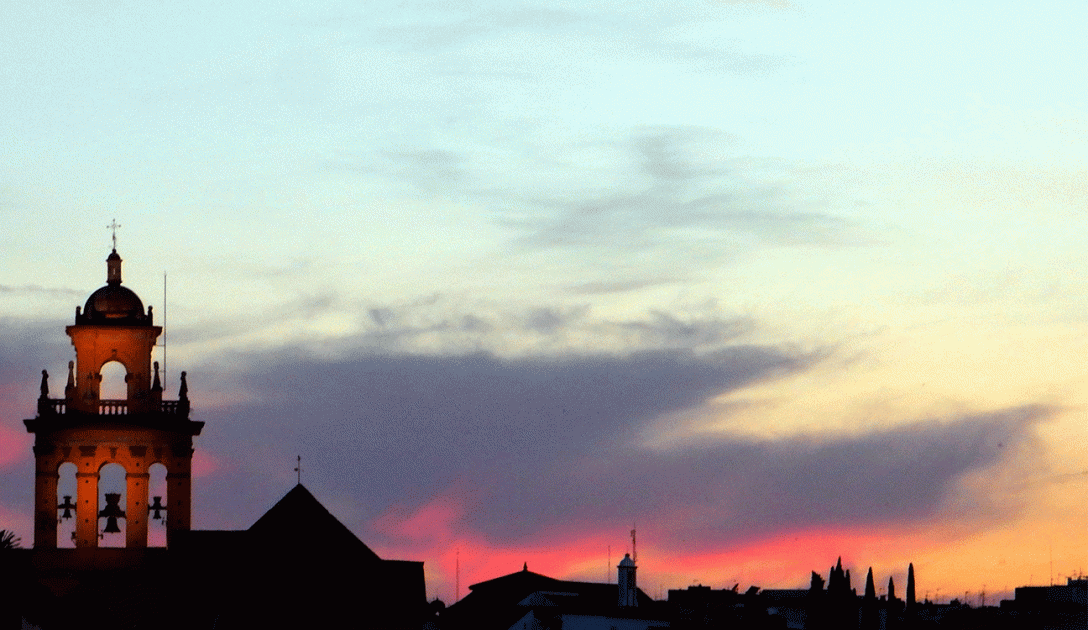
Postcard from Cordoba, Spain: A city filled with churches

When Ferdinand III (1199-1252), King of Castile, conquered Cordoba in 1236, he launched a flurry of construction projects to formalize the city’s conversion to Catholicism. The mosques destroyed in the process provided convenient foundations and served as quarries for building numerous of these. Through the centuries, the original medieval structures received Renaissance alterations topped by a Baroque overlay.

Shells left by pilgrims who have traveled the Camino de Santiago dangle from the statue of Santiago, or Saint James the Greater, in the temple built atop a mosque and dedicated to the saint. Following the death of Jesus, James proselytized throughout the Iberian peninsula before returning to preach in Samaria and Judea.

In the year 44, King Herod Agrippa I (11 BC-44 AD) ordered him beheaded, making James the first of the 12 apostles to be martyred. According to Acts 12:20-23, Herod himself perished later that same year because: “he had not given the glory to God, an angel of the Lord struck him down, and he was eaten by worms and died.” Legends associated with Santiago as the patron saint of Spain claim he, with neck intact, miraculously appeared armed atop a horse to lead outnumbered Christians to victory in a battle with the Moors – 800 years following his death.

And, continuing on a saintly topic, a large silver vessel enshrined in the Basilica of San Pedro contains a jumbled assortment of skulls and bones purported to belong to the Martyrs of Cordoba. According to accounts recorded by San Eulogio, these 48 Christians were beheaded by their Muslim rulers between 851-859 for their violations of Islamic law, mainly blasphemy and apostasy, or renunciation of the Islamic faith.

Eulogio’s writings, The Memorials of the Saints, ended abruptly upon the priest’s own execution in 859.