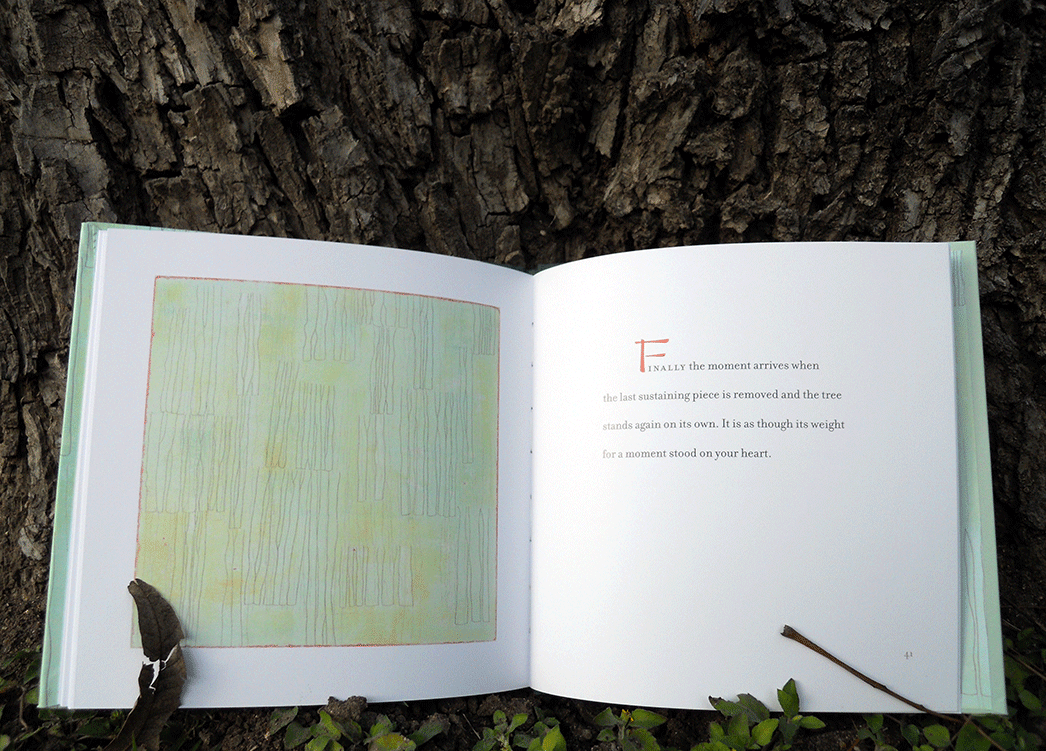
The title of the book published in 2014 by Trinity University Press immediately conveys the message inside.
Despite the promise of the title and your wish for it to be possible, you know it is not. W.S. Merwin almost could have stopped there – a perfect reduction of words to express concern for the environment.
But your desire to believe a toppled tree could be healed in a magical way that “all the king’s horses and all the king’s men” failed to achieve for Humpty Dumpty and the lyrical prose of the Pulitzer-Prize-winning writer entice you inward:
Start with the leaves, the small twigs, and the nest that have been shaken, ripped, or broken off by the fall….
The soothing silverpoint drawings illuminating the inner cellular life of trees by Liz Ward, a professor of art at Trinity University, lessen the fear of approaching the immensity of the task of righting a tree.
Finally the moment arrives when the last sustaining piece is removed and the tree stands again on its own. It is as though its weight for a moment stood on your heart.
Walking the Mission Reach along the banks of the San Antonio River as it wends its way southward makes one wish all the towering trees that shaded the river for centuries before mid-20th-century bulldozers eradicated them for flood control could be “unchopped.”
Alas, the dictionary fails to include the word in its inventory of things that can be undone for obvious reasons.
So great patience is required as the San Antonio River Authority painstakingly strives to restore the natural habitat, sapling by sapling.
A Chinese proverb reminds us:
One generation plants the trees;
another gets the shade.
For, to heal our environment, as Merwin advises in Unchopping a Tree:
Everything is going to have to be put back.
March 16, 2019, Update:
Mr. Merwin’s ardor for the natural world took frequent root in his poetry….
Stylistically, Mr. Merwin’s mature work was known for metrical promiscuity; stark, sometimes epigrammatic language….
Lawrence Lieberman wrote…. “The poems must be read very slowly, since most of their uncanny power is hidden in overtones that must be listened for in silences between lines, and still stranger silences within lines.”
“W.S. Merwin, Poet of Life’s Evanescence, Dies at 91,” Margalit Fox,The New York Times, March 15, 2019
A month in the searing desert sun building a huge wooden structure.
A mere four days to enjoy it. Then setting it ablaze.
“It is not that easy to burn your own installation down,” said artist Arne Quinze during a June 2013 lecture sponsored by the San Antonio River Foundation at the San Antonio Museum of Art. “I still have goosebumps from it.” While an estimated 50,000 people witnessed the conflagration at the 2006 Burning Man Festival in Nevada, “The day after, nothing was left over.”
The Belgian artist’s first public art took the form of graffiti, but his work evolved into large-scale three-dimensional structures, often installed in urban settings, including Nice, Shanghai, Rio de Janeiro, Brussels, Rouen and Beirut. Quinze views cities as “open-air museums,” with art teaching “you to look at the world in a different way.”
Many of his installations are temporal, although not as fleeting as the one in Nevada. His installations sometimes spark controversy, but, by the time they are removed, there are public protests. “When we take it down, the space is more empty than before,” he said. “It makes them realize the importance of art in their lives.”
example of a “pillar” of wind
The artist is drawn to strong hues of red and orange because they are “full of contradictions – a fire burns or warms; blood means life or death.” His series of “Wind” sculptures seem to follow that predilection. On his website, he describes the elements he installs in the landscape as representing “the frozen movement of wind going through a grass field, a sculpture waving like leaves in the sun.”
Berg’s MillMission San Juan Capistrano
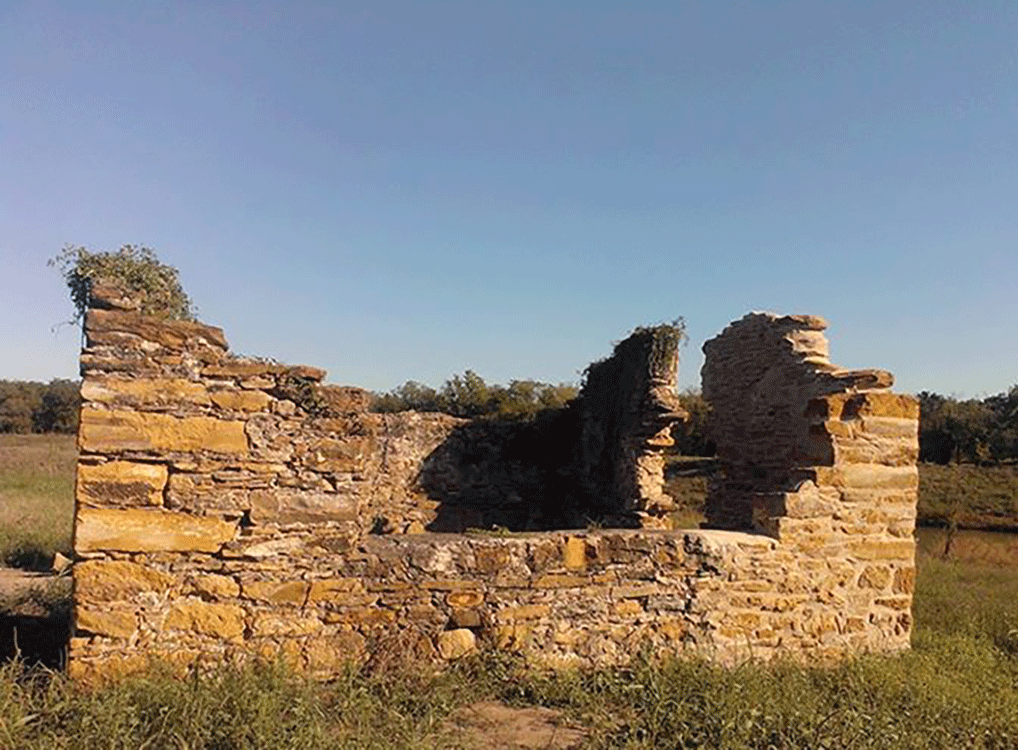
Perhaps that is what makes “Wind” most fitting for the rural river setting chosen by the River Foundation for his installation. His monumental blades of wind will serve as a gateway transitioning and leading people up from the river to the area where the ruins of the historic Berg’s Mill community are perched on the left and Mission San Juan Capistrano lies ahead on the right.
“Wind,” according to Quinze’s website, is designed to: “evoke emotion, spark conversation and make people stop in their tracks. They will be attracted to explore this surreal experience of the shadow and sunlight shining through the fixed pillars….”
Looking forward to being stopped in my tracks in 2015.
April 20, 2015, Update: Noticed that Arne has more site-specific renderings for his “Wind” installation posted online now.
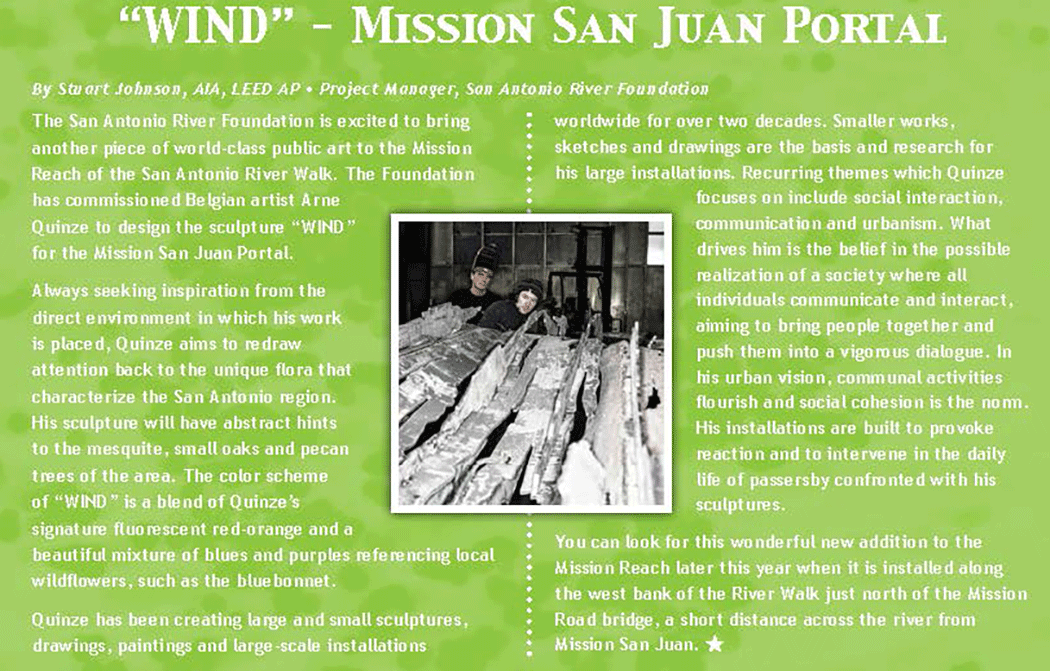
And this is from the April 2015 River Reach, published by the San Antonio River Authority:
October 20, 2015, Update:
Artist Lecture: Arne Quinze will talk about “Wind” installation, his first permanent public art piece in the United States, at Blue Star at 6:30 p.m. on Thursday, October 22.
Sculpture Unveiling: Mission San Juan Portal will be unveiled at 10 a.m. on Wednesday, October 28.
No matter what, it’s the San Antonio Book Festival’s fault. Writing about some of the authors scheduled to appear there sent me back to a post from long ago about Jake Silverstein’s book, Nothing Happened and Then It Did, which had sent me delving back into The Devil’s Dictionary. Hence the omen reference. Add to that overstimulation from listening to five full sessions of authors talking followed by the Literary Death Match.
National Park Service photo of red-tailed hawk
This past Thursday morning, the Mister and I headed southward for our morning walk. A hawk swooped onto a tree not 15 feet in front of us. It was a newly planted tree on the Eagleland stretch of the San Antonio River, the name of which comes not from sightings of eagles but from the Brackenridge High School’s mascot.
The branches of this 12-foot tree were not big enough to successfully support a hold-onto-your-chihuahua-size hawk; so, before we could even zip out and focus the smartphone, he flew off. While we were fiddling like dummies with the smartphone, the hawk caught something white now dangling helplessly from the hawk’s claws.
I wasn’t thinking omen yet. But a mile or so later on the Mission Reach by Lone Star, we saw another hawk swooping through the sky. We were impressed by a two-hawk day because we rarely even spy one.
But that afternoon, there was a third flying across 281 right in front of me as I headed to a meeting.
Three hawks. Now that seemed ominous to me.
Some people view hawks as messengers. Messengers bearing warnings, not usually glad tidings. I was afraid to even begin to surf the internet to find out what it would mean if three were trying to deliver news to me. I elected to prefer the theory that the hawks just happened to live nearby; it was meal time; and I was passing through their grocery store.
The next afternoon was warm. We had the doors on the second floor wide open. I kept hearing noises, though home alone.
Bravely going back up the stairs to the third floor, I found the source. A sparrow clinging to the shade on the south bank of windows.
I’m thinking omens again. Some people believe a bird flying into your house is a sign of death. I prefer the belief it means a loved one is trying to communicate with you from the grave. That seems more comforting.
Unfortunately, the windows on the third floor do not open. I was pondering how I was going to convince the sparrow to go back down a floor to the open doors when the sparrow spied this:
The bank of windows on the north side. Well, the sparrow went for it as fast as his wings could flap through the length of the house.
Smack. Thud.
I’m thinking serious omen.
A bird breaks his neck flying into your window, particularly while inside the house? Not a good sign. A harbinger of death.
But a break came. A major stroke of good luck. When the sparrow hit the glass, he fell smack into the middle of the trashcan beside my desk onto a soft bed of kleenix, ever-present during this season of pollen.
I was able to cover him with a jacket and cart him out to the back porch. Upon my removal of the cover, he sat there stunned for quite a while. He had been tricked by those very same green leaves once, and, no fool, he wasn’t going to race toward them again. After about 30 minutes, he trusted his surroundings and fluttered home.
Surely that trumped all prior gloomy warnings.
I fretted a bit all weekend but finally decided no news was good news.
Our daughter solved it all inadvertently with an email with this photo attached. Aha, the sparrow must have been trying to tell me there had been a storm in Austin, and a branch blew into their house and smashed a window. Phew.
And then, on the phone later, she told me about the impending death. The Mister’s Infinity that had passed her way was in the process of passing away.
The Mister was sad. He loved that car.
But I was jubilant. Those hawks were only trying to tell me the Infinity was dying. I can handle that. I never even learned to find it in a parking lot; one silver sedan looks just like all the others to me.
I’m not paying attention to messages from birds again though; no matter what that pair of coots on the Mission Reach seems to be trying to say. The foreboding row of dark cormorants perched on the dam won’t scare me.
And those herons and egrets? They and all the other birds who didn’t use to flourish here are only here because our environment is improving everyday as the San Antonio River Improvements Project matures.
The Mister and I just happen to walk right across their dining room table, often interrupting a crawfish feast, as we head southward.
And, that sparrow spared by the bed of kleenix absolutely has to be a sign of good luck.
April 29, 2014, Update: The flock of wild parrots that are spied around Southtown periodically just spent about 10 minutes fluttering around a cypress tree outside my window. Spectacular. Wish they would stay, but I think even that temporal a siting is a good sign.







 Postcards from Barton Springs