Postcard from Rome, Italy: A literal definition of a marriage made in heaven

But bright Cecilia raised the wonder higher:
When to her organ vocal breath was given,
An angel heard, and straight appeared
Mistaking Earth for heaven.

“A Song for Saint Cecilia’s Day,” John Dryden, 1687

Music the fiercest grief can charm,
And fate’s severest rage disarm:
Music can soften pain to ease,
And make despair and madness please:
Our joys below it can improve,
And antedate the bliss above.
This the divine Cecilia found….

“Ode on Saint Cecilia’s Day,” Alexander Pope, 1708

Some time in the first or second century, the daughter of a wealthy family in Rome was betrothed to a young pagan. A Christian, Cecilia was dragging her feet about entering into the arranged marriage, fasting and pleading with God and the Virgin Mary to help her preserve her virginity. Definitely not the vow a prospective groom envisions.

As the musicians played at the feast celebrating the wedding, Cecilia stared upward, focused on serenading the heavens with the song in her heart. Valerian, the groom, was miraculously understanding when she explained her wedding night plans to him did not include consummation of their marriage.

Cecilia claimed she had an angel protecting her. A little suspicious, he asked for proof. She directed him to the third milestone on the Appian Way and to be baptized by Pope Urban I (died in 230). Valerian complied and, upon his return, saw her guardian angel with her, crowning her head with roses and lilies. In addition to his religious conversion, he accepted her vow of chastity.

Valerian’s enthusiasm was so great, his brother followed suit. Christianity was far from the official religion in Rome at the time, so Valerian and his brother busied themselves gathering the bodies of executed Christians and providing them with burials. This chore kept them quite occupied until their dedication attracted too much attention, and they themselves became martyrs.

Cecilia then threw herself more fervently into spreading the word, converting more than 400 pagans to the still somewhat new religion. Until…

… you know where this is leading, she attracted attention of those in power. But Cecilia’s angel did not let her succumb quickly to the efforts to dispose of her. First condemned to death by “spa,” she was locked in the baths with the heat and steam stoked up unbearably high. She emerged unfazed, so a more direct approach was taken.

Chop off her head. The executioner swung his axe three times. Despite profuse bleeding, her head remained in a semi-attached state. This afforded Cecilia time to make arrangements to distribute any remaining wealth to the poor and to donate her home in Trastevere for a church. Pope Urban I complied.

In the 800s, Pope Paschal I rebuilt the church. Desiring to locate Saint Cecilia’s remains and transfer them to her church, the pope searched the catacombs. After a vision, he finally located them and those of her husband and brother-in-law. Saint Cecilia’s original robes, blood-soaked, were at her feet; she was clothed in gold. All three bodies were moved to the church.

While the mosaic in the apse from that period survives, much remodeling followed. Fast forward to the 1500s, Cardinal Niccolo Sfrondrato (1535-1591), later becoming Pope Gregory XIV, was trying to confirm the location of the remains of Santa Cecilia.

Workers uncovered a marble coffin and opened it in front of the cardinal and, even more conveniently, sculptor Stefano Maderno (1576-1636). And there she was. Santa Cecilia incorrupta. The first Catholic saint recorded as emerging in this totally preserved state, further demonstrated by the fact that she had rolled over to a more comfortable position on her side.

Word spread like wildfire in Rome, and the cardinal was fortunate to escape being crushed by the crowds eager to view their patron saint of music, still cloaked in golden cloth. Maderno recorded this miracle by sculpting a realistic depiction of her body for the altar. But her actual body was reinterred elsewhere in the church.

The Mister is wise. A sign on the left side of the church offered entrance to the basement for a couple of euros, and he said, “Never turn down an invitation to visit the crypt.” And he proved so right.

Down underneath the church are ancient crypts and the remains of an old tannery, but then you stumble into a magical space. Arcades and walls covered with glittering mosaics heralding Saint Cecilia’s final resting place.

The Mister’s fingers seem to be gliding across his travel guitar’s strings more effortlessly ever since.


Postcard from Mexico City: The Lord of Poison and potent relics

lord of poison christ mexico city cathedral

The Metropolitan Cathedral in Mexico City also features a black statue of Christ, known there also as Lord of Poison which is a pretty interesting name for a Christ figure. This is the most venerated statue in the entire cathedral and… dates back to the 18th of August, 1602 when the Dominican Fathers came to Mexico with several Christ sculptures, all white.

Legend has it that this particular figure was installed in a small chapel in Tlanepantla where the regent archbishop prayed daily and at the end of a prayer, would kiss the feet of this statue. When his enemies saw what his routine was, they applied poison to the feet of the statue in the hopes that they could off him in this way after his next prayer. Alas, their cunning plan was foiled when the statue (faith, people, faith) shrank back from the archbishop’s approaching lips, thereby saving his life and providing for yet another biblical story. …the poison that had been applied by the evildoers… is what turned it black.

The story quickly got out and spread rapidly amongst the flock; the great back story and the fact that the chapel was not open to the public heightened the mystery and devotion to this black Christ. After being under wraps for many years (ie the marketing plan had worked and the product was ready) in 1935 the now heroic black Christ was moved from its private location to the Metropolitan Cathedral so as to be available for worship by all.

The Mystery of the Black Christ at Chumayel,” Lawsons Yucatan

The black figure of Jesus on the cross is somewhat of a newcomer to the Metropolitan Cathedral. Whether the version above or the story of the poison fed to Don Fermin by Don Ismael is preferred, the willingness of the figure to absorb the evil dark potion to spare the good man does make the Lord of Poison somewhat of a star attraction. The largest cathedral in the Americas actually is dedicated to the Assumption of the Virgin Mary. If the halo-bearing statue below is of Mary, she appears quite shocked by her immaculately conceived swollen shape.

Construction of the first part of the church was begun under orders of Hernan Cortes in 1524. Original building materials were recycled from the destroyed temple of the Aztec god of Huitzilopochtili, which stood on the site.

It would take more than a few Hail Marys to make a pass the entire length of the cathedral, as it measures the entire length of a football field, including the two endzones. There are two major gilded altars surrounded by 16 chapels. Ornate facades mark four major entrances to the cathedral. The main entrance was barred when we were there, and a crane appeared to facilitate an inspection or repair of any possible damage above incurred during the recent severe tremors.

Despite floods, fire, earthquakes and general sinking of the foundation, the church has remained steadfast in its determination to occupy the symbolic location in the heart of the city. As the huge capital city drained the water table, the cathedral continued to sink. Work to rectify that in the 1990s required extensive excavation. The successful stabilization project revealed ancient treasures, discussed here in a post-to-come.

The rather substantial first-class relics of San Vital housed in the glass case reside at the front of a gated chapel filled with portions of numerous saints. I am confused about whether these belonged at one time (until about the year of 304) to San Vitale, whose bones we first became acquainted with in the Cathedral of Bologna where they are enshrined combined with some of those of Saint Agricola. Or were they originally part of San Vitale who was buried alive, probably about the same time, for his faith in Ravenna, on the spot where a basilica now stands in his honor? Or someone entirely different?

Outside of the main chapel of reliquaries, unbeknownst to us, life-size wax statues of saints contain secret stashes of more human relics recently revealed via digital X-rays, according to the San Diego Union-Tribune.

Anyway, I’m totally uncertain of what causes this particular San Vital is in charge. But surely relics of this size are pretty potent, so go ahead. Pray for his help for anything.

Postcard from Budapest, Hungary: Home for Saint Stephen’s holy dexter

The right hand of the blessed man was deservedly exempt from putrefaction because, always reflourishing from the flower of kindness, it was never empty from giving gifts to nourish the poor.

Bishop Hartvic, Life of King Stephen of Hungary, about 1116

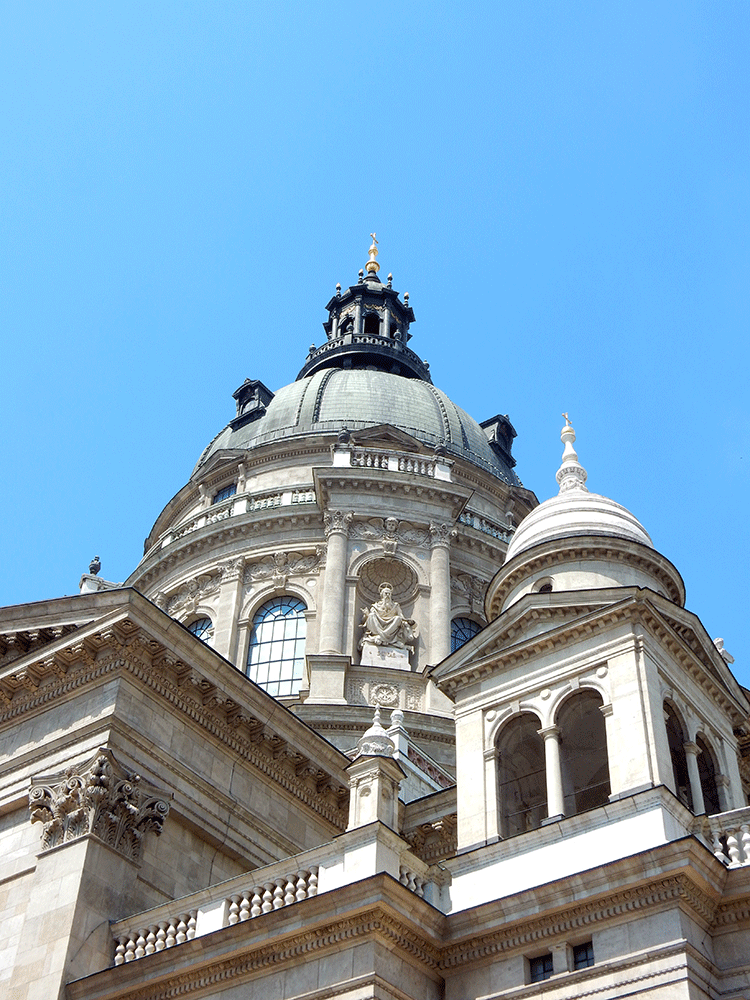
Construction of the Basilica of Saint Stephen in Budapest took more than 50 years because the original dome over the facility designed to accommodate up to 8,500 worshippers completely collapsed in 1868. During the intervening years, the desired style evolved from neo-classical to neo-renaissance by the time the church was inaugurated by Emperor Franz Josef in 1906. The dome is the same height as that of Parliament, and no buildings in the historic center are allowed to tower above them.

Saint Stephen (975-1038) is celebrated as the first king of Hungary. His royal coronation was held on the first day of the second millennium, and the crown itself was a gift from Pope Sylvester II. King Stephen’s later sainthood was merited for his commitment to crush paganism in Hungary and for miracles credited to his right hand, the holy dexter.

The incorrupt hand was stolen at one point, recovered, hidden by nuns and finally returned and honored with a public procession in 1938 and enshrinement in a chapel in the basilica. The annual procession of the mummified dexter was ended abruptly by the communists in 1950. Since 1988, the church has been free to parade it through the streets annually on his day, August 20.

The crown presented to King Stephen served as the coronation crown for all subsequent kings of Hungary, but, like the dexter, spent some time in hiding. It and some of the royal jewels were spirited away for safekeeping in the United States during World War II. They remained locked in Fort Knox until returned to the Hungarians by an order of President Jimmy Carter in 1978. The crown and jewels are displayed in the House of Parliament.