Postcard from Oviedo, Spain: Sacred relics attract peregrinos and thieves

Above: Central detail of the main Gothic altarpiece, dating from the early 1500s, in Santa Iglesia Catedral Basilica Metropolitana de Oviedo

He who goes to Santiago and not to the Savior visits the servant and forgets the Lord.”

Back in the year 40, the apostle James was preaching in Zaragoza when the Virgin Mary miraculously floated down on a cloud to assist him with his efforts to convert pagans living under Roman rule to Christianity. Soon after establishing a chapel in her honor, James traveled all the way back to Jerusalem. His preaching incurred the ire of the King of Judea, Herod Agrippa (11 BC-44 AD), who had him beheaded in the year 44. Avenged as, according to Acts Chapter 12, Verse 23, King Herod Agrippa met his maker within the same year:

…an angel of the Lord struck him, because he did not give glory to God. And he was eaten by worms and died.”

The head of Santiago, as James is known in Spain, is said to be entombed below the altar of the Armenian Apostolic Cathedral of Saint James, the church built on the site where he was martyred in Jerusalem. But what became of the rest of his body? As Santiago is the country’s patron saint, let’s go with the miraculous version. A band of angels arrived on a cloud to retrieve it, placed it in a simple boat and guided it to shore in northern Spain.

Continue reading “Postcard from Oviedo, Spain: Sacred relics attract peregrinos and thieves”
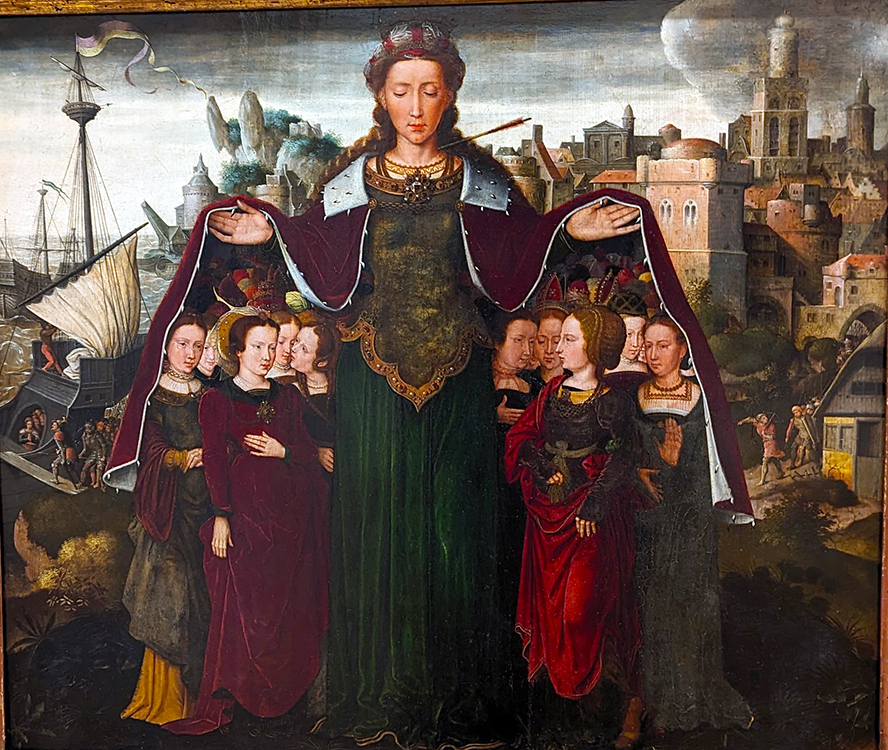
Postcard from Oviedo, Spain: A few pieces from Museo de Bellas Artes

Above: “Saint Ursula and the 11,000 Virgins,” Pieter Claeissens, 1560

Pieter Claeissens’s painting hanging in Museo de Bellas Artes de Asturias attracted my attention because of my unfamiliarity with Saint Ursula. According to legend, 11,000 handmaidens of Princess Ursula set sail with her from southern England on a journey to marry the pagan to whom her father had betrothed her. The ship was blown off course, so Ursula and her entourage decided on an extended pilgrimage to Italy first. Huns had taken over Cologne by the time they finally arrived there, and, for some reason, the Huns failed to appreciate having all those virgins in their midst and slaughtered them.

Continue reading “Postcard from Oviedo, Spain: A few pieces from Museo de Bellas Artes”

Postcard from Palermo, Sicily: Putti play while Jesuits pray

Above: Putti sculpted of marble in Chiesa del Gesu

Known as soldiers of God, Jesuits travel throughout the world to educate and evangelize the masses. They take a vow of poverty when they enter the order, which makes the extravagant beauty found in their churches particularly surprising.

The website of Chiesa del Gesu explains their evangelization efforts through art with words of Saint John of Damascus (676-749):

If a pagan comes and says, Show me your faith!” take him to church and show him the decoration with which it is adorned and explain to him the series of sacred pictures.

Continue reading “Postcard from Palermo, Sicily: Putti play while Jesuits pray”