Postcard from Malaga, Spain: All the saints and those Limbo babies, too

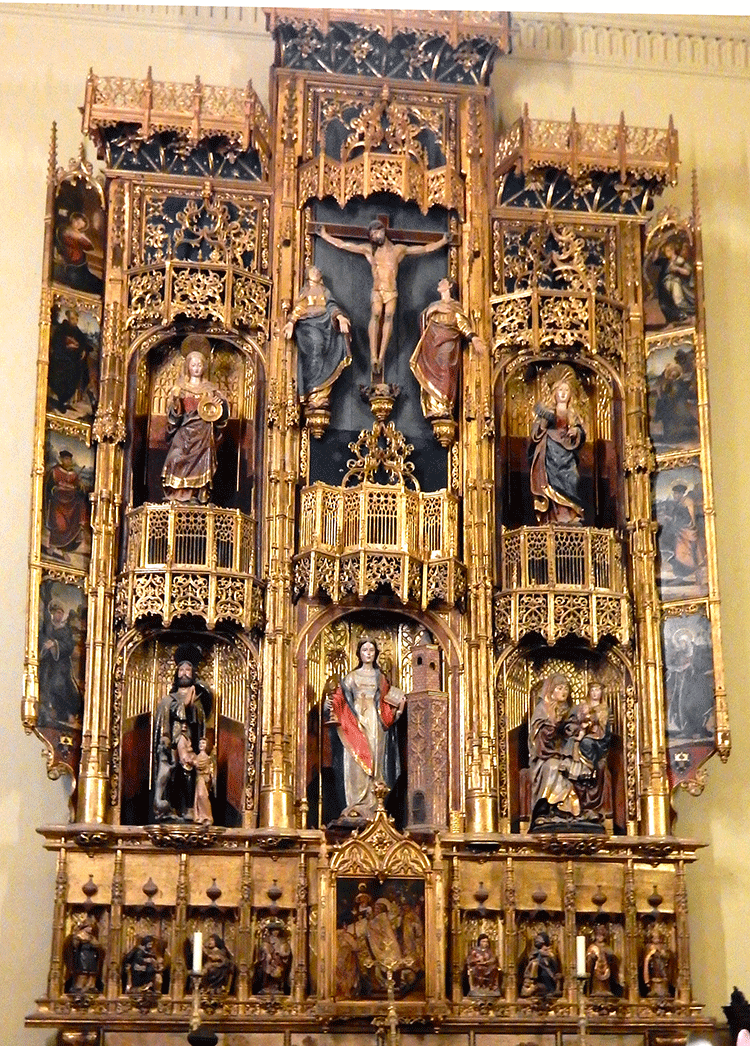
Gothic altar in the Chapel of Santa Barbara in the Cathedral of Nuestra Senora de le Encarnacion in Malaga

Layers upon layers of of saints climb the numerous gilded altars found in the Malaga Cathedral. Saints carved in wood by Pedro de Mena (1628-1688) grace the choir stalls. Today is all of their days. November 1. All Saints Day, and, for Catholics, a Holy Day of Obligation.

When I was young, the thrill of a night of trick-or-treating with its late night sugar high always was followed the next day by attendance at Mass. Unlike many holidays, it was particularly hard to comprehend why almost none of my friends had to go to church on November 1.

My godmother, Aunt Gen (Genevieve Louise Brennan Savage, 1907-2004), tried her best to explain things, but the nuns really never talked to us much about saints. Like Santa Barbara, whose own father carried out her martyrdom for her belief in the Holy Trinity. Although he was struck by lightening and consumed by fire on his way home after the act.

But the major impact for me was November 2, All Souls’ Day. You might not know this, but there are all of these bazillions of poor souls stuck in Purgatory – not so evil that they were condemned to hell but instead hanging around in an uncomfortable state trying to slip through the gates to heaven. Our prayers were supposed to free some of them and send them soaring above the clouds.

Even more concerning for me was Limbo. Limbo was where the little babies throughout the world who died unbaptized were supposed to go. Through no fault of their own, they were sentenced to remain suspended, constantly fluttering their wings in some mysterious twilight zone.

Those little poor souls were the ones for whom I would join my hands, palms sweating in those uncomfortable white gloves, squeeze my eyes tightly together and plead. God took a while to process my prayers from almost 60 years ago. In 2007, the Catholic Church finally liberated them all, burying the whole Limbo concept.

Sorry for the detour. Back to Malaga and its Cathedral. After all it’s a Holy Day of Obligation.

The foundation for the Cathedral of Nuestra Senora de le Encarnacion was laid in 1530 atop the Almohad Mosque. Taking more than a century to complete, the church is viewed as a chronicle of the transition of religious Gothic architecture into the Renaissance. The facades reflect extensive Baroque updating.

In addition to photos taken in the Cathedral, this post includes images from the Parroquia de los Santos Martires Ciriaco y Paula. The two were executed, with great difficulty requiring several attempts, for their Christian beliefs at the dawn of the 4th century. While their executioners set their remains ablaze, an unexpected torrential rain quenched the flames and faithful carted them off for more respectful last rites. It is believed the two somehow resurfaced to miraculously help expel the Moors about a millennium later, so they were proclaimed the patron saints of Malaga.

My prayers have lapsed, but I trust there are a multitude of people inclined to remember as many saints as possible today. Tomorrow, please pray doubly hard, just in case any little babies somehow remained stuck in Limbo.
Postcard from Malaga, Spain: Interacting with music and my old friend Nipper

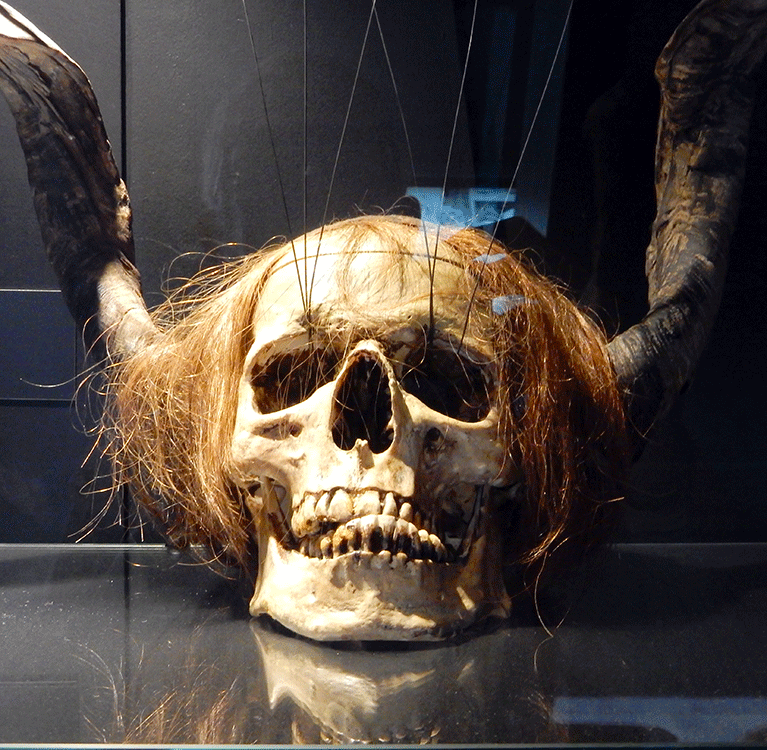
Kissara Lyre

The ghoulish lyre above is far from what I normally would choose to lead off this post about MIMMA, Museo Interactivo de la Musica Malaga. But it is high Halloween season. Impressively, the lyre is made from all-natural organic materials, hopefully found objects not freshly harvested for the crafting of the musical instrument.

MIMMA overall is far from fear-inspiring; it is melodic dream-inspiring. There is a learning lab for kids to experiment with sound. There are huge percussion instruments one can strike, and there is a room with play-me instruments, an invitation the Mister did not turn down.

While the Mister was distracted in a sound-proof room toying with electronic sound boards of some sort, I engaged with the interactive screens. Instead of wandering around gazing at obscure old instruments wondering at their sounds, you can tap the screen and listen to a recording of someone playing appropriate music on them. Mesmerizing.

Favorite instruments though were two 21st inventions by Ignacio Rodriguez Linares, both of which appear vintage. They present solutions for when the band or dancers fail to show. Carmen, a rather complex machine:

…has a series of levers that when activated, interpret Buleria percussion. It also includes the specific clapping accompanying this type of dance., as well as other typically used Buleria sounds, such as the rhythm and off beats, triples, calling, climax and conclusion, in addition to syncopation, 2, 4, and 6-beat bass, 3-beat sharps and 12-beat (clave) rhythms.

Then there are the cute petite stomping feet featured on his Melquiades Flamenco Beat Machine. This novelty allows musicians to select the appropriate rhythms for the seven most common Flamenco styles (Lajos – Kathleen Trenchard definitely needs this for Christmas).

Máquina flamenca “Carmen,” del inventor Ignacio Rodríguez Linares on Al Sur

But what photo would I have featured were it not Halloween? Nipper. The most important thing in the museum to me is Nipper.

With his brother’s part terrier mix dog, nicknamed for his annoying habit of nipping at the heels of any passersby, as his inspiration, Mark Henry Baraud painted the dog with his head cocked toward a Gramophone, listening to “his master’s voice.” The Gramophone Company paid the artist 100 pounds for it in 1898. Eventually the rights to the image made its way to RCA Victor.

While the Nipper in MIMMA appeared a little cold, it still felt like a reunion of sorts with my sleeping companion for several years. Some friends of my parents who owned an appliance store in Virginia Beach showed up one night for dinner when I was six years old with what would become my favorite stuffed animal, a three-foot high version.

Nipper joined George, a green monkey; Tony, the toucan; and little Lambs-Eat-Ivy to occupy a good 2/3 of my single bed. Despite the crowded sleeping arrangement, I never once let any of them fall off the bed. We had a mutual protection agreement. I kept them from the edge of the precipice above the alligator pit under the bed, and Nipper vigilantly prevented any alligators from scaling a bedpost. The alligator problem was Davy Crockett’s fault (Or my sister’s. It’s a long story).

Although alligators never got any of us, it was a tough assignment. Nipper sometimes suffered from leaking innards and had to undergo surgical repairs at the capable hands of my mother several times before his eventual retirement to the attic.

Back to the museum. We were ready to leave, when the nicest man asked us to stay for a Chopin piano recital in a small performance hall. Wine time was calling, but his invitation was so sincere. And there were only six of us in the audience. A rather intimate personal recital. It was beautiful.

Peering over the pianist’s shoulder, merely eyeing the number of notes on the sheet music was humbling, to say the least. There was no way I could have begun to follow the music enough to even have volunteered to serve as a page-turner.

Postcard from Malaga, Spain: High season for spotlighting cemeteries

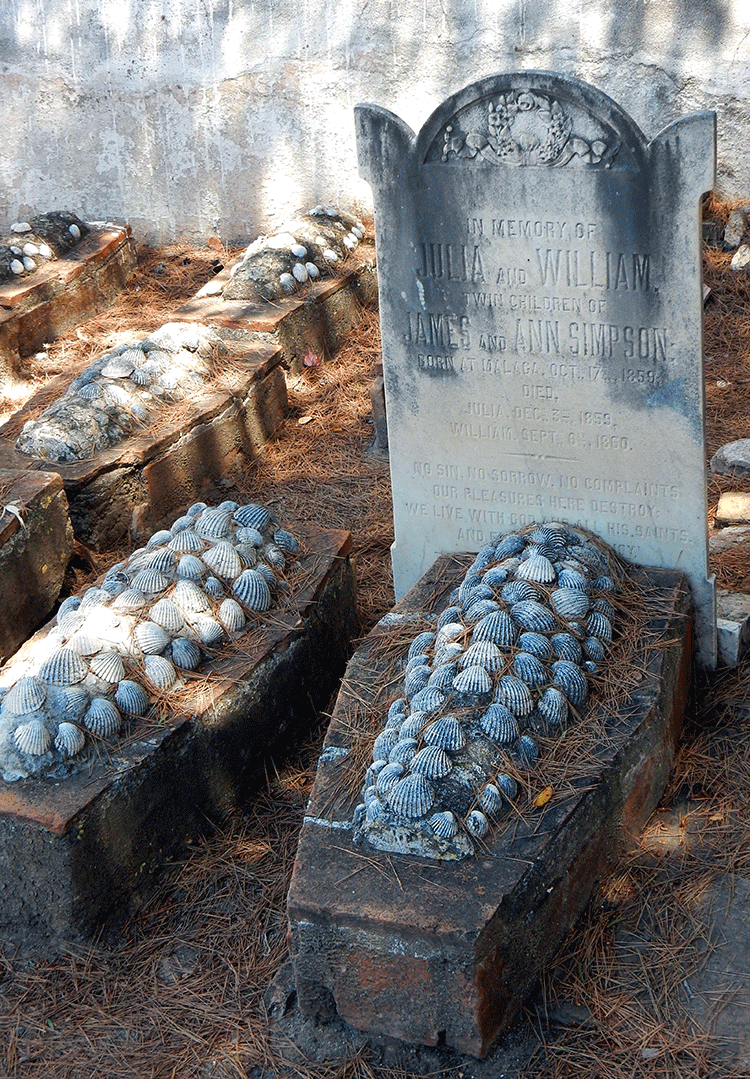
In Memory of Julia and William, Twin Children of James and Ann Simpson, Born at Malaga, October 17, 1859. Died. Julia December 3, 1859. William September 6, 1860. No sin. No sorrow. No complaints our pleasure here destroy. We live with God and all his saints….

Body disposal for non-Catholics in Malaga in the 19th century was a problem. Interment of Protestants was not permitted in the existing graveyards. By law, non-Catholics could only be buried during the night on the beach in a non-restful upright position, hardly comforting to relatives left behind to envision them exposed by tidal fluctuations, easy prey for soothing the hunger pangs of dogs on the prowl.

In 1829, the British Consul succeeded in gaining permission for a cemetery for Protestants on land that was then on the outskirts of town – the first Protestant cemetery in all of Spain.

Among its early residents was Robert Boyd, an Irish-American. Boyd came under the influence of Jose Maria Torrijos y Uriarte (1791-1831), and it is no coincidence they died on the same date. Following his exile in England, Torrijos launched a group of 60 liberals from Gibraltar to deliver a manifesto supporting the constitution of 1812 in opposition to the absolute monarchist Ferdinand VII (1784-1833).

The idealists thought they would land to spread the words that would immediately inspire an uprising. Unfortunately, the king’s men were expecting them. Forty-nine men were executed on San Andres Beach of Malaga. Forty-eight of the men regarded as heroes after the unpopular King Ferdinand VII’s death were interred under a landmark obelisk in the middle of Plaza Merced. Boyd, the Protestant, instead was bound for Cementerio Ingles.

Eight crew members of the SMS Gneisenau found permanent harbor there in December 1900. The Bismarck-class corvette of the German Imperial Navy had full sails to supplement its steam engines and bore a battery of 14 15-centimeter guns, all of which were useless when a fierce storm drove the ship into a stone breakwater at Malaga.

The nonprofit operating the English Cemetery struggles to maintain it. Much of the small graveyard is crumbling. It is far from the elevated aristocratic monumental cemeteries Protestant dead luxuriate in elsewhere in Europe.

But I’ll leave you with the words inscribed on my favorite headstone, that of Joseph Bertram Griffin (1920-1968), who died in Torremolinos. We think his wife, three children and little Zizi (a dog?) missed him, but the inscribed double negative made their feelings unclear. Typos carved in stone:

May God have your soul (in French).

Also with the love of your 3 children and your little Zizi which cannot never forget the wonderfull Daddy and for me husband you was.

Rest in peace. You too, Zizi, whatever and wherever you might be.