Postcard from Segovia, Spain: Castilian castle commands bluff despite those painful pointy-toed shoes

There was a lot of fighting going on in what we now call Spain, Portugal and the rest of Europe in the old days. Boundaries constantly were changing; kingdoms were proclaimed and reclaimed over and over.

My feet were never meant for pointy-toed shoes, but what were those medieval designers thinking? I mean, Jimmy Choo’s highest spiked heels are so much kinder to women’s feet than the armor those soldiers were forced to endure.

Realize one would want every body part protected during battle, but how could one move without assistance in such absurdly curved and pointed shoes? And, with every finger armored, how could one wield a sword? I guess the more the protection inhibited movement, the more protection one would need?

Fortunately for the rulers ensconced at Alcazar, geography played a role in preventing mobile-impaired soldiers from having to maneuver more than possible.

The castle seems so familiar, so, well, Disney-like. But Alcazar definitely came first, its turrets and spires serving as inspiration for Walt centuries later.

Ruins of an ancient Roman fortress became the base for a Moorish post, which in turn was the foundation for a monumental stone compound, the primary home for Spanish royalty and its parliament.

King Alfonso VIII (1155–1214) began the first permanent construction of Alcazar, with Juan II (1405-1454) adding the major tower during his reign. Felipe II (1527-1598) updated things to keep up with the latest European architectural whims of royals by adding the slate-covered pointy spires.

Things went south from that point. King Felipe II moved the seat of government to Madrid, and the former home of royalty suffered the indignity of serving as a prison for two centuries.

King Carlos III (1716-1788) repurposed it into the Royal Artillery School. But that meant storage of highly explosive materials within the fortress walls, which added to the spectacular fireworks display when a fire broke out in 1862.

Royalty briefly was out in Spain, but, when reestablished (a major oversimplification of history), Alfonso XII (1857-1885) began restoration of this monument to Spain’s past. Although the young monarch died of complications from tuberculosis and dysentery at age 28, Alcazar still reigns over Segovia and the surrounding countryside.
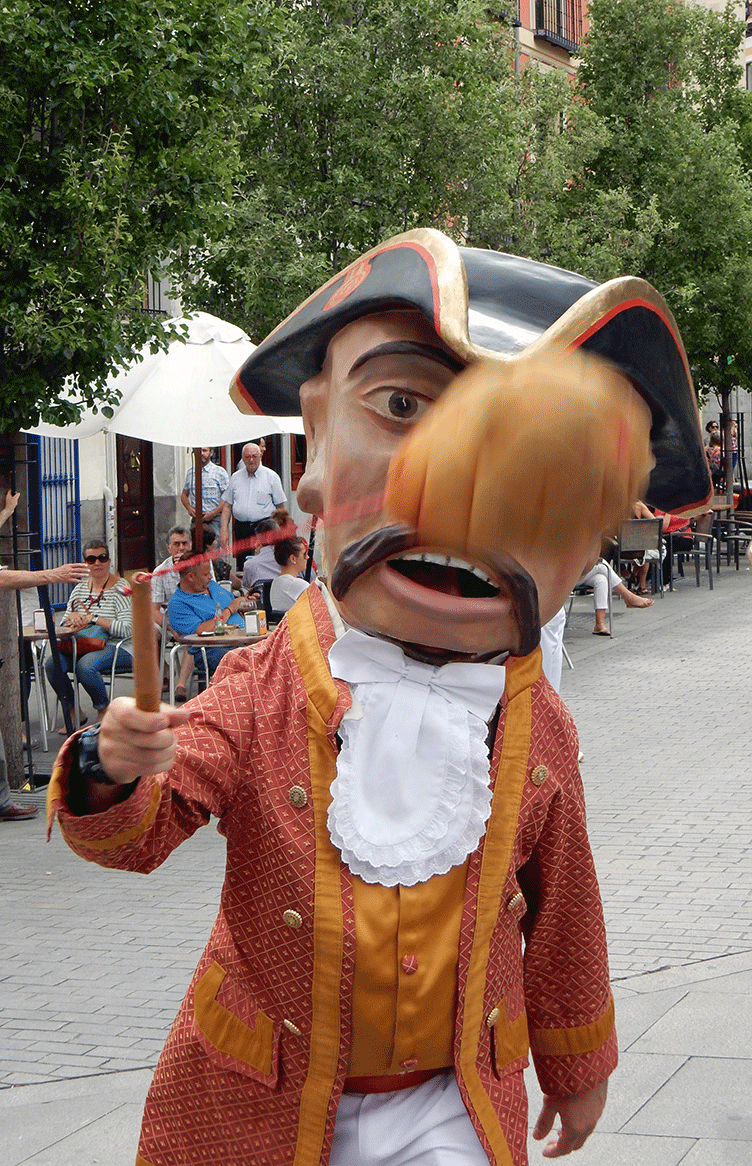


Postcard from Madrid: Gigantes y Cabezudos parade to greet us

We arrived on a holiday, a three-day weekend for Madrilenos as they honor their patron saint, San Isidro Labrador (1070-1130). San Isidro was credited with hundreds of miracles, but the one most coveted by working stiffs? Angels would fill in for him, kindly taking over his plowing while Isidro lost himself in religious meditation and prayer.

Madrid has changed a lot since adopting the patron saint of farmers as its own. Arriving here after staying in small cities surrounded by farmland, we were shocked and a bit overwhelmed by the city’s size, both in the scale of the buildings and the number of people. Major sidewalks and pedestrian-only streets were packed.

But celebrations for San Isidro Labrador brought things back to a more human scale for us. The first thing we encountered was a hokey, hometown, colorful parade of Gigantes (Giants) and Cabezudos (Big-Heads) weaving through the streets. One of the shorter advance enforcers, a big-nosed Kiliki, hurled his foam weapon at Mister photographer; the event would be at home in any small town in Mexico.

San Isidro’s remains still reside here, or most of them, behind nine locks in the church bearing his name. Only the King of Spain has the key, and even he is not allowed access without the approval of the Archbishop of Madrid.

The high level of security might seem extreme, but even royalty can’t be trusted from temptation to take a bit of a saint home with them to provide a few miracles needed around the kingdom. Supposedly, Charles II had one of San Isidro’s teeth pulled to keep underneath his pillow. And what of San Isidro’s wife, Santa Maria de la Cabeza? Her head used to be trotted out and paraded around every time the farmers in the area needed rain.

Which brings us back to the parade of big-heads on May 14, followed by the saint’s official day on May 15 that began with many Madrilenos donning traditional fashions of yore and ended with an explosion of fireworks.

Postcard from Madrid: Move over macaron

Capture%20decran%202015-04-30%20a%2014.36.18

Time to move past the macaron, I learned today both by word of mouth from Laurence van Strydonck and by taste in mouth on Calle de Villalar in the Salamanca neighborhood. Laden with bags of fresh cheese, bread, vegetables and fruit from a visit to Centro Commercial La Paz Mercado, I was waiting in the shade near her doorway for the Mister to buy some wine nearby.

Communication was easy, as I seem to understand food in almost any language and she spoke fluent English. Belgian-born, raised in France, Cordon-Bleu-trained and living in Spain, Laurence micro-produces hybrid pastries – les petits choux – that are wonderful. Packed with flavorful filling, the outer pastry shell has the crispy texture and taste of Florentine cookies – much better than even the best macaron. Plus, visually they have so much more personality.

The website for Miss Chou Paris is here, but I don’t think the shop’s offering shipping to Texas yet.

Next time I’m wandering nearby, I’m leaning toward tasting Miss Citron Meringue.

Wonder how long it takes a trend like this to jump from Spain to Texas….