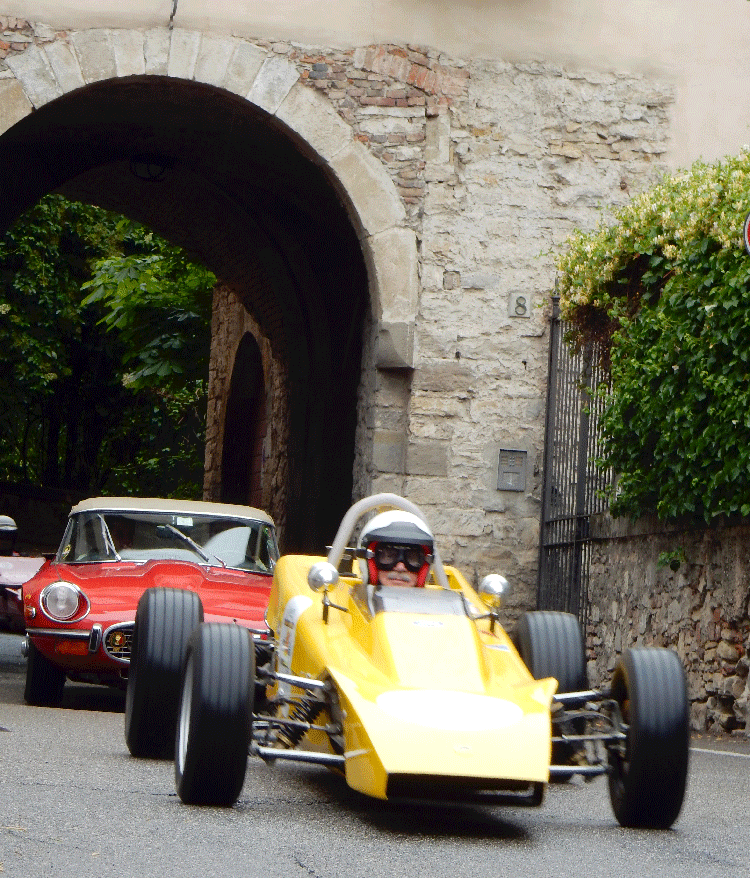
Postcard from Bergamo, Italy: Steering classics round and round the town

This is the first of a series of “postcards” almost lost in the shuffle of 2016; their delivery has been delayed by more than six months.

The first automobile race through the city’s gates and around the walls of Bergamo was held in May of 1935. Alfa Romeo, Maserati and Bugatti cars completed 70 laps on the winding narrow streets of the hilltop town to attain a distance of 150 miles.

In 2004, the city began hosting annual reenactments of that first event. I’m not much of a car-person, but even I could not resist the charm of these classic cars cruising circling the upper city. These beauties were among the participants on a drizzling day in May of 2016.

The main trophy awarded for pre-war classics at the Bergamo Historic Gran Prix Circuito dell Mura is named in honor of the hometown racing hero, Guilio Foresti (1888-1965). Foresti drove for virtually all of Italy’s famous carmakers. Fans of speed remember his 1927 efforts to break the British speed record of 174.88 miles per hour in Pendine Sands, Wales. He drove a Djelmo, a test car of Prince Dejaleddin. According to William Pearce on Old Machine Press:

On 26 November 1927, Foresti took the Djelmo out on the sands to make a few runs. As was typical, Foresti wore only goggles and no other protection. The Djelmo had exhibited a tendency to fishtail at high speeds. While travelling on the beach at around 150 mph (240 km/h), Foresti lost control. The Djelmo rolled several times, and Foresti was ejected from the racer. Miraculously, Foresti suffered only minor injuries and walked toward rescuers. The fact that he was ejected clear of the rolling Djelmo and into the soft sand probably saved his life. The Djelmo was destroyed. Prince Djelaleddin had lost interest in these speed projects: the Djelmo was never repaired and the twin-engine racer was never built.

Fortunately for amateur photographers, the classics in Bergamo’s Historic Gran Prix cruise at a much tamer speed. The main challenge appeared to be to keep these vintage vehicles in running condition.

Postcard from Bologna, Italy: Reflecting on fine “finestre”

Wandering under the miles of sheltering porticos lining the streets of Bologna, it is easy to miss the wonderful attention paid to the architectural details a floor above. Bolognese architecture does not treat windows as merely functional holes in the wall filled with glass, but as sculptural artistic expressions.

And, yes, that is the Mister who slipped into Edward Hopper’s plain-old-American-style-windowed “Second Story Sunlight” at a major retrospective of the artist’s works at Palazzo Fava while we were in Bologna. The contrast between the architecture surrounding us in Italy and the slices of Americana portrayed by Hopper made us cast our eyes upward with even more appreciation.

Postcard from Bologna, Italy: Rampant tagging mars appreciation of street art

Any regular followers of this blog might have noticed the uncharacteristic lack of photos of street art encountered on this trip.

Bologna has a problem. Tagging is totally out of control, marring the facades of many handsome ancient palaces lining the streets of the center of the city. At first, it can make an American feel threatened, as though ignoring warnings to turn back from an unsafe area.

But that first impression is erased quickly when one realizes the signs are false indicators of danger. Wandering was magically wonderful in this city with miles of shading arcades, and rich architectural details triumph over the inartistic scribbles.

We have enjoyed major exhibitions of street art in Portugal, Spain and Mexico, but there was something off-putting, besides the 13-Euro ticket, about the Street Art – Banksy & Co. exhibition in Palazzo Pepoli – Museo della Storia di Bologna. For one thing, there was so little of Banksy represented that having his name in the title seemed like false advertising.

But what worried me were all the teenagers crowding into an exhibition with several rooms devoted to tagging. Elevating tagging to inclusion in a museum in Bologna seemed to downright encourage its proliferation.

Bologna does try to keep tagging under control, angering street artists. According to an article by Giovanni Vimercati for the Guardian:

Last December, the mayor of Bologna Virginio Merola welcomed to the town hall a delegation of volunteers who had taken part in the “no tag” cleanup project that Bologna’s centre-left administration launched against what it called “graphic vandalism” in the city. The municipality also offers apartment building administrators a paid-for service to have graffiti removed from their edifices after this first, freebie scrubbing.

A few months later and the city is hosting the Banksy & Co show, organised by Genus Bononiae, the cultural output of Fondazione Carisbo, Bologna’s main bank foundation. The exhibition’s aim is to “understand how cities live and communicate also through an unregulated overlapping of words” sprayed on city walls and “encourage visitors to discover a new way to look at and relate to urban spaces.”

The exhibition created incredible controversy, but not for any of my reasons above. Well, except for the price tag for admission. Two of the photos below are from the Palazzo Pepoli exhibition, and the rest can be seen freely on the streets.

Take the street artist known as BLU. BLU had left his/her mark on unoccupied buildings throughout Bologna and numerous other cities, but BLU revolted at the “taking” of some of the actual walls bearing his art for inclusion in the museum. The artist was stung by the concept that something painted to be viewed freely now was confiscated and could only be seen by those who paid. BLU was so angry, in fact, that he/she enlisted a team of volunteers to cover all of the artist’s remaining murals in Bologna with gray paint. All are now lost.

Street artists rallied in support of BLU and in protest against the Banksy & Co. show by staging R.U.S.Co – Recupero Urbano Spazi Comuni (Urban Renewal Common Spaces), according to a post on the website Brooklyn Street Art. The 16,000 square-meter admission-free exhibition featured the work of numerous artists painted on walls of an abandoned industrial site ultimately slated for demolition.

The photos of these new protest works posted on Brooklyn Street Art are much more interesting with the backdrop of the crumbling buildings than the exhibits housed inside the museum. Wish I had seen those instead and saved my 13 Euros for a lunch at E’Cucina Leopardi.

A key role of art is to stimulate controversy, and both of the exhibitions certainly succeeded in doing so.

The Guardian article concludes:

Blu’s decision to erase their work exposes the inherent contradictions surrounding the reception of street art – in particular how palatable it has become to municipalities who might once have wanted to clean up graffiti but are now eager to speed up gentrification by giving their cities a cool makeover.

Davide Conte, Bologna council’s member for culture has welcomed Blu’s action as “a stimulating artistic performance that in my opinion is part of the conversation about the role of street art our city has been having over the past years.”