Postcard from Catania, Sicily: Path to sainthood painful, but it’s Santuzza’s day

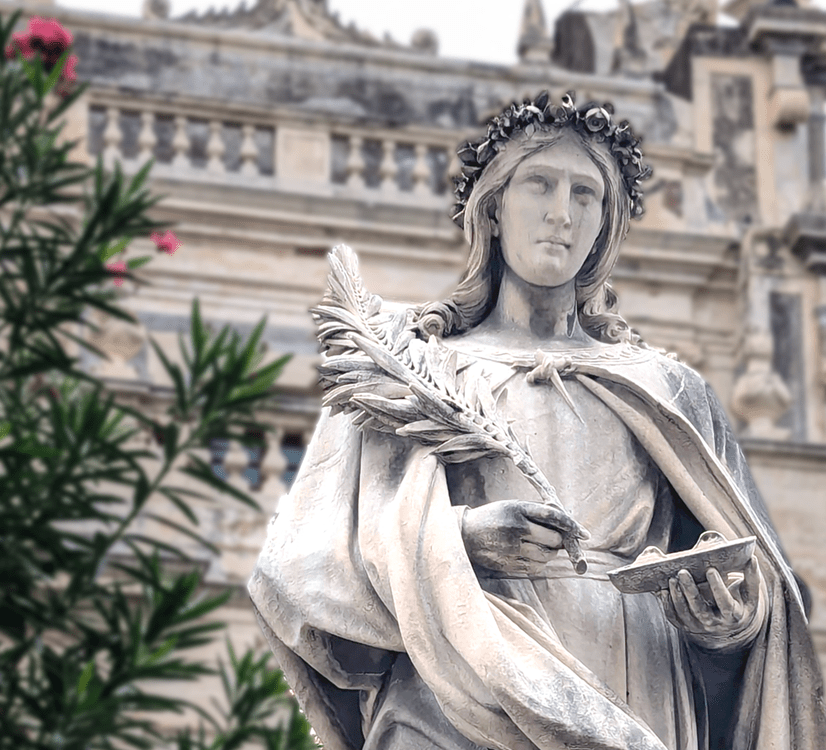
Above: Statue of Saint Agatha, affectionately known as Santuzza, in front of the Basilica di Sant’Agata in Catania

I wanted to do a “birthday” post for Saint Agatha (231?-251?), but recent world news knocked the wind out of my sails to the point I felt unable to complete it last night. But that’s not fair to Santuzza on her feast day, February 5.

Saint Agatha can’t be expected to solve all the world’s problems. The faithful turn to her for intercession so often; she already has a lot on her hands. The Sicilian martyr serves as the patron saint of victims of breast cancer or rape, and of wet nurses, firefighters, workers in bell foundries and bakers. Plus, Sicilians offer prayers to the Catania native for safety from earthquakes and volcanic eruptions of Mount Etna. The virgin martyr also is the patron saint of both Palermo and Catania in Sicily.

Continue reading “Postcard from Catania, Sicily: Path to sainthood painful, but it’s Santuzza’s day”
Postcard from London, England: Journeying inside the V&A

Above: Reflections in the viewing mirror installed above the Ardabil carpet, a commission for the ruling Shah of Iran made by Maqsud Kashani about 1540

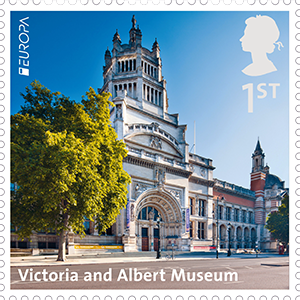
One of the most popular spots in the Victoria and Albert Museum is the long sofa next to the ancient Ardabil carpet. While the rug’s design is exquisitely executed with about 3,500 wool knots per square inch, for many, the bench is the main attraction. Ah, the chance to reflect and rest. We were fortunate to have the time to visit more than once during our stay.

It’s easy to be bowled over by the swirling, shimmering colors of Dale Chihuly’s immense contemporary glass chandelier suspended under the graceful dome of the grand entrance hall to the museum. The sheer size of the 1862 iron choir screen from the Hereford Cathedral addressing the space competes for your attention.

Continue reading “Postcard from London, England: Journeying inside the V&A”

Postcard from Palermo, Sicily: Byzantine mosaics and Moorish muqarnas

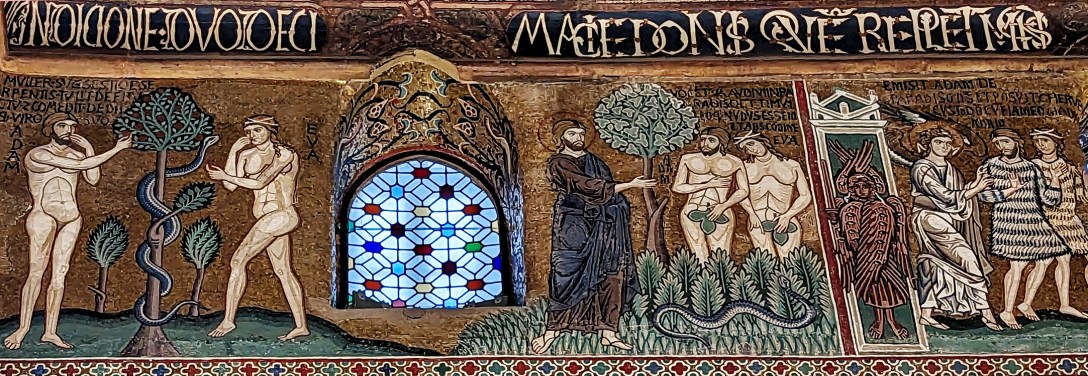
Adam and Eve, 10th-century mosaic in the Palatine Chapel inside the Norman Palace

The Palatine Chapel is the most beautiful in the world, the most surprising religious jewel ever evolved up by the human mind and executed by the hand of an artist…. where the harshness of the Gothic style brought here by the Normans is tempered by the wonderful art of Byzantine ornamentation and decoration.”

Guy de Maupassant, “La Vie Errante,” 1901

The facade of the immense Norman Palace is so cold and boring, I could not bear to take a photo of it. The original stark building was built to serve as the residence of kings installed after the Norman conquest in 1072. But one should never judge a book by its cover….

Proclaimed the King of Sicily by papal bull in 1130, Roger II (1095-1154) had been exposed to the various architectural influences that had ebbed and flowed with invasions of the island for centuries. For the eight-year construction of the royal chapel within the palace, he recycled some rather wild Corinthian columns and tapped both the talents of Moorish builders to craft the honey-combed muqarnas of the vaulted ceilings and Byzantine artists for the exquisitely detailed mosaics of the transept. The mosaics of the nave, a little bit cruder but still stunning, were commissioned from local artisans by William I (1120-1166), known as William the Bad; and William II (1153-1189), known as William the Good.

Continue reading “Postcard from Palermo, Sicily: Byzantine mosaics and Moorish muqarnas”