Postcard from Trieste, Italy: Nightmarish end to palatial dreams

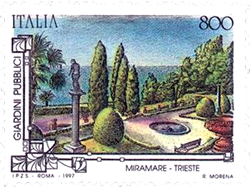
An Italian postage stamp featuring a scenic view of the Miramare Gardens in Trieste, showcasing neatly trimmed hedges, a statue, and a fountain against a background of trees and the sea.

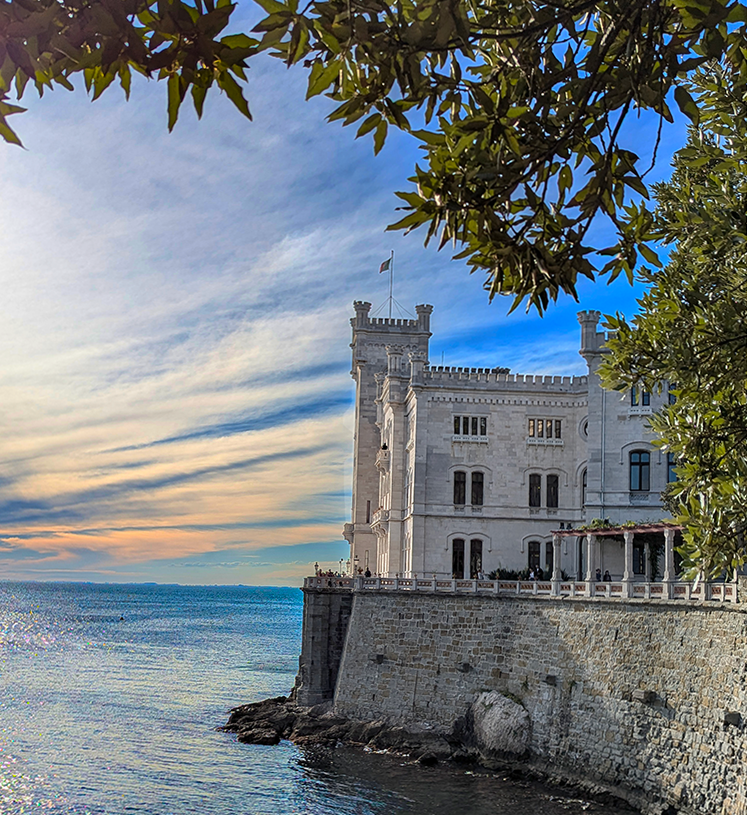
Above: Miramare, a palace erected by Princess Charlotte of Belgium and Archduke Ferdinand Maximilian of Austria

At age 22, Archduke Ferdinand Maximilian (1832-1867) was named Commander-in-Chief of the Austrian Navy. Sailing in 1855 in the Gulf of Trieste, then ruled by the Kingdom of Austria, the young archduke spotted a promontory jutting out into the water. Barren, rocky, yet a gorgeous waterfront view on three sides. He decided to acquire the land for his home.

Construction of the house, which he named Miramare, was already underway at the time of his 1857 marriage to Princess Charlotte of Belgium (1840-1927). Also in 1857, his older brother, Emperor Franz Joseph I of Austria (1830-1916), appointed Maximilian Viceroy of Lombardy-Venetia.

The couple moved into the Royal Palace of Milan while continuing work on Miramare. Charlotte’s royal dowry contributed to the money-pit project, including bringing in tons of dirt and topsoil for extensive gardens. Surrounded by all the requisite family portraits, the couple moved into their completed dream home in 1860.

Continue reading “Postcard from Trieste, Italy: Nightmarish end to palatial dreams”

Postcard from Toulouse, France: A far from humble home for city’s leaders

Above: Under renovation this past fall, the distinctive pink brick Neoclassical facade of the Capitole stretches across the entire eastern side of an impressive plaza.

The city government of Toulouse has headquartered itself on the same expansive plaza since the 12th century.

In the early 16th century, the people of Toulouse lived in fear of invasion by Spanish forces under the flag of King Charles V (1500-1556). The threat was ongoing because Charles V was at constant war somewhere on the continent as he tried to defend his multiple titles in a far-flung Hapsburg Empire. Charles simultaneously was King in Germany, King of Italy and Emperor of the Holy Roman Empire. This powerful threat inspired city leaders to build what is now the oldest remaining governmental portion of its Capitole compound, a brick tower designed to protect the city’s archives and gunpowder. The tower often is referred to as Le Donjon, or The Keep. Le Donjon’s centuries newer belfry was added by the architect known for remodeling Notre Dame in Paris, Eugene Viollet-le-Duc (1814-1879).

Continue reading “Postcard from Toulouse, France: A far from humble home for city’s leaders”